What Should I Fix First on My Website: SEO, Speed, Content, or Backlinks?
When building a website, it can be difficult to know what to prioritize, such as how much effort to put into building backlinks versus optimizing your content versus the difference between quality and technical SEO. If your website isn’t helping you generate leads then what should you fix: the design and speed of your website, the quality of your content, or the number of backlinks your website has? Starting with search engine optimization means you have to think about how search engines access and understand, and how search engine users trust and verify your website. It’s best to approach SEO services with a plan and consider the different aspects of SEO as one interconnected process. Rather than offering SEO services like many other SEO companies, the goal at Ranks Growth is to help clients achieve long-term growth with an improved foundation of their website and business.
Start With the Foundation: Technical SEO
You shouldn’t invest heavily in your content or backlinks until you fix the technical issues on your website. Technical issues can be so severe that even content care and backlinks become unnecessary. For technical SEO issues, a lot of search engines won’t crawl or index a page. Users will be unable to see your content.
Is your website indexed? You want to look for broken links, incorrect redirects, duplicate pages, missing title tags, poorly arranged URLs, and crawl-related issues. An internal link structure that directs crawlers and users to your important pages is essential.
Along with the above issues, having a mobile-friendly website is essential. Having a desktop-optimized website should not be done at the expense of losing mobile users.
This doesn’t mean you need to fix every little thing before moving forward. Focus your energy on issues related to visibility and usability, and specific issues search engines have understanding your site.
Next Priority: Website Speed
The relationship of site speed to user experience and site performance is obvious. People aren’t going to wait a few seconds for your page to load, especially if they are comparing multiple sites or looking for an immediate answer.
Homepage speed tests may be helpful, but don’t forget to check your most important landing pages as well. Large images, unnecessary scripts, unoptimized code, and poor hosting, among other things, can contribute to slow site speed.
Practical improvements to site speed include:
- Optimizing code and images.
- Reducing scripts and plugins.
- Browser caching.
- Response time optimization.
- Removing clutter.
Site speed is not a one-time fix. As you add new code and images to your site, your speed can deteriorate.
A fast site enhances all other marketing efforts. Attracting visitors through search becomes meaningless is they leave before the page loads.
Then Look Closely at Your Content
Control performance issues and bugs, and then examine your content’s quality. Are you answering the questions your potential customers are asking?
A lot of business websites describe their services, but few actually target the real problem of the potential customer, the process, the solution, or even helpful differentiating factors.
Successful content should focus on helping potential customers before it focuses on selling. Answering questions, explaining services and processes, showcasing service or product expertise, and providing enough detail should all be part of the content.
Focus first on your key services. Are all these elements present: a clear description of the service, heading hierarchy, helpful supporting content, relevant internal linking, and a clear next step?
Do not make a service page solely because a keyword happens to have strong search volume. Make service pages because you know those pages will help your prospective customers.
This is where a good professional SEO Services agency can really help. Making pages without Search Intent or a good content strategy will not meet your business goals.
Backlinks Come After the Basics
Creating a great website should be the business owner’s focus! Backlinks give search engines an idea of a site’s authority. But backlinks should NOT be the first issue a business owner looks to fix.
Let’s imagine for a second that a business owner has several awesome backlinks. What if the website has slow page loads, broken navigation, or outdated content? Sure, those links may give the website some added authority, but they won’t create a positive user experience.
Building a network of external links to your website is a gradual process that requires planning and time. A good website attracts links. Offering quality resources such as case studies, original research, detailed resource lists, expert perspectives, and quality service information will easily get quality links.
Process over quantity is important. Relevant, trustworthy links are more valuable than masses of links from irrelevant websites.
So, What Should You Fix First?
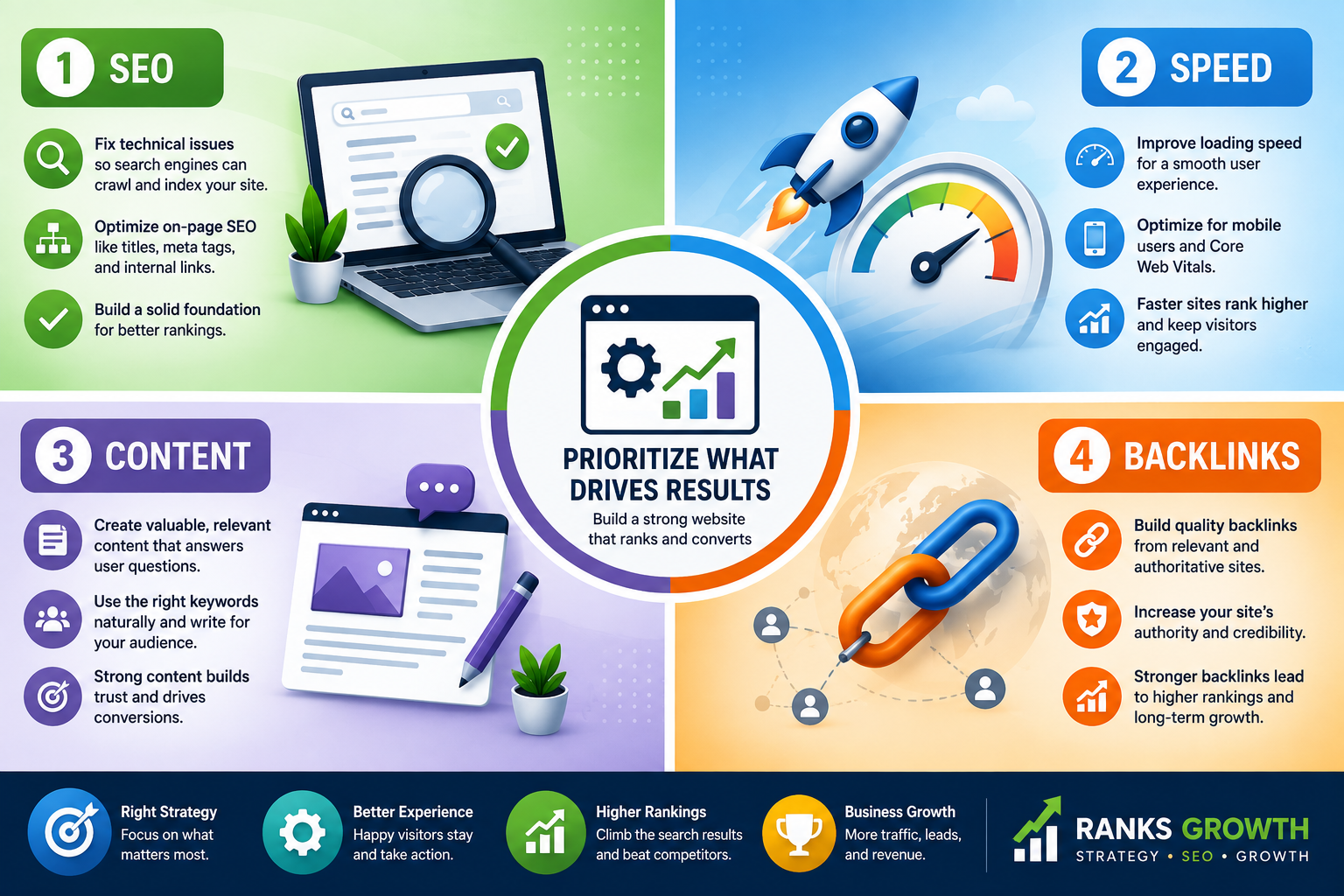
For most businesses, the best answer to this would be in the following order:
- Technical SEO – Ensuring search engines can crawl, understand, and index your most vital pages.
- Performance and User Experience – Solving issues and frustrations faced by site visitors that affect user engagement.
- Content – Improving pages essential for search users and articulating to them the site’s value.
- Backlinks – Backlinking after the site’s foundation is secure and worthwhile.
This sequence of operations is not strictly accurate. For example, if your site technically is in good shape but has extremely no content, then content may have to be the next priority. If your site has great content but takes forever to load, then performance may move to the top of the priority list.
The best place to start is with an audit, and not with assumptions.
What About Larger or Complex Websites?
Large-scale sites put multiple limitations on the individual pages they can afford to optimize. Large multinational corporations likely have a number of categories, services, regions, and even segments served.
Enterprise SEO tools help address the scalability issue. Enterprise websites need a tighter structure, predictable processes, structured linking, a policy on page count, and monitoring. Enterprise SEO tools help scale optimization for larger websites.
Many firms’ websites require both search engine optimization and web design. Sometimes, a site’s design fails to incorporate user experience (UX) considerations, architecture, and search performance.
Search engine optimization (SEO) depends a lot on a number of design and content considerations. It is imperative to get these right from the get-go.
Think of SEO as a Connected System
Most small business owners think of SEO in a silo, along with content, backlinks, and site speed.
They’re all connected.
On-site linking, site speed, site content, and backlinks rely on one another. A well-designed, fast site is more likely to rank for valuable keywords regardless of the strength of your backlinks.
Improving one aspect often reveals other problems. For instance, the answer could be a rewrite of content. If you do so, you may realize you have weak internal links.
Prioritizing what matters is the best approach when deciding how to improve your website.
Make Your Next Website Improvement Count
Thinking about what to address first? Avoid buying backlinks or publishing a ton of articles without first getting a sense of what is or is not working with your current website.
To understand your website, take a look at the core content and the speed of your pages. Next, see how your backlink profile looks. Lastly, see how your technical SEO holds up. The next step is to address these in a prioritized action plan based on what is likely to provide the greatest value, efficiency, and effort.
An improvement in search engine optimization services goes beyond a webpage showing up at the top of search results. The goal of effective SEO is to develop and nurture a webpage that draws the right visitors, engages them, builds trust, and converts visitors into customers.
Ranks Growth builds authority. By combining content strategy with the other pillars of web development, they take a holistic view of your webpage to improve your chances of success.
SEO is sometimes a tricky game of sequence. Many webmasters overlook the basics and rush to publish as much content as possible. The right approach is to build upon a solid foundation and address the user experience, content, and authority in that order.
FAQs
1. Should I worry about SEO or web page speed first?
It is best to work on severe technical SEO issues that impact web crawling and indexing. Following that, work on website speed. Both are essential, but it is better from a technical optimization standpoint, to address major issues first.
2. Is Content or Backlinks More Important for SEO?
Both content and backlinks are important for SEO, but quality content should always come before quality backlinks. You cannot expect to rank if your website doesn’t have quality pages. Once your pages have quality backlinks,page authority can slowly start to grow.
3. How Do I Know Which First SEO Problem I Have to Fix?
The first step to figuring out what is most important in regard to SEO is a website audit. Conduct a technical SEO audit, a page speed audit, an indexing audit, evaluate the quality of the content, check the mobile usability, and evaluate the internal and external linking structure. The most important problem to fix first is the one with the greatest impact on search visibility, user experience, and conversions.
4. Can a Fast Website Rank Without Backlinks?
A website that is both fast and optimized and has good content can rank well even with a moderate backlink profile. However, backlinks will be essential in the competitive search environment against websites that have a strong authority.
5. When Should I Get Professional SEO Services?
You should get professional SEO services when you do not understand why your ranking has stagnated or you have gaps in time and expertise to do ongoing optimization. Hiring professionals to create a customized strategy for your business is the best way to prioritize the technical side of your website, content, speed, internal linking and ranking from a position of authority.