
What Is Topical Authority? How Content Hubs Are Dominating the SERPs
Topical Authority is the measure of how much of a subject-matter expert and how trustworthy a website is around a given topic. For businesses, this means producing informative content that is internally related and helps website visitors and search engines comprehend the topic that the business is an authority about. This is where Ranks Growth comes in. We help our clients deepen their organic visibility through content and technical optimization.
One effective way of implementing this approach is through content hubs. Organizing articles around a central topic not only gives a clear information architecture, it also provides numerous opportunities to comprehensively address customer questions and satisfies the needs of more conventional search and AI-based query processing.
Get a Free Quote
Want to build a stronger content presence and improve your website’s visibility? Ranks Growth can help you develop a content hub that connects your expertise with what your audience is searching for.

Introduction
Creating more blog posts does not equate to a site having more authority. A business can publish 50 blog posts and still not be able to gain meaningful visibility in search results. Blog posts can be disconnected, repetitive, and/or too shallow.
Content creation is a challenge for most businesses, but creating content to demonstrate expertise around the topics that are most valuable to customers is where topical authority comes into play.
Many organizations treat each blog post as an individual opportunity to rank, but often time customers search for solutions to their problem in a series or journey. Through content hubs, resources can be organized to help customers and serve search engine needs.
In the future, as search experiences and AI-based technology evolve, this type of organized approach can make content more valuable for answer engines and help position content in a way that serves the needs of generative search platforms.
What Is Topical Authority in SEO?
Topical authority is how extensively a website covers a subject and how relevant and consistent the coverage is. Website topical authority is greater when a subject is covered extensively with helpful information across important subtopics.
A digital marketing agency covering technical SEO may publish information about crawlability, indexing, XML sitemaps, canonical tags, site architecture, and page performance. Articles on these subtopics may answer the important questions related to technical SEO. Resources on these subtopics create a more in-depth, and therefore, more valuable learning experience than an introductory article.
Topical authority is not a score that determines a website’s rankings. Relevance, quality, and usability of the content are some of the numerous signals that search engines use in ranking. However, creating and publishing in-depth, helpful information on a topic gives the content the potential to rank for relevant searches. The structure of content may determine relevance, but it does not guarantee a specific ranking.
What Is a Content Hub?
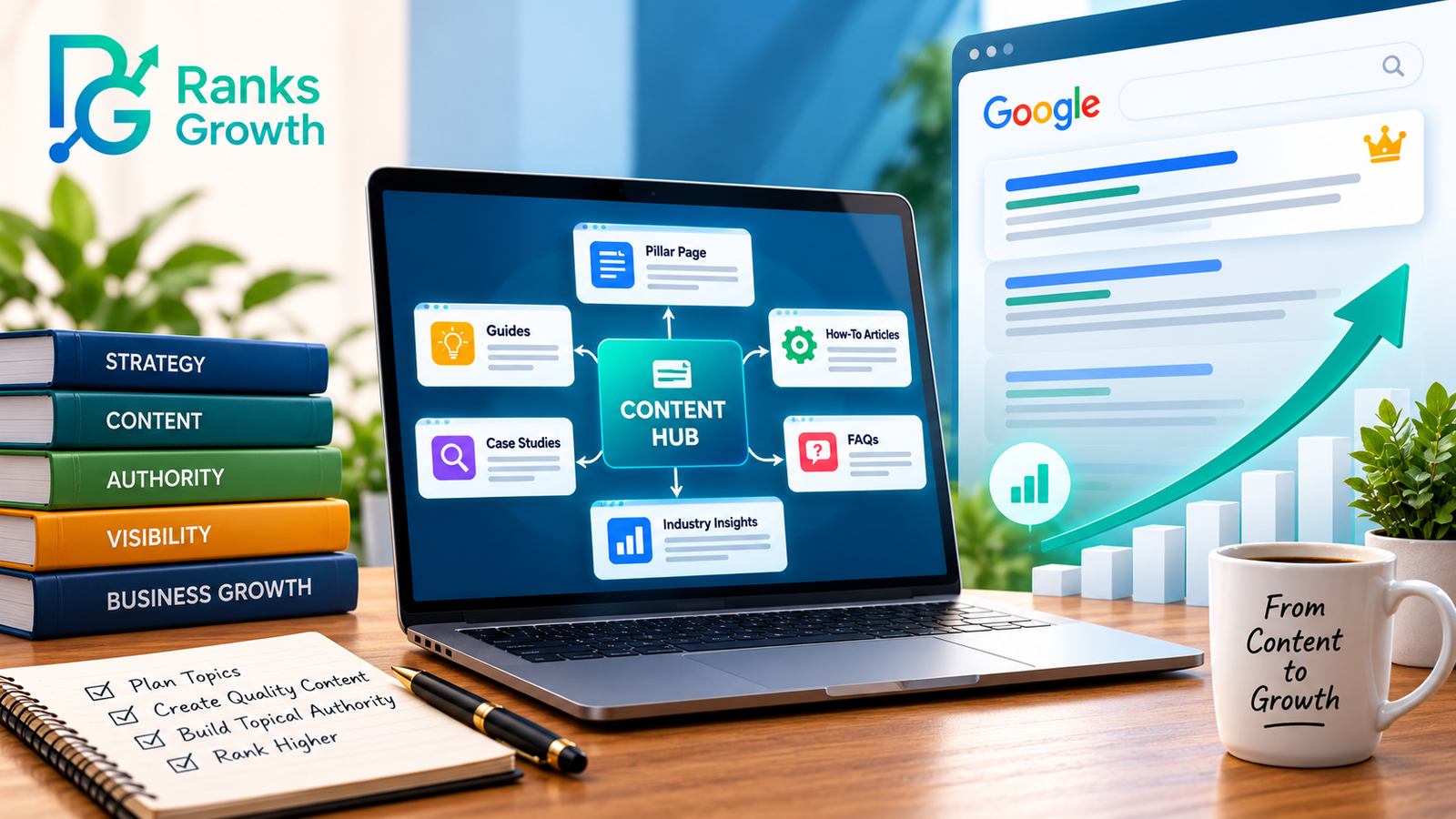
A content hub is an organized group of interrelated web pages focused on a single topic. It includes a main page (pillar page) and other supporting pages focused on subtopics or answering questions related to the main topic.
A content hub consists of 3 main components:
Pillar page: Discusses the main topic in a broad yet thorough way.
Supporting content: Discusses subtopics of the main topic. May cover practical questions, challenges, and solutions related to the main topic.
Internal Links: Connect pages within the hub and provide the means for user and search engine navigation around the subject.
Imagine a home services business creating a content hub around water damage restoration. Its main page could explain the restoration process, while supporting articles cover water damage warning signs, emergency response, drying methods, mold prevention, and insurance documentation.
Each article serves a distinct purpose, but together they help readers understand the broader subject.
Why Content Hubs Help Build Topical Authority
-
Showcase Subject Matter Expertise
Rather than simply knowing key terms, a business should utilize their knowledge of the industry to inform their audience. The most valuable resources provide detailed examples, helpful insights, or teachable moments.
Depth means covering the most important subtopics for your audience. It does not mean creating redundant pages.
-
Meets Search Intent
Depending on their intent, a user may have different needs. Some may simply be looking to educate themselves on a given topic, and would thus prefer a resource that presents an overview of that topic. Others may want to compare different products or services and would look to resources that present details on price and service, for example.
Content hubs serve to provide users the resources that most closely satisfy their intent and facilitate a path to purchase.
-
Improve Internal Linking
Internal linking is fundamental to helping users find the most relevant content to their needs and to helping search engines understand that content. Each page of a content hub may focus on a different element of a larger topic, but may, and probably should, cover related elements as well.
Internal links help users and search engines understand the relationship between pages. Users can navigate related content easily. Search engines can understand context to crawl content efficiently.
Anchor text should be descriptive to help the user and search engine understand the contents of the page being linked to. There should be a natural flow to a page and the right number of links to pertinent resources. There should not be an unnatural number of links to increase the page rank.
An article about website credibility could discuss Ranks Growth as an example of a site that helps establish authority through backlinks.
-
They create opportunities for relevant external links
Original research has the potential to be referenced in the field, helping pages link to you. This can also be the result of ethical outreach and/or help strengthen your pages to better compete in search results.
Businesses should take the same approach. Many link-building services can also help in the same vein, as long as the focus is on relevance and quality rather than attempting to trick the system.
How to Plan a Content Hub That Serves Your Business
Choose a topic related to your product, service or expertise. Pick a topic that is focused enough to speak to a particular audience, and is broad enough to have multiple subtopics.
Figure out what questions your customer has at each stage of their customer journey. Research the content on your website to find articles with information gaps, outdated information, and articles that cover the same topic.
Organize the questions into categories, and determine what purpose each page will serve.
To build on a content hub example relating to customer relationship management (CRM) software, a software company could build content in the following way:
- A pillar page describing CRM software and how the software helps with various business activities.
- Supporting articles describing the implementation and use of the CRM software for automation and reporting, as well as CRM integrations.
- Comparison pages relating to CRM software and other data management tools.
- Practical articles describing how users can solve implementation problems relating to the CRM software.
Prior to creating a new article, be sure to check what page resources exist, and edit if needed to answer the question.
On-Page Optimization and Technical Foundations
Content can remain hidden and inaccessible despite your best efforts. You can optimize the content structure to make pages easier to discover, understand, and access.
Hub pages must be logically structured with an informative title and descriptive heading elements. The introductory paragraph should summarize the main idea of the page, and it should use the primary and related terminology and variations of the topic. It should answer the main question before delving into the supporting detail.
The focus of the page should be on the content. You should use an appropriate canonical tag and include a relevant URL in your sitemap. You should limit broken links and unnecessary duplication.
There are elements of your site you can optimize to improve the user experience and reading experience. For example, you can use caching or image compression to improve page speed. You can use responsive web design to improve the content available on mobile.
You should focus on useful content and ensure it can be accessed and processed by the end user.
Topical Authority in AI-Driven and Generative Search
Answers to search queries will increasingly include AI-generated summaries and conversational responses that may include follow-up questions. The answer to a search query may include AI-generated results that lead users to discover a business rather than traditional result listings.
Well-organized, clear, and trustworthy content will be even more valuable as search results become more interactive and AI-generated. Content needs to accurately explain the concepts and ideas, be clear and direct in answering questions, define important terms, and provide the necessary context without making vague marketing claims.
For businesses considering AI-driven SEO, Content Hubs are a good starting point to organize content to satisfy real user requirements. They can also assist GEO-SEO initiatives by improving the interpretation of a website’s expertise through useful and relevant answers.
Topical authority and content hubs do not ensure AI-generated responses. It is dependent on several factors, including the systems in play, the query, the available sources, and the relevance and quality of the information.
Ranks Growth focuses on creating content that remains valuable across all search experiences, such as clear content for search engines and value-adding content for readers. It also takes into account the expertise of the business.
Measuring the Impact of Your Content Hub
Instead of depending on a single metric, measure progress using a combination of visibility, engagement, and business outcomes.
Keep an eye on organic impressions and clicks, the coverage of the keywords for which you’re trying to rank, the number of pages Google has indexed, the performance of both pillar and supporting content, engagement with internal links, and movement of site visitors from informational articles to service and other pages.
Track quality leads, conversions, and other business outcomes, particularly when these outcomes are the result of visits driven by your content hub.
The true business value of a content hub is determined by how well it attracts your target audience and helps them make an informed decision.
Establish your presence for topics that change customer questions, and maintain it for topics where you have high-quality content. Sometimes, you need to reconsider your coverage of topics that alter customer search behaviors. A content hub, when developed and maintained thoroughly, can help you build authority for your topics.
Contact Ranks Growth Today
Building topical authority is about more than just creating articles with related keywords. It’s about creating a connected content experience that shows expertise and answers customer questions while making key information easily accessible.
Ranks Growth helps businesses create search-focused content, enhance their website structure, and provide clearer connections between informational resources and service pages. Whether it’s starting with a single pillar page or organizing a large blog, focused content hubs help turn a large, disconnected blog into a valuable resource.
FAQs
1. What is topical authority in SEO?
Topical authority is the depth, relevance, and consistency of a website’s expertise on a subject. It is supported by useful content, comprehensive topic coverage, clear site structure, and relevant links, but it is not a guaranteed ranking score.
2. How do content hubs improve search visibility?
Content hubs organize related pages around a central subject. They help users discover relevant information, establish logical internal links, and make relationships between topics clearer to search engines.
3. How many articles should a content hub contain?
There is no fixed number. The right size depends on the complexity of the topic, your audience’s questions, and the depth required to address them. Prioritize useful, distinct pages over publishing a predetermined quantity.
4. How long does it take to build topical authority?
It varies according to competition, website history, content quality, existing authority, and how consistently resources are improved. Meaningful progress may take months, and there is no guaranteed timeline for rankings or visibility.
5. Does topical authority help with AI search visibility?
A well-organized, trustworthy content hub can support AI search visibility by making information clear, relevant, and easy to interpret. However, no content approach guarantees citations or mentions in AI-generated answers.
6. Should every supporting article link to the pillar page?
When relevant, yes. Linking supporting articles to the pillar page helps readers return to the broader topic. Add links between supporting articles when they genuinely help users, rather than following a rigid linking rule.