Why Internal Linking Matters More Than You Think for SEO
Building internal links is one of the easiest methods for improving SEO, but it’s often ignored by businesses as they deal with complex problems like ranking, content creation, and off-page optimization. For the business clients of Ranks Growth, the appreciation of how internal links affect visibility, among other factors, was a game-changer for client websites. While link building services, manual link building, guest posting, and authority backlinks can improve a website from an external perspective, internal links help both search engines and website visitors understand what matters on the website.
What Is Internal Linking?
Internal Linking is the process of placing hyperlinks on a webpage to connect it with other pages on the same website domain. An example of this would be a blog that simplifies the concepts of technical SEO and links to a related service page. Alternatively, a service page could link to a detailed guide that describes the service.
Although Internal Linking seems fairly straightforward, a strong Internal Linking structure can influence many aspects of an SEO strategy.
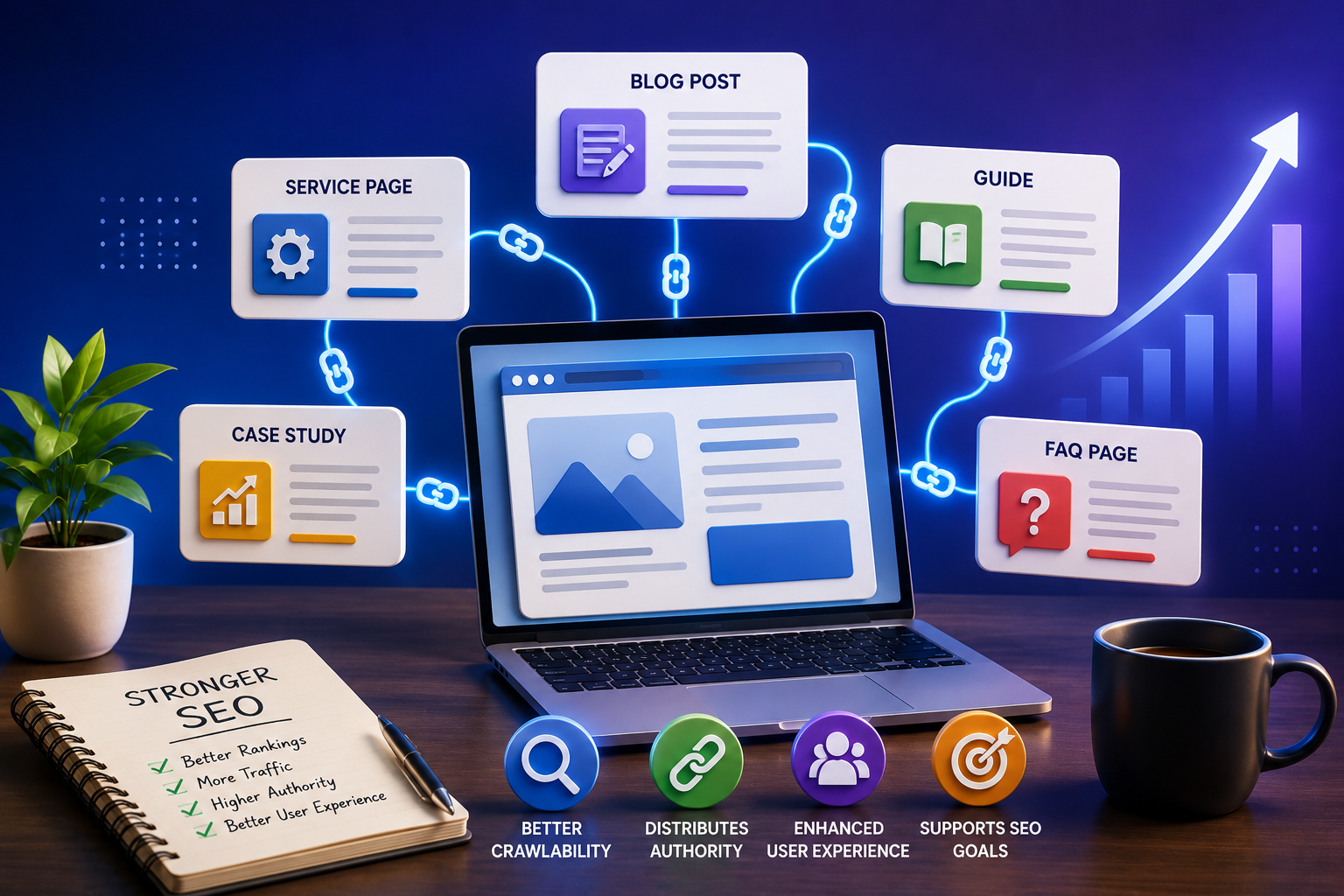
Internal Linking can help:
- Search engines find and crawl pages quicker
- Distribute site-wide authority
- Relate one idea to another
- Guide users to information that matters
- Boost important pages in search results
Improve site navigation and user experience
As you think of your website as a linked network, the more important pages that logically relate to each other, the easier it will be to search engines and visitors to navigate your website.
Why Internal Linking Is Important for SEO
Internal links connect every page on a website. Search engines do not evaluate each page on a website in isolation.
It is critical for websites to have clear internal linking structures, as internal linking gives search engines context as to how different pages on a website relate to one another.
Internal links also create a path for search engines to discover and crawl different pages. It also provides context to search engines as to the importance of a page and what that page is about.
This matters for businesses to consider because content may get buried and lost in the site if it is not internally linked properly.
A clear internal linking structure is beneficial because search engines are guided to the necessary pages to help achieve the goals of the business.
1. Internal Links Help Distribute Page Authority
Not all pages on a website have the same level of authority. Some pages have a higher level of engagement than other pages. Natural links, visits, and other page interactions are stronger on some pages than others.
A channel for equal distribution of internal page authority is a solid internal link structure. Internal links provide that structure.
A company could have a strong blog post that generates consistent page traffic. That post could include an internal link to the service page related to the blog post in order to direct both the search engine and the page user to the service.
From that example, one should not assume internal links equate to a strong ranking page authority value. Rather, internal links help search engines understand the value of different pages.
2. They Improve Website Navigation and User Experience
SEO doesn’t concern itself purely with search engine crawlers. Humans are equally important.
Suppose you wrote a blog post on improving online visibility. You include a link to your service page, or perhaps a more detailed post that is also relevant. This adds value to the user’s experience, as they can continue their journey without returning to the site’s main navigation.
This simplifies your visitor’s path.
There’s a simple question that determines how useful a link is:
“What would the visitor want to read next?”
When links are indeed useful, they can all of the following:
- Stay relevant, and thus user engaged
- Help users find your valuable services
- Help direct users down an invisible/conversion path
- Useful and helpful
Internal links also help search engines find useful and helpful content. They aren’t just thoughtful usability assistance, but also a signal to search engines that content is helpful.
3. Internal Linking Helps Search Engines Understand Content Relationships
SEO has come a long way from matching keywords. Search engines need to know topics, entities, context, and relationships.
Let’s say your website posts a toned-down version of content on SEO. One page is about technical SEO, another is about content SEO, and yet another is about off-page SEO.
Linking these pages creates internal links that bring a semblance of order to and context of the post.
This brings transforms your posts from a collection of unrelated posts to an ordered semblance of a post on a related topic.
Additionally, descriptive anchor text gives context. Avoid saying “click here” repeatedly. Describe what the link is about.
4. Internal Links Can Support Important Service Pages
Many companies put a ton of effort into building a blog, but forget to integrate that blog with their service pages.
This is a missable opportunity.
Blogs can attract informational searches, while service pages help a potential customer move toward action. Internal links can connect these two customer journey steps.
Informational article → related guide → relevant service page → enquiry
This structure has a logical path from learning to decision-making.
It also helps ensure that blog content attracting informational searches supports and enhances visibility of service pages that are critical to the overall growth of the business.
Internal Linking and Off-Page SEO Work Together
Internal linking and external (or off-page) SEO are both important and should not be viewed in opposition. They complement each other.
External link building, guest posting, and even services like link building are great for building a site’s visibility and trust among external sources. However, if those external links lead to a site, then that site’s trust and visibility must be built internally as well.
This is where a complete SEO strategy comes in.
Let’s say a site has hired a link building service, and external links have been built to a specific article. It is good practice for that article to link back to internal guides and other articles relevant to its services.
External links bring authority to a site. Internal links distribute that authority.
Having a complete SEO strategy means thinking about both.
5. Internal Linking Can Help Older Content Stay Relevant
It’s normal for websites to amass hundreds, even thousands of pages. Some great content may not be accessible if it’s buried.
Internal link building brings that page back into the fold.
Every time a new article is published, older content should also be reviewed for link-building opportunities. The opposite should also be done: when a new resource is published, related articles should be reviewed for any outdated content that may benefit from a link.
This brings a site’s infrastructure to a single unified content structure.
Best Practices for Internal Linking
A strong internal linking structure is more about intention and less about volume. Relevant links in consistent places keep the user on task.
Here are some things to consider:
- Link purposefully: Link when a purpose will be served by doing so.
- Anchor text wisely: Help the user know what they will find without being overly keyword-centric.
- Value pages: Ensure visibility to important content.
- Lift pages, not links: Too many links clutter pages.
- Build content associations: Show related content in a logical order.
- Check for dead ends: Check destinations when linking.
- Plan for the user: Think about how a new page might fulfill remaining user needs.
Whenever you significantly update your website, add significant content, or reorganize your pages, your internal link structure should be checked.
A Simple Internal Linking Strategy for Business Websites
If you’re just getting started, then simple is best.
Start by identifying your premier commercial pages. Then, create a list of associated blog posts and resources for each of those pages.
Once you have that list, look for ways to connect those pages naturally.
Also, look at pages that draw a lot of organic traffic, and consider making them your main linking pages. Then draw your visitors to related services and resources.
Your goal isn’t to make the world’s most complex website. Your goal is to design a website that allows your customers to quickly find the information they need.
The Bigger SEO Picture
Internal links create a connection between the pieces of your SEO strategy. After you provide the content of your site, internal links do the connecting. SEO techniques such as controlling accessibility of webpages, off-page SEO, and link-building strategies, draw focus to your content beyond your website.
When your strategies combine, your SEO strategy becomes more integrated.
Ranks Growth considers internal links as one piece of the off-page and organic search efforts. Internal linking strategies draw focus to extending off-page SEO for websites that want to strengthen their overall SEO efforts. It is important that the internal links reinforce the authority and traffic that off-page SEO efforts draw to the website.
Final Thoughts
Internal linking may seem less glamorous than a backlink campaign, but it cannot be overlooked. It helps search engines access your content, remotely transfer authority to different sections, improves navigation, creates a link between informational and transactional pages, and improves navigation.
For most business people, the main idea is that you shouldn’t think of each page as a standalone page. Most of the website’s best SEO performance comes from how a web page links to other pages.
Services that offer external link building, manual link building, guest posting, and obtaining authority backlinks help bring relevant traffic to your website. Internal linking is a valuable way for a website to use this new audience.
Ranks Growth use logical web frameworks with top-notch content and proper SEO practices to help clients have a solid base to build their online visibility, one relevant link at a time.
FAQs
1. What is internal linking in SEO?
Internal linking connects one page of your website to another page on the same website. It helps search engines understand your site structure while making it easier for visitors to discover relevant content.
2. Why is internal linking important for SEO?
Internal linking helps search engines crawl your website, understand relationships between pages, and identify important content. It can also improve navigation and keep visitors engaged with your website.
3. How many internal links should a page have?
There is no fixed number that works for every page. Add internal links whenever they are genuinely relevant and useful to the reader, while avoiding excessive or forced linking.
4. Can internal linking improve website rankings?
A strong internal linking structure can support SEO by improving crawlability, distributing internal authority, and providing contextual signals. However, rankings depend on many factors, including content quality, technical SEO, and external links.
5. How does internal linking work with link building?
Internal linking and external link building complement each other. Link building services, manual link building, guest posting, and authority backlinks can strengthen a site’s external signals, while internal links help connect and distribute value across relevant pages.