
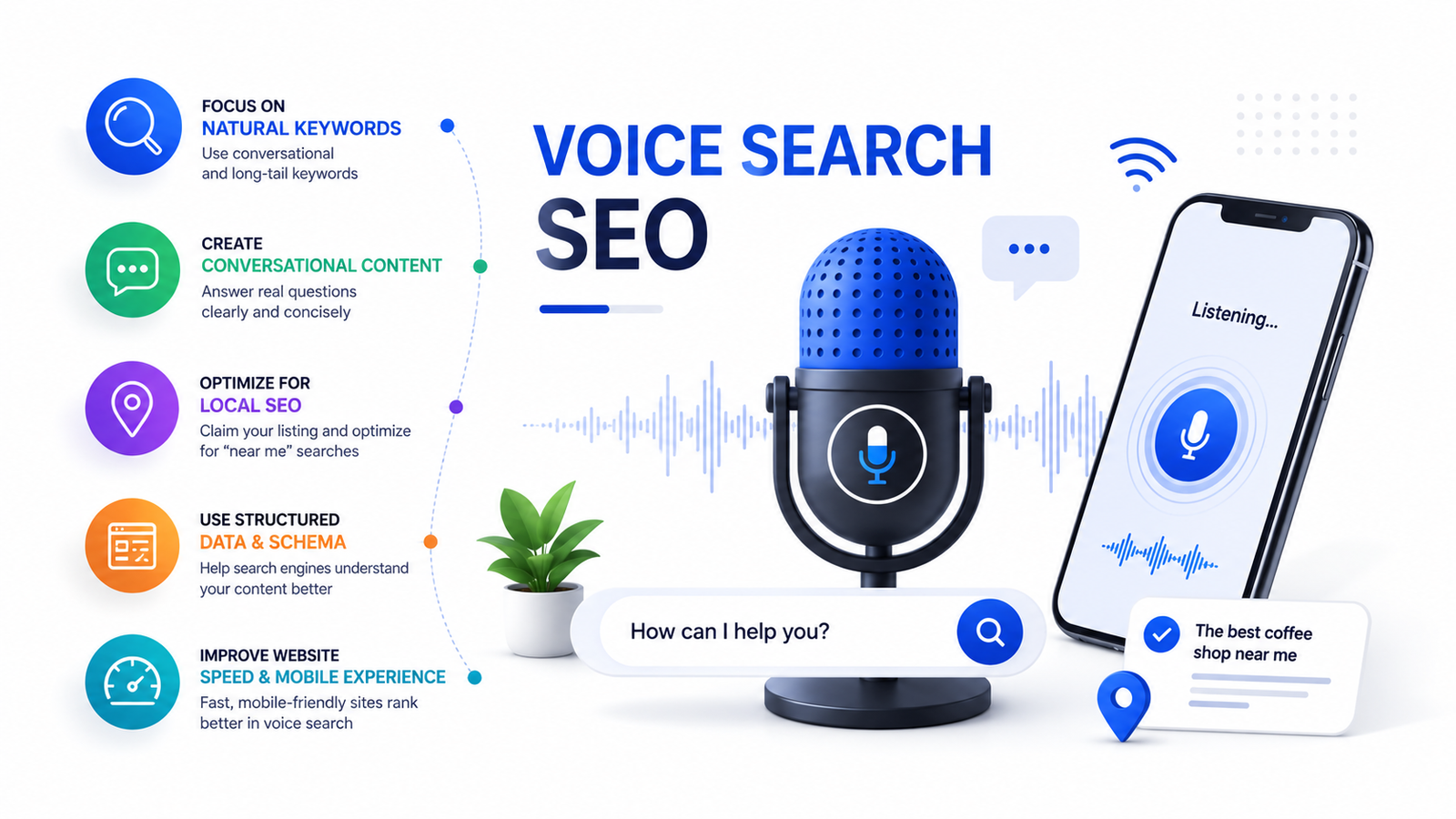
How to Optimize Your Website for Voice Search SEO
Voice search is officially a regular part of the online search process. Whether a person is inquiring about “the best roofing contractors near me” or “the best digital marketing contractors,” search engines analyze queries and present spoken results at their discretion based on relevance, authority, and user intent.
For both homeowners and business owners, the need to optimize for voice search has created a digital marketing necessity. Ranks Growth offers voice search optimization services to assist companies in optimizing for voice queries and enhancing their local voice search optimization.
What Is Voice Search SEO?
Voice Search SEO is the customization and optimization of a website to ensure that it will appear in results for searches that are spoken via voice-assisted devices such as Google Voice, Siri, Alexa, and Gemini.
Unlike traditional text-based queries, voice searches are conducted in a conversational tone. For example, rather than writing “New York plumber,” a user may ask any one of the following:
- “Who is the best plumber near me?”
- “Which company provides emergency plumbing services today?”
- “How much does water damage restoration cost?”
This evolution of the search requires websites to provide and articulate relevant answers in a conversational yet thorough tone.
Why Voice Search Matters for Your Business
Voice search is becoming more popular for business reporting. Local searches are usually the voice reports that come from an Assistant. There is often a clear intent for local searches as they are generally for businesses that are nearby.
The advantages for businesses that optimize for voice searches includes:
- Increase local website traffic.
- Generate more qualified leads.
- Improve mobile search visibility.
- Build trust with search engines and AI assistants.
- Increase conversions from high-intent users.
If a competitor is optimizing their webpage for voice searches and your business is not, your business is losing opportunities.
How Voice Search Differs from Traditional SEO
The traditional SEO uses short keywords and searches like;
- SEO company
- Roofing services
- HVAC repair
But voice search is now using full or longer phrases.
- Which SEO company helps local businesses grow?
- Who repairs air conditioners near me?
- What is the best roofing company in my area?
Because of this difference, your content should answer complete questions instead of focusing only on short keywords.
1. Focus on Conversational Keywords
People do not type how they talk. When entering a keyword, they select the term that relates best to the answer in full. Exact matching is not required. Instead, write naturally and respond to all possible customer queries.
For example, do not use:
- Best SEO Company.
Instead consider:
- What should I look for when choosing an SEO company?
This will help your SEO with AI and with most modern voice assistants, too.
2. Create FAQ Sections
Because of the nature of how people respond to questions, FAQ pages are very convenient for searches done by voice.
Some examples may be:
- What is voice search SEO?
Voice Search SEO helps web pages appear in results produced by voice and AI search assistants.
- Why is voice search important?
Connecting businesses with users that search in a conversational tone that often have an immediate buying intention.
- How long does voice search optimization take?
Because of the competition, results vary, but ongoing optimization will help in the long run.
If an FAQ is well-structured, it will most likely appear in a feature snippet and AI-generated answers.
3. Optimize for Local Voice Search
If a user is searching locally, voice search will find what they are searching for.
Some of the more common examples of local voice searches are:
- “Best restaurant near me”
- “Find an emergency electrician near me”
- “Find a digital marketing agency near me”
For good local voice search results, you need good local search results.
To be visible locally, you need to do these things:
- Always update your Google Business Profile.
- Always have the same business information across all directories.
- Collect genuine customer reviews.
- Make service pages that are specific to your location.
- Include neighborhoods and local landmarks in your content.
If your business has strong local SEO, it will help your business with voice search as well.
4. Improve Website Speed
Speed is a factor that voice search users demand.
Website load problems can lead to lower rankings and higher bounce rates.
To improve load times, consider:
- Compressing images.
- Using browser caching.
- Minimizing unnecessary scripts.
- Choosing reliable hosting.
- Optimizing Core Web Vitals.
Better load times lead to better user satisfaction and better SEO.
5. Make Your Website Mobile-Friendly
People tend to do voice searches using their smartphones. This means you need to ensure that your website:
- Loads quickly on mobile
- Looks good on all screens
- Has easy-to-read text
- Is easy to navigate
- Has buttons that can be clicked and contacted
Google only looks at the mobile version of your website. This is why you need to optimize your website for mobile.
6. Structure Content for AI and Voice Search
More and more, search engines use AI to analyze and summarize content before they give an answer to a search.
If you want to make your page AI-friendly:
- Use clear H2 and H3 headings.
- Write concise paragraphs.
- Answer questions directly.
- Use numbered and bulleted lists where appropriate.
- Add descriptive titles and meta descriptions.
Following this will make your content more readable for both people and AI.
7. Use Schema Markup
Structured data makes it easier for search engines to understand your content.
Types of schema that can be helpful are:
- Local Business
- Organization
- FAQ
- Service
- Review
- Article
Using schema won’t guarantee a ranking, but it will give context to your content and can help improve your ranking in voice and AI search.
8. Write Helpful, Experience-Based Content
Search engines want all search results to have content that is high-quality and shows expertise and trust.
Instead of creating content to serve a search and include keywords, think of content that will actually help people.
Instead of saying something like:
- We do search engine optimization.
You could say something like:
- We have seen that optimizing a business’s website with structured data and local optimization helps a business get better-quality inquiries through voice search.
This is more valuable and relevant content that will help you get visits.
9. Optimize for Featured Snippets
A lot of voice assistants read information that is pulled from a featured snippet.
To increase your chances of getting a featured snippet:
- Answer the question in 40-60 words.
- Use clear and descriptive headings.
- Organize your information clearly.
- Use tables and lists where they are needed.
- Say simple things.
Your response is likely going to become a spoken answer for a voice search.
10. Build Trust Through Consistent SEO
Voice search queries and results require performing a variety of tasks, such as:
- Technical SEO
- Quality content
- Local SEO
- Internal links
- Backlinks
- User Experience (UX)
- Active content
This collection works to improve your authority and visibility in the long term.
How Ranks Growth Helps Businesses Succeed
Voice search requires technical skills, content, local SEO, and constant work to be functional.
Ranks Growth has a full range of voice search services to help companies be voice search ready while optimizing their Google visibility. Starting from technical audits and content to local voice search, we cover modern SEO, GEO (Generative Engine Optimization), and AEO (Answer Engine Optimization) queries.
If you are a client in need of dependable local services, or a business client in need of solid leads, our tailored offers keeps your search competitive from evolving searches.
Final Thoughts
Searching for businesses online using a voice search is the new way. It is a way that is going to be used more and more in the future. People are going to ask questions using their voice because they want fast answers. More and more people are going to search using AI voice assistants.
Companies optimising for voice search now understand they will have better access to high-quality leads in the future. You can enhance your web presence in both conventional search, AI, and voice technologies by crafting conversational content, enhancing your website, using structured data, and optimizing for user intent.
If you are looking to strengthen your position in search results, Ranks Growth provides advanced voice search optimisation to improve your business’s position in voice search and improve your local voice search optimisation. With the proper techniques, your web presence can gain a larger audience, create more goodwill, and provide greater longevity in the competitive realm of search.
Frequently Asked Questions (FAQs)
1. What is voice search SEO?
Voice search SEO is the process of optimizing a website to rank for spoken search queries made through voice assistants like Google Assistant, Siri, and Alexa. It focuses on conversational keywords, user intent, and quick, accurate answers.
2. Why is voice search optimization important for local businesses?
Most voice searches have local intent, making it easier for nearby customers to find your business. Optimizing for local voice search can increase calls, website visits, and qualified leads.
3. How can I optimize my website for voice queries?
Use conversational content, answer common customer questions, improve page speed, implement schema markup, and create mobile-friendly pages. These strategies help search engines understand and recommend your content.
4. What are voice search optimization services?
Voice search optimization services improve your website’s content, technical SEO, local SEO, and structured data to increase visibility in voice search results. They help businesses attract users searching with voice-enabled devices.
5. How does voice search SEO support AI search and AEO?
Voice search SEO complements Answer Engine Optimization (AEO) by providing clear, concise answers that AI assistants can understand and display. This increases your chances of appearing in featured snippets and AI-generated responses.