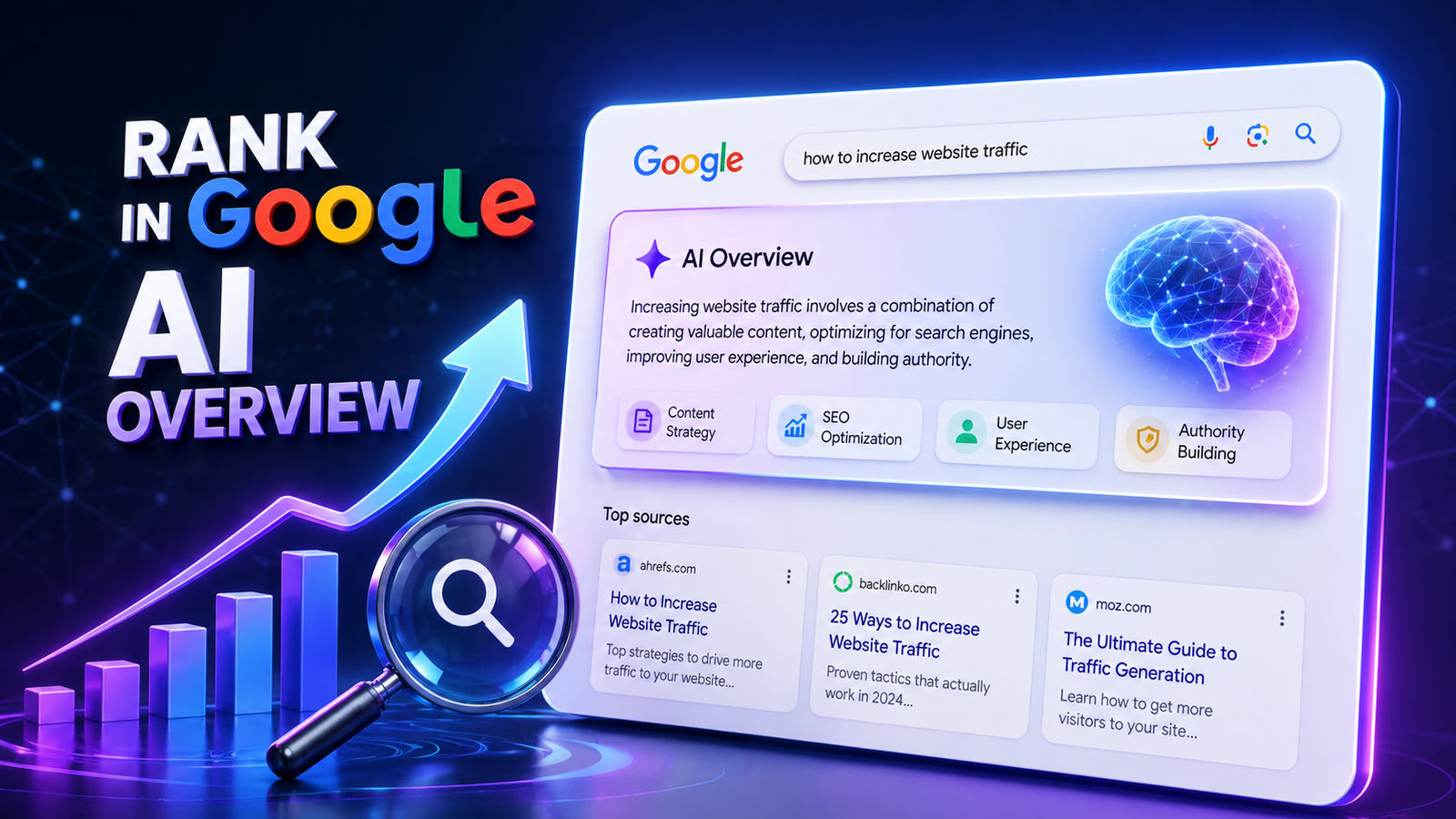
How to Rank in Google AI Overview
Google AI Overview means search results expand to include AI-generated summaries from multiple sources instead of just a page of blue links. This means easier and smarter ways to glean information. It also means different ways to gain visibility on the Internet. Instead of just being on the first page and being clicked on, Google’s AI must trust the website to cite.
Adapting to the changes are a “must” for companies and websites to stay competitive. How well you are ranked is determined by how your content aligns to Google AI’s interpretation, the user’s search intent, and Google’s authority signals. With AI driven SEO, the content marketers have to create is well-structured, and supported by their company’s data and user experience. This content must solve user-centered AI problems.
Table of Contents
- Understanding Google AI Overview
- Key Google AI & SEO Updates Shaping Rankings
- Why Problem-Solving Content Wins in AI Search
- High Search Problem-Based Keywords (Traffic + Leads)
- AI Keyword Research for Intent Mapping
- AI Content Optimization Strategies
- Leveraging AI SEO Services for Growth
- Building Strong E-E-A-T Signals
- Structuring Content for AI Extraction
- Mistakes That Prevent AI Overview Rankings
- Final Thoughts
- FAQs
Understanding Google AI Overview
To provide a quick answer to the user, Google AI looks at content from many sources and then finds the relevant, accurate, and well-structured content to summarize. Google AI doesn’t rank pages; instead, it looks at how well content sources are adding and supporting the content.
This means your content needs to be deeper than just the basics of traditional SEO. It needs to be accurate and organized in a way that relates to what AI does and how it interprets content. Websites that accurately provide the information users are seeking quickly and comprehensibly in a clear and authoritative way will be featured more often.
Key Google AI & SEO Updates Shaping Rankings
Recent updates place an emphasis on trust and ranking over the typical factors that determine a ranking. Google’s AI is more focused on:
- Fully understanding user intent
- Assessing the credibility of the content using a variety of components
- Recognizing content that is truly beneficial
- Extracting information that is clear and correct
AI SEO has significant importance and value in these updates and continues to grow in importance, as these updates and the AI-enhanced search behavior are focused on helping the user.
Why Problem-Solving Content Wins in AI Search
AI Explainers generally provide an answer to the user’s question. Content that solves a user’s problem will have the best chance of being selected.
Focus on:
- User pain points
- Specific and clear solutions
- Logical content
Taking the time to create content that actually answers the need for “how to rank in Google AI Overview” will yield better results than writing general and vague SEO content.
AI will prioritize content that answers users’ questions.
High Search Problem-Based Keywords (Traffic + Leads)
Focusing your content on what your target audience is actually trying to solve as a core user problem is the best way to ensure that your content and website are generating leads, as it indicates to the user that your service is what they need to solve their problem. It’s a common misconception that keyword-focused content is the best way to gain traffic; however, your target audience needs must be the focus.
Here are some examples of long-tail search queries I might want to write answers for:
- Why is my website not ranking on Google?
- How to optimize content for AI search results?
- Best AI tools for SEO optimization?
Here are some strategies I might want to try:
- Use search data to identify common user questions
- Focus on long-tail keywords with clear intent.
- Align content with problem-solution frameworks.
Keywords, especially long-tail keywords, can significantly improve a writer’s visibility and attract high-quality traffic to their content.
AI Keyword Research for Intent Mapping
AI keyword research is dissecting user intent despite the rapid changes search engines are experiencing.
Here are some of the main benefits:
- Identifies semantic keyword relationships.
- Group keywords into topic clusters.
- Predicts emerging trends.
Take a proactive approach and offer comprehensive topic coverage instead of concentrating on solitary search phrases. This gives the content producer a greater chance of being referenced in AI-generated summaries.
AI Content Optimization Strategies
To rank in the AI Overview, your content must be optimized for both users and AI systems. Effective AI content optimization includes:
Clear Answer Structuring
Start sections with direct answers before expanding further.
Semantic Depth
Use related terms and concepts to enhance context.
Readability & Formatting
- Use headings and subheadings
- Break content into short paragraphs
- Include bullet points for clarity
Data & Examples
Support your content with real insights, examples, or case references.
Content Freshness
Regular updates signal relevance and reliability to Google’s AI.
Leveraging AI SEO Services for Growth
Professional AI SEO services provide a competitive edge by combining automation with strategy. They help in:
- Identifying ranking opportunities
- Optimizing content structure
- Enhancing technical SEO
- Monitoring performance in real time
Businesses that invest in AI-driven strategies can adapt faster to algorithm changes and maintain consistent visibility.
Building Strong E-E-A-T Signals
Your E-E-A-T (Experience, Expertise, Authoritativeness, Trustworthiness) rank in AI search is changing. AI helps with:
How AI Supports E-E-A-T:
- Analyzes credibility signals across content
- Identifies gaps in expertise
- Enhances consistency
AI Risks:
- Automation resulting in mediocre content
- content lacking human oversight
- increase the gap of trust
Best Strategies:
- case studies
- transparency
- authentic content
AI can assist, but authenticity must come from human expertise.
Structuring Content for AI Extraction
AI can quickly interpret and extract content from well-organized written material. Here are a l few tips for content organization to increase visibility:
- Use questions for headings
- Answer them directly
- Organize responses logically
- Add summaries and highlight important points
Design your content so AI can quickly extract and summarize.
Mistakes That Prevent AI Overview Rankings
For a specific audience and a specific user intent:
- Include contextless, stacked keywords
- Add generic content written by AI and verify with editors
- Neglect to enhance your content when needed
- Lack of well-defined author experience and expertise in AI Truth
These content quality issues result in lower rankings and a reduced chance of recognition by the AI.
Final Thoughts
Shifting your company’s SEO strategy is required to compete in Google-AI. Focus on problem-solving to build authority rather than targeting keywords. Doing this builds confidence in your brand. Align your SEO strategy to AI programs and their principles. Put the user’s thought processes and goals at the front and center of your strategy. Finally, develop a true solution to their goal by creating high-quality content.
Companies that integrate AI with best practice content structuring to optimize posts and build authority with a front and center approach (the new type of search engine’s) E-E-A-T signals, will build their own audience. Innovators will restructure their content to maintain high standards. Quality wins.