How to Recover After a Google Core Update
Experiencing ranking and traffic drops after a Google Core Update? It’s common. Google Core updates affect every website. View these updates as an opportunity instead of a detriment. Declining rankings mean the website is not competitively ranking. In these cases, recovery is entirely plausible through the right strategy and online marketing solutions.
Ranks Growth has the expertise to understand the true causes of ranking losses and build up stable recovery strategies through SEO consulting, content, and technical improvements. From homeowners with a local service to the most established of companies needing the best web agency, this guide will show you the recovery strategies for after the Google Core Update and will help you build a more prominent digital presence alongside your Google My Business Local SEO.
What Is a Google Core Update?
Google Core Updates are large-scale modernizations for search ranking systems. Since Core Updates are broad, they don’t aim to solve ranking issues such as spam or page speed. Instead, they refine Google’s assessment of content and overall UX.
Since Core Updates are broad and modernizing, Core Updates mean there’s nothing specifically wrong with your website. In fact, there may be a page that’s a more relevant search result that satisfies your target market.
There are a few common symptoms you can look for:
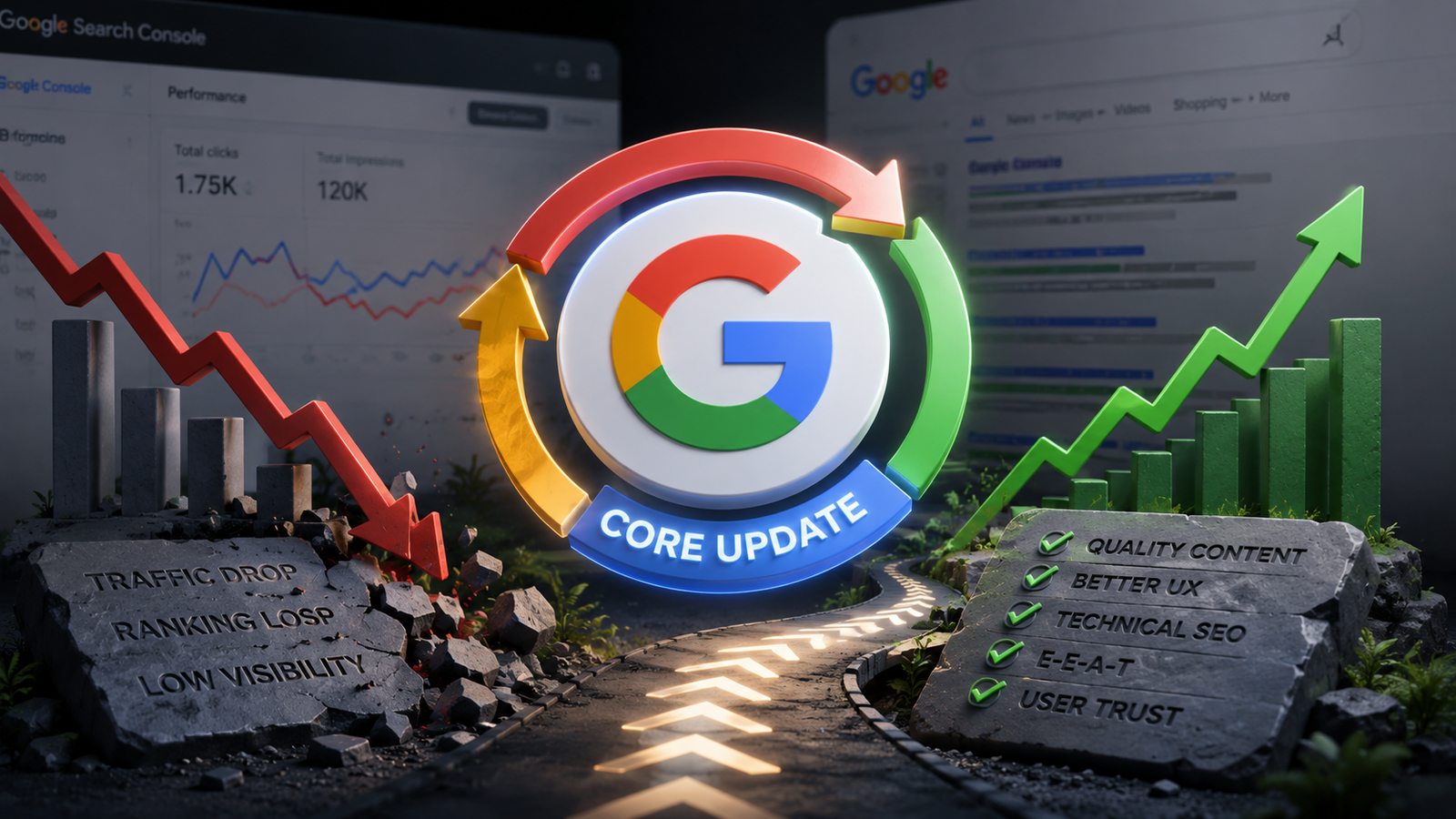
- Traffic suddenly drops
- Multiple pages are losing rankings for keywords
- Impressions and clicks in GSC are declining
- There are several competing websites above yours in the SERP
- There is a decline in conversions due to a lack of visibility
Your first instinct is typically to act quickly to fix your website after noticing a decline in performance. However, the first thing you should do is remain calm and be sure to analyze the website thoroughly for the performance decline. Only after you are sure you understand the performance decline of your website should you begin to make small, calculated adjustments.
The first step is to stay calm and analyze your website before making major changes.
Step 1: Confirm That a Core Update Is the Cause
The first step before making any changes to your website is to confirm that there has been a significant Google Core Update.
You can check the following:
- Performance reports on the Google Search Console
- Trends in traffic on Google Analytics
- The rankings for your keywords
- News in your industry about major updates in Google
If you confirm that there has been a major update, assess the impact and avoid any major changes to your website. Instead, see if you can determine the pages that were most impacted.
Step 2: Perform a Complete SEO Audit
The most impactful first step to recovering your lost Google rankings from an SEO perspective is to complete a thorough and comprehensive SEO audit.
Pay special attention to the following:
Technical SEO
Check for:
- Broken pages
- Errors when crawled
- Pages that load slowly
- Usability issues when viewed on a mobile device
- Core Web Vitals that are poor
- Content that is duplicated
- Canonical tags that are set incorrectly
Although Core Updates evaluate quality to a greater extent, a site that has poor technical SEO will also have a poor ranking.
Content Quality
Google appreciates content that actually helps its users.
When assessing your pages, ensure that your page content:
- Answers the questions that users ask
- Is accurate and not stale
- Is in fact original
- Shows a reasonable amount of expertise
- Thoroughly surpasses the page content of your competitors
Never remove content that is thin or that is stale. Instead, do your best to update it.
Step 3: Strengthen E-E-A-T Signals
Experience, Expertise, Authority, and Trustworthiness have become even more critical to Google.
Increase trust by:
- Providing more in-depth author bios
- Adding verifiable and real business data
- Publishing original, quality, and peer-reviewed case studies
- Documenting and displaying customer testimonials
- Displaying your certifications and awards
- Google-friendly content that is E-E-A-T rich, quality, and trustworthy
Step 4: Improve User Experience
Google wants to create an environment where all users can easily find and view the content that best suits their needs in the shortest amount of time.
Make Your Website More User-Friendly
What’s important is:
- Quick loading speeds
- Simple to use
- Responsive on phones
- Straightforward headings
- Easy-to-read fonts
- Images that provide help
- Links that take you to other pages
One of the best ways to keep users on your site and help them engage is to make your site easy to use.
Creating a site that is easy to use and performs well is the best way to keep your site SEO focused.
Step 5: Update Existing Content Instead of Creating More
Publishing tons of new content is something many site owners feel they need to do after a ranking drop.
What you need to do is add value to your pages by doing things like:
- Refreshing page stats
- Completing sections that need more info
- Adding FAQs
- New, high-quality images and graphics
- New links that match the intent of the search
The quality of your pages is what you need to focus on after a core update, rather than the number of pages you publish.
Step 6: Strengthen Your Local SEO
For many local enterprises, the Google My Business profile for local SEO is crucial for sustaining customer outreach.
You can optimize your profile by doing the following:
- Ensure your profile information is current
- Add new pictures
- Collect and respond to customer reviews
- Make appropriate posts
- Respond to reviews
- Choose the appropriate business categories
When combined with excellent website optimization, the local SEO Google My Business profile helps draw the local clientele you desire, even with temporary fluctuations in organic rankings.
Step 7: Build Topical Authority
Google likes websites that provide comprehensive coverage of a topic, as opposed to publishing articles in a vacuum.
For example, if you happen to own a roofing business, don’t publish only a single roofing article.
You should create the following supporting articles:
- Roof inspections
- Roof repairs
- Roofs after the storm
- Roofing materials
- Insurance claims
- Roofing tips
This content cluster provides the supporting articles that demonstrate expertise and help search engines recognize your authority and expertise in your coverage of the topic.
Professional SEO consulting services can help identify the strategic publishing gaps for you.
Step 8: Analyze Competitors
Often, the best way to improve your SEO rankings is to analyze the strategies employed by your competition.
You should compare the following items with your competition:
- Content depth
- Layout of the page
- Links to and from the page
- User Experience
- Search Intent
Avoid duplicating your competitors. Instead, use their strategies to find content that is of greater value.
Step 9: Strengthen Your Overall Digital Marketing Strategy
SEO strategies alone will not help you recover.
Successful businesses implement combinations of the following to their SEO strategies:
- Content Creation
- Social Media Marketing
- Email Marketing
- Conversion Rate Optimization
- Reputation Management
- Paid Advertising
Diversifying your marketing strategies can minimize reliance on search rankings while your SEO strategies take effect.
At Ranks Growth, we build holistic growth strategies that help businesses grow sustainably rather than relying on a single source of traffic.
Step 10: Be Patient and Continue Improving
A common pitfall for businesses is the expectation of a rapid return.
Corrections for Google Core Updates may take weeks or even months to be fully realized.
During this time, you must
- Continue posting relevant and valuable content.
- Address technical issues as needed.
- Check Search Console often.
- Analyze keyword performance.
- Work to enhance user engagement.
- Make consistent changes to the site.
In the long run, consistent changes yield better results compared to constant redesigns or aggressive SEO changes.
Why Partner with Ranks Growth?
Core Updates are some of the most challenging algorithm updates and require specialized knowledge to recover from.
At Ranks Growth, we have specialized custom SEO consulting services that include:
- SEO audits
- Technical SEO
- Content optimization
- Site speed optimization
- Google My Business local SEO
- Link profile assessments
- Competitive analysis
- Full-service online marketing
We offer sustainable SEO practices and the best SEO web services if you are a homeowner with a local service business or a large corporation. Our dedicated team is focused on Google’s new quality SEO web services.
Final Thoughts
Google Core Updates should be welcomed rather than feared. The most successful websites rank because of focus on quality, helpful content, great user experience and trust. These websites do not employ risky and quick tactics and in turn, are successful in the search engines. This is a long-term and sustainable method.
The perfect blend of online marketing, the best SEO consulting with quality managed Google My Business and local SEO, and a great website can ensure a recovery even better than before.
If you are hoping to find the best web agency for safe rank recovery and growth, look no further than Ranks Growth. We have the perfect blend of innovative consulting to ensure you are adjusting for the currently competitive search landscape with a focus on ongoing improvements rather than quick solutions.
FAQs
1. Why did my website lose rankings after a Google Core Update?
Google Core Updates reassess content quality, relevance, user experience, and trustworthiness. If competing pages provide more value, your rankings may temporarily decline.
2. How long does it take to recover from a Google Core Update?
Recovery can take anywhere from a few weeks to several months, depending on the improvements made and how quickly Google re-evaluates your website.
3. Should I update existing content or create new content after a Core Update?
In most cases, improving your existing pages with fresher, more comprehensive, and user-focused content delivers better results than publishing large amounts of new content.
4. Can optimizing my Google My Business profile help after a Core Update?
Yes. For local businesses, maintaining an optimized local SEO Google My Business profile with accurate information, reviews, and regular updates can improve local search visibility while your website recovers.
5. When should I consider hiring professional SEO consulting services?
If your rankings continue to decline despite improving your website, professional SEO consulting services can identify technical, content, and authority issues and create a long-term recovery strategy.