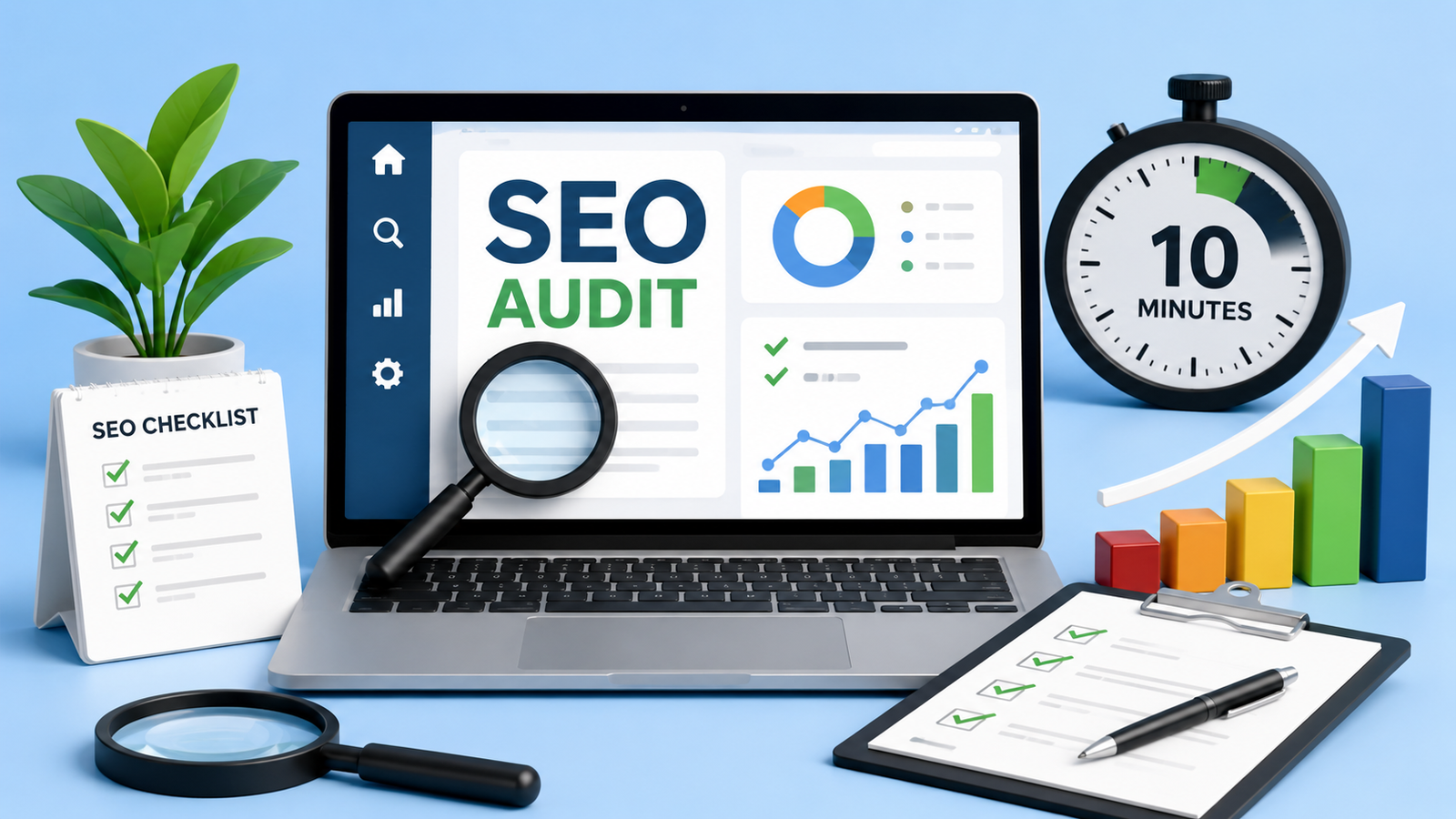
How to Audit Your Website SEO in 10 Minutes
Even an awesome-looking website can fail to rank on search engines. Below the surface, slow loading pages, broken links, or missing metadata and aspects of usability & indexing can quietly damage visibility and traffic. That’s exactly why every webmaster should run regular SEO audits to uncover hidden issues before they impact rankings or conversions.
The bright side is that discovering one of the most typical SEO issues does not require hours of tech job. A 10-minute audit can uncover many insights about your website health, user experience, and search performance.
This quick audit will help you gain visibility and stay digitally alive, regardless of whether it is a local business website or an online store, while functioning as a service-based company.
Table of Contents
- Why a Quick SEO Audit Matters
- Step 1: Check Your Website Speed
- Step 2: Test Mobile Friendliness
- Step 3: Review Title Tags and Meta Descriptions
- Step 4: Check for Indexing Problems
- Step 5: Analyze On-Page Content
- Step 6: Check Internal Links and Broken Pages
- Step 7: Review Basic Keyword Visibility
- What a 10-Minute SEO Audit Can Reveal
- When to Use Professional SEO Audit Services
- How Ranks Growth Helps Businesses Improve SEO
- Signs Your Website Needs an SEO Audit Immediately
- Creating a Long-Term SEO Growth Strategy
- Final Thoughts
Why a Quick SEO Audit Matters
Over time, even small mistakes negatively affect your SEO, content, and the user-friendliness of your site, which affects your rankings. Just like the search engines that rank your site, you should rank your own site too. Here are some SEO issues which downloadable tools will help you with.
Performing a rapid website SEO audit will help you with:
- Discover indexing and crawl problems
- Identify slow-loading pages
- Improve mobile usability
- Find missing SEO elements
- Detect broken links or redirects
- Evaluate content optimization
- Monitor keyword visibility
- Strengthen your overall SEO growth strategy
Some businesses ignore their SEO until they begin to see the traffic drop to their site. This is a poor SEO strategy. Just like you’d want to contract with a good worker to fill a gap, you’d want to hire SEO audit professionals to help implement strategies that aid your business growth.
Step 1: Check Your Website Speed
Time Required: 2 Minutes
One of the first things to look at on a fast-paced audit is page speed. Visitors become frustrated, and conversion rates are impacted by slow websites. Search engines also prioritize websites with better user experiences.
Use tools like:
- Google PageSpeed Insights
- GTmetrix
- Lighthouse
Focus on these areas:
- Largest Contentful Paint (LCP)
- Mobile loading speed
- Image optimization
- JavaScript blocking issues
- Server response time
Website speed is critical; if your site takes more than three seconds to load, people will leave before they see what you have.
Quick Fixes
- Compress large images
- Enable browser caching
- Remove unnecessary plugins
- Utilize a content delivery network (CDN)
- Minify CSS and JavaScript files
A high loading speed is essential for better rankings, along with great user engagement.
Step 2: Test Mobile Friendliness
Time Required: 1 Minute
Most searches are on mobile. If your website does not function well on smaller screens, your ranking can fall, and user experience can worsen.
As part of your audit:
- Open your site on a phone
- Test button spacing
- Check text for readability
- Check navigation menus
- See if images resize correctly
Flexible designs are essential for SEO and user satisfaction.
When businesses ask, “How do I check seo health quickly?” mobile usability should always be part of the answer.
Step 3: Review Title Tags and Meta Descriptions
Time Required: 2 Minutes
Title tags and meta descriptions provide critical information that helps search engines comprehend your web pages. From the search results page, they can also affect the click-through rate.
Check the following:
Title Tags
- Unique for every page
- Under 60 characters
- Includes target keywords naturally
Meta Descriptions
- Around 150–160 characters
- Clear and compelling
- Encourages clicks
Poor metadata can reduce visibility even if your content ranks well.
Suppose your page is targeting something like a technical SEO Audit. In that case, the keyword should seamlessly be written in the title and the description.
Step 4: Check for Indexing Problems
Time Required: 1 Minute
There can be pages on a website that search engines haven’t indexed.
First, you will want to search Google for:
site:yourdomain.com
You will see all of the pages that have been indexed from your site.
Look for:
- Missing pages
- Duplicate pages
- Strange URLs
- Old content still indexed
If pages that need to be indexed are not showing, there are issues with indexing or crawling.
You should also review:
- XML sitemap status
- Robots.txt configuration
- Noindex tags
A basic indexing review is a key part of any technical SEO audit because it directly affects visibility.
Step 5: Analyze On-Page Content
Time Required: 2 Minutes
Content quality ranks higher than most other factors.
During your quick review, ask:
- Does the content answer search intent?
- Are headings properly structured?
- Are keywords naturally included?
- Is the content easy to read?
- Are internal links present?
Don’t cram keywords into paragraphs like a high school essay. Google has changed their algorithm and value the meaning and relevance behind content.
If you want to optimize content for ranking, put thought into your content and target real problems for your audience.
For each page that ranks, a potential customer’s SEO site audit usually identifies key missing content on the site.
Step 6: Check Internal Links and Broken Pages
Time Required: 1 Minute
Broken links frustrate visitors and waste crawler budgets.
Use tools like:
- Screaming Frog
- Ahrefs
- Broken Link Checker
Look for:
- 404 errors
- Redirect chains
- Orphan pages
- Missing internal links
Linking pages gives search engines the site’s architecture and directs users to the pages you want them to keep seeing.
For long-term and consistent growth for your SEO, a solid link structure is a must for your site.
Step 7: Review Basic Keyword Visibility
Time Required: 1 Minute
Don’t worry; accessibility tools aren’t necessarily required to take a basic visibility check.
Search your primary keywords manually and review:
- Ranking positions
- Competitor pages
- Featured snippets
- Local search visibility
If you are targeting phrases like:
- SEO audit services
- website SEO analysis
- seo analysis reports
Your pages should address these topics clearly, staying as non-repetitive as possible.
This quick assesses whether your content remains current to queries and emerging rank positions.
What a 10-Minute SEO Audit Can Reveal
A short audit may seem simple, but it can uncover issues that quietly affect rankings and traffic.
An SEO audit might seem quick and easy, but these basic examinations can surface issues that lead to a loss of rankings and a decrease in web traffic.
Some quick issues that may be noted in an SEO audit:
Common findings include:
- Slow mobile performance
- Missing metadata
- Weak internal linking
- Thin content
- Crawl errors
- Duplicate pages
- Indexing problems
- Poor user experience
All or a selection of these issues, if identified and corrected, can lead to better website rankings and a greater presence in the future.
If companies continually practice good SEO habits and regularly conduct quick SEO audits, they can expect to see these benefits:
- Improved website rankings
- Improved visitor website engagement
- More visitors becoming customers
- Fewer visitors leaving the website
When to Use Professional SEO Audit Services
A quick assessment is great for noting basic problems, but larger websites need a little more digging.
Professional SEO audits will cover more complex forms of issues that include
- Core Web Vitals issues
- Schema markup problems
- JavaScript rendering problems
- Structured data gaps
- Competitive keyword issues
- Backlink issues
- Crawl budget problems
In addition, comprehensive SEO analysis reports will give the consumer actionable problems to solve, rather than issues.
Professional audits are crucial for businesses that truly want to grow and have a stable, long-term investment in their visibility to the world.
How Ranks Growth Helps Businesses Improve SEO
Many business owners know their website needs optimisation, but are unsure where to begin. That is where professional guidance becomes valuable.
Ranks Growth has custom solutions that improve a web sites visibility, performance and search rankings.
Their dedicated audit process focuses on:
- Technical SEO improvements
- Content optimization
- Keyword targeting
- Mobile usability
- Site structure
- Performance tracking
Typically, most businesses will need to explore the company’s specialized SEO audit strategy services to better understand the process of a detailed audit to help them with their long-term organic growth.
Professional audits allow businesses to improve their decision making through the provided data.
Signs Your Website Needs an SEO Audit Immediately
Your website may already be experiencing SEO troubles if you notice any one of the following things.
Warning Signs of Trouble:
- Traffic drops suddenly
- Keywords ranking down
- Pages load slowly
- Conversions happen infrequently
- Mobile pages function poorly
- Bounce rates are high
- Lead generation drops
- Pages stop showing in search engines
If you have been googling “check seo health” or “test my SEO score” even one time, your website is probably in need of a greater seo analysis.
Keeping an eye on things may prevent these issues from getting out of control and costing you ranking your website higher on search engines.
Creating a Long-Term SEO Growth Strategy
Having a one-off SEO plan doesn’t work. Algorithms change all the time. Competitors refresh their content, and users change how they look for information.
An SEO growth strategy needs the following:
- Regular technical audits
- Content updates
- Keyword tracking
- Competitor analysis
- Link monitoring
- Performance reporting
It all seems complicated, but easy actions hold the greatest value. Just 10 minutes a month on your site to do a quick assessment can benefit it greatly. You’ll keep traffic healthy and have a bottom line for improvement.
Staying even a little consistent with the plan can hold more value than having a complex strategy.
Final Thoughts
A basic SEO audit identifies simple areas of improvement on your website. You can get this info with no high-level analytics and without expensive tools. By spending about 10 minutes directly on your website to assess certain areas like: speed, mobile usability, how quickly pages index, site metadata, site content, and internal links, you can discover issues that might be causing you to lose potential visitors, boost web traffic, and improve your rankings on search results pages.
Once issues have been identified, the most important thing is to take action. More action is taken by making small changes regularly opposed to big changes sporadically.
If your business needs more advanced insights, tracking, or expert assistance, you might consider more advanced SEO audit offerings. Ranks Growth offers services to help companies with SEO to help discover the issues universal to SEO and help them think about optimization in a new way data laced.
No matter your website, local business or online business, frequent website audits improve UX, help you remain competitive, and improve your chances in search results. They do amazing things to your site.
FAQs
1. What is an SEO audit?
An SEO audit is the process of evaluating a website’s search engine performance, technical structure, content quality, and user experience to identify issues that may affect rankings and traffic.
2. How often should I perform a website SEO analysis?
A basic website SEO analysis should ideally be done every month, while a complete technical SEO audit can be performed quarterly or after major website updates.
3. Can I check SEO health without professional tools?
Yes. You can check SEO health using free tools like Google PageSpeed Insights, Google Search Console, and manual checks for mobile responsiveness, indexing, and broken links.
4. What does a technical SEO audit include?
A technical SEO audit typically includes checking crawlability, indexing, site speed, mobile usability, XML sitemaps, structured data, redirects, and overall website performance.
5. Why are SEO analysis reports important?
SEO analysis reports help website owners understand current SEO performance, identify weaknesses, track keyword rankings, and create a more effective SEO growth strategy for long-term visibility.