How Can I Create Long-Tail Content Clusters to Build Topical Authority?
Overview
Long-tail content clusters help you build topical authority. Topical authority is the level to which you are understood as an expert on a specific topic. You can no longer build authority by publishing hundreds of unrelated blog posts. You have to strategies content in a way that shows your expertise on multiple topics and in a way that provides in-depth answers to your audience’s questions. Long-tail content clusters allow you to do just that.
At Ranks Growth, we strive to help our clients improve their content strategies, so that their site performs better and serves its customers.
Get a Free Quote
Build Topical Authority with Content
If you need assistance with topics such as how to build topical authority with content, and other areas of your online business, give Ranks Growth a call. Our team of internet marketing experts provides a myriad of top-notch online marketing services.

Introduction: Understanding Long-Tail Content Clusters
When a potential client searches broad terms, you had better believe they do a deep-dive with more specific keyword phrases.
For example, a website development business should have supporting content about website maintenance costs, various types of designs (i.e. mobile friendly, interactive, etc.), security and site speed, just to name a few.
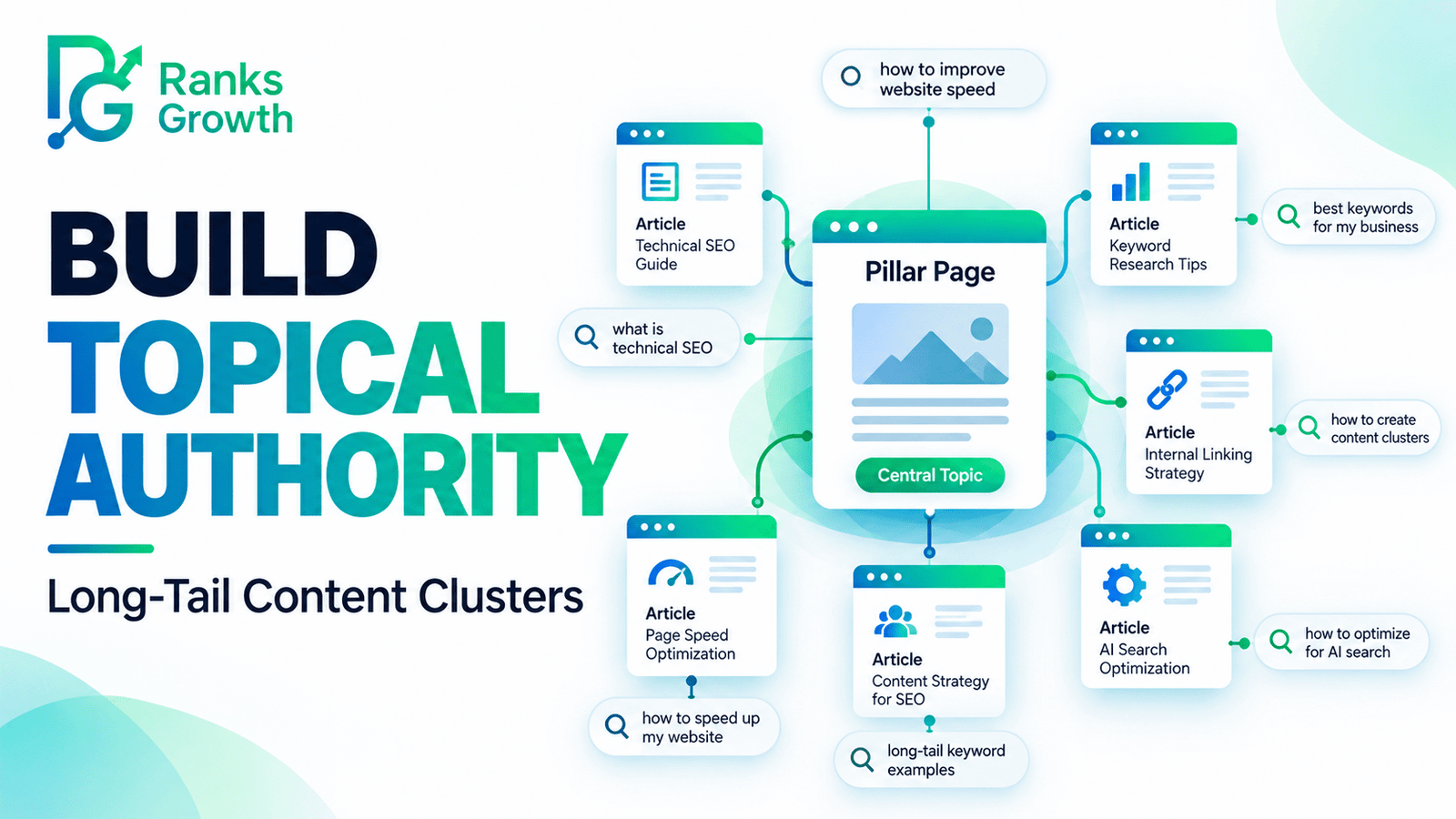
Instead of creating standalone articles, content should be organized in long-tail content clusters.
This strategy is beneficial, because not only do you create a more resourceful and in-depth article on the main topic, you are able to create better internal links and support your reader with related content and provide answers to their questions.
How to Research, Group, and Link Long-Tail Content Clusters
1. Identify a Clear Pillar Topic
What is the core area in which your business wishes to establish itself as subject matter experts? Typically, an ideal pillar topic is related to your product and service offerings and also meets your customers’ needs.
For example, a digital marketing agency may want to build its SEO expertise and therefore may want to build its content around this topic. Other topics may include
- What is the best way to optimize my website for search?
- What are the best ways to conduct keyword research and analysis for search?
- What are the best ways to optimize my website and content for thesearch?
- Where can I learn about local search engine optimization?
- What are the best strategies to incorporate AI into search and help my business be more competitive?
Your pillar content may cover the above examples broadly while your supporting content may delve into details around each example.
2. Research Long-Tail Keywords and Customer Questions
Choose a pillar topic. Then, find the phrases of interest to your customers that relate to that topic. You’ll use these phrases in your content strategy to capture customers’ interest.
Generate your own long-tail keywords and customer queries using Google’s search suggestions, and use Ahrefs, SEMrush and Google Search Console.
Think about searches like:
- “how does technical SEO affect web rankings”
- “what causes a website to load slowly”
- “what is the difference between an SEO audit and a technical SEO audit”
- “best seo agency”
Think about searches that require information and services related to your product or business.
Find searches with a specific intent that indicate a high level of interest in the potential buyer.
3. Create Relevant Content Clusters
Once you have generated keyword ideas, group them according to relevance and intent.
If two or more keywords describe the same user query, you should not create a separate article for each of them. Although related keywords should be covered in the article, you should not repeat the same information multiple times.
It is best to talk about website performance and the related challenges, and provide solutions for improving website speed and usability.
Images should be optimized to be loaded quickly. Other performance improvements can be made to the website.
Creating unique articles about different keywords in the same cluster helps in providing appropriate information for each keyword. This process prevents keyword cannibalization.
4. Develop Logical Internal Linking
Internal linking helps to structure your content, and assists users in locating related information. It connects your pillar page to supporting articles.
Use descriptive anchor text to offer the reader a preview of the target content. Relevant articles may be supported linking to the pillar page, and linking articles to related pages if the article content adds value.
An article on website performance may link to page speed optimization services, and an article on crawlability may link to technical SEO services.
Linking structures assist users in navigating your content, and provide search engines with an understanding of the inter-relations and hierarchy of your content.
5. Implement Content Strategy With Technical SEO
Outstanding content can’t reach its potential with problems such as crawling, indexing, or performance issues on your website. Professional technical SEO services identify broken links, orphaned pages, indexing issues, and poor website architecture.
Page speed optimization services enhance the performance and loading experience of your web pages.
Content clusters must have logical categories, and mobile-friendly designs. Wherever applicable, they must have properly implemented structured data.
6. Optimize Content for Traditional and AI Search
Modern consumers use search engines and content discovery platforms in different ways, and good content meets both needs.
It is important that supporting articles have their own, unique set of keywords to answer search queries. Repetitive keywords are unhelpful and may even count against your ranking for that query.
Similar to traditional search, to succeed with AI search, content needs to be organized and structured in a way that is easy to understand and reference by the system.
To meet that goal, content should contain descriptive headings, examples, statistics, and relevant information.
Writing content that answers the questions your audience has in a natural way is more important and effective than forcing keywords throughout your article.
At Ranks Growth, we combine content planning, website improvements, and various changes and tweaks to meet your overall business goals to strengthen your digital authority.
7. Measure Performance and Expand Your Clusters
Successful content clustering is an ongoing process.
Additional internal and external resources should be provided as needed.
Look for content that is ranking but may not be attracting a lot of visitors or conversions. Identify content that is attracting the right visitors and editable opportunities.
There are plenty of opportunities to improve your content, but don’t feel you always need to be generating new content to succeed. Often the most helpful, sustainable thing you can do is improve content already published.
Contact Ranks Growth Today
Aside from keyword targeting, what does it take to build topical authority? It takes thoughtful research, valuable content, an effective internal linking structure, and a highly optimized web presence.
Ranks Growth provides businesses with various SEO services including strategic, technical and keyword SEO services as well as AI search optimization.
Looking to build a new content strategy or overhaul your current web presence? The team at Ranks Growth can help. We can create content clusters to positively impact traffic and change visitors into customers.
Want to increase topical authority for your web presence? Get a Free Quote from Ranks Growth today!
FAQs
Q1. What are long-tail content clusters in SEO?
Long-tail content clusters are groups of related articles built around a central topic. Each supporting article targets a specific search query or customer question, while internal links connect the articles to the main pillar page.
Q2. How many articles should a content cluster contain?
There is no fixed number. A small cluster may contain three to five supporting articles, while broader topics may require ten or more. Focus on covering relevant search intent rather than reaching an arbitrary article count.
Q3. Do long-tail content clusters improve topical authority?
Yes. Well-researched clusters demonstrate subject coverage, connect related information, and help search engines understand your website’s expertise. Consistent quality, relevance, and useful internal links are essential.
Q4. How do I avoid keyword cannibalization when creating content clusters?
Assign a distinct search intent and purpose to every page. Combine closely related keywords when they serve the same intent, and create separate articles only when they address meaningfully different questions.
Q5. Can content clusters improve AI search visibility?
Yes. Clear, authoritative, interconnected content can make information easier for AI-powered search systems to understand and retrieve. However, visibility is not guaranteed and also depends on content quality, credibility, accessibility, and relevance.