How UX and SEO Work Together to Drive Website Conversions
Overview: Why UX and SEO Must Work Together
A website that ranks highly can still fail to generate leads or make sales. The reason for this is that the purpose of ranking well is to bring visitors to your site. It is the users’ experience once they get to your site that ultimately determines if they make a purchase.
User Experience (UX) and Search Engine Optimization (SEO) play a critical role throughout this entire process.
SEO is responsible for bringing visitors to your site. UX is responsible for facilitating visitors’ understanding and engagement with your site.
When SEO and UX work in conjunction, potential visitors to your site become qualified leads, and more leads convert into customers.
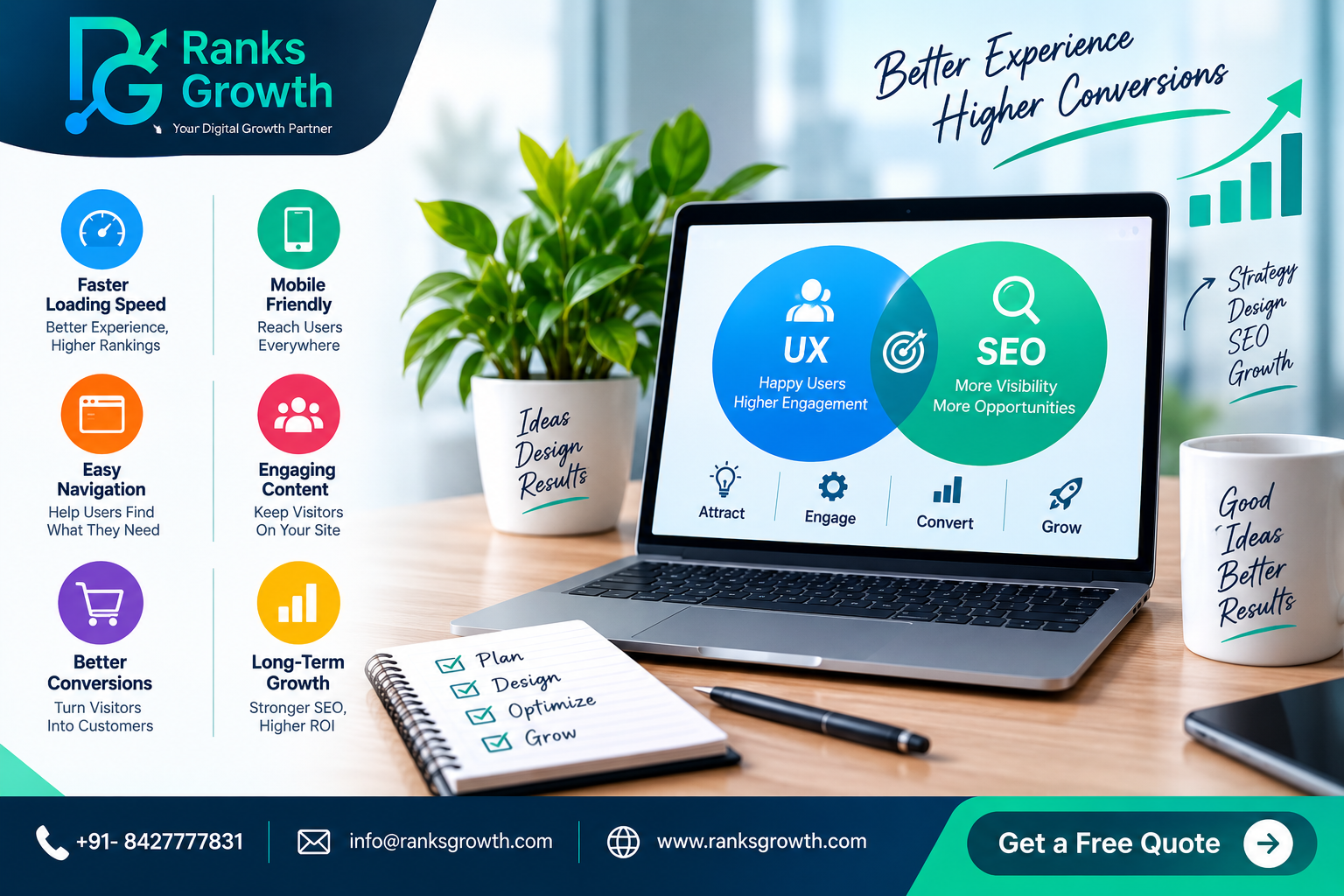
At Ranks Growth, SEO, along with web design and UX, builds digital experiences that, due to their visibility and engagement, help grow the business.
Get a Free Quote
Want to improve your website’s visibility, usability, and conversion potential?
Contact Ranks Growth for a free consultation and quote for SEO services, UI UX design services, website UX optimization, and other online marketing solutions.

Introduction: UX, SEO, and Conversions
To illustrate this point, imagine you have a site that, through optimal SEO, is visited by thousands of users, but due to slow loading and poor design and navigation, users end up leaving your site.
We know that SEO cannot be treated as a traffic-only strategy.
Search engines and users believe that the best sites are useful, mobile-friendly, and capable of providing the best answer to any given query.
As a result, the modern best practices of SEO require businesses to consider the entire user journey.
Clear UX helps users navigate information and forms without slowing them down or distractor friction. Positive UX drives customers to take more actions throughout your site — whether that be filling out a form, requesting a quote, buying a product, or reaching out to your business.
How Does UX Impact SEO?
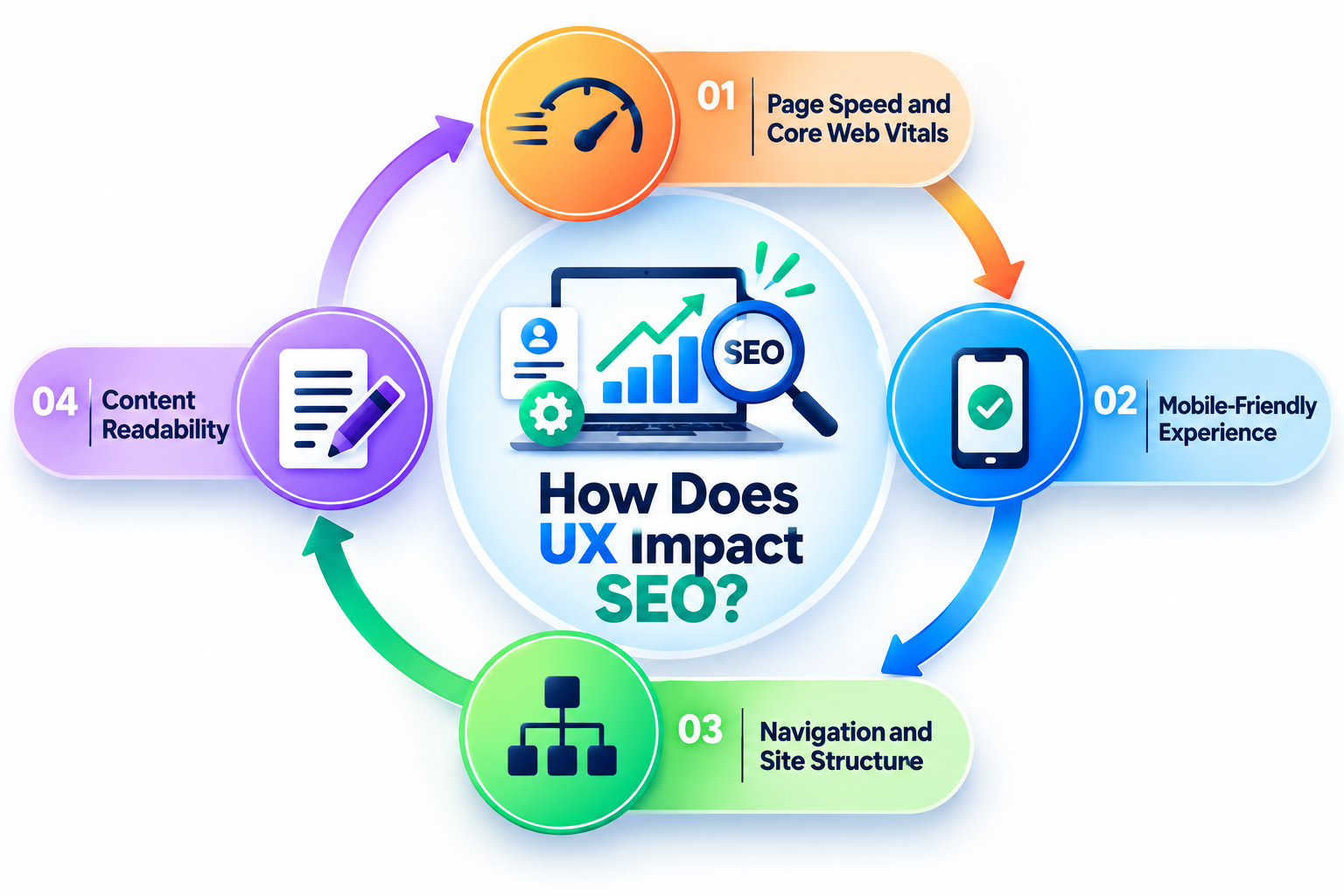
The effectiveness of SEO is tied to User Experience (UX) in several areas of website quality and user behavior.
1. Page Speed and Core Web Vitals
Everyone knows users hate slow sites. Frustration can drive users to exit your site before engaging with your content.
Core Web Vitals incorporate the page’s loading performance, responsiveness, and the stability of page elements. Improving these areas fosters a better page experience for users and aids in the performance of SEO.
Effective SEO services factor in technical performance with key elements of SEO, which include site speed, mobile optimization, crawlability, and the integrity of the site. Ranks Growth includes the outlined elements within their scope of SEO
2. Mobile-Friendly Experience
Website design needs to account for user behavior and accommodate the way users interface with your site. Having a page that is attractive and functional from a desktop perspective is useless if the mobile version of your site is unusable.
Responsive design involves the layout of your site and the adaptability of images and content (navigation, menus, etc.) The aimed functionality of a mobile site should be the ability to achieve the defined site goals using a mobile interface.
3. Navigation and Site Structure
Good navigation helps visitors quickly answer three questions:
- Where am I?
- What information can I find here?
- What should I do next?
Clear menus, logical categories, breadcrumbs, internal links, and descriptive headings make websites easier for both users and search engines to understand.
4. Content Readability
While valuable content is valuable content, it can become unproductive if it is presented in a format such as large blocks of text
Use lots of headings, short paragraphs, lists, links, and clear formatting. Good content design helps users scan and answer questions quickly.
This design helps AEO and AI-search visibility. Search engines and AI algorithms that process and summarize search results will benefit from structured data.
How Better UX Leads to Higher Website Conversions
SEO tactics are only the first step in driving customers to your site. Your website’s UX design determines the response rate and the number of conversions you achieve.
Build Trust
With a professional site design and structure, visitors immediately gain confidence in your business. Business credibility and trust can be built using testimonials, reviews, contact information, safe payment methods, and a clear business information section.
Making It Easy to Act
Your visitors should never have to search for the next step.
Use prominent and descriptive calls-to-action such as:
- Get a Free Quote
- Book a Consultation
- Request a Demo
- Shop Now
- Contact Our Experts
Effective user interface design services make these actions visually clear without overwhelming visitors.
Reduce Friction
Every step is an opportunity for users to drop off. Ease common pain points such as lengthy contact forms and checkout flows, broken page links, and redundant fields.
Create Consistency
Button or icon placement, spacing, and overall layout and design should be the same site-wide to reduce the learning curve for your users.
Practical Strategies for Website UX Optimization
Improving the user experience(UX) and search engine optimization(SEO) of business websites is simpler with a rational approach.
Audit the website: Large images and unnecessarily long scripts can slow down a website, as can broken page links and other technical issues. Big issues slow everything down.
Improve navigation: Put desired information where users need it and where they can easily find it.
Optimize for mobile: It’s important to keep the big mobile menu, but also important to check mobile menu navigation, like the forms and checkout. Keep in mind all the elements like images and the typography navigation.
Improve content structure: Create headings and sections that answer customers’ questions.
Strengthen internal linking: If one page has a particular piece of information, cross-link to related pages so users and search engines get where they need to go.
Improve CTAs: Make your conversion techniques obvious and relevant on each page.
Optimize your customer journeys: Step into the shoes of your users and follow pathways including the home page to contact, product to cart, and landing page to a lead form page.
Monitor and measure: It’s good business practice to monitor the organic traffic on your site and see how users are engaging, how many sales were made, and how many forms were filled out.
The Role of UI UX Design Services
Professional UI UX design services bring strategy, usability, and visual design together.
Good design is centered around function, not just beauty. It is accessible, responsive, intuitive, conversion-centric, and aesthetic.
The approach taken by Ranks Growth includes UI design, a layout centered around UI, performance, SEO, lead generation, and conversion.
Why Ecommerce UI UX Design Requires Extra Attention
There’s a strong connection between UX and revenue for ecommerce websites.
A customer can discover a product in a Google search result, visit the product page, add the product to the cart, then abandon the purchase if the checkout process is slow or comes with a confusing design.
Some of the main goals of an effective ecommerce UI UX design are to optimize:
- Simple product navigation
- Powerful site search
- Clear product categories
- High-quality product images
- Descriptive product information
- Visible pricing and availability
- Easy cart management
- Multiple payment options
- Mobile-friendly checkout
- Trust signals and reviews
- Clear shipping and return information
A smaller purchasing friction means a greater conversion rate.
The Synergy Between SEO Services and Website UX Optimization
SEO and UX shouldn’t be separate tasks.
SEO sees users searching for a service. UX can determine how to showcase that service in a way that helps users see the service and why it is valuable, and what the user should do next.
SEO audits can show slow-loading pages or issues with mobile usability. UI UX design service can solve design and interaction issues that contribute to those problems.
This creates an improvement cycle:
Search visibility -> Website visit -> Positive UX -> Engagement -> Conversion -> Data -> Optimization
This integrated approach is really important when businesses are looking for integrated online marketing solutions, instead of isolated marketing activities.
Contact Ranks Growth Today
Designing your website to look professional is just the first step in drawing your client base. A website should make navigating the site easy, build confidence in your website’s security and legitimacy, and prompt the user to take meaningful action.
Your website might be bringing visitors, but if leads and sales are falling short, low visibility might not be your only issue. Your website’s design may be unnecessarily tough to use for your visitors.
Ranks Growth offers services in SEO, website creation and design, optimization of website experiences, and marketing to help your business grow.
Give your website the boost it needs. Call Ranks Growth today and learn how one of their SEO and UX consultations can help your site convert more visitors.
FAQs
1. Does UX affect SEO?
Yes. UX-related factors such as mobile usability, page performance, site structure, readability, and accessibility can influence how effectively users interact with a website and support overall search performance.
2. How does UX improve website conversions?
Good UX makes it easier for visitors to find information, understand a company’s value, trust the brand, and complete actions such as submitting a form or making a purchase.
3. What is website UX optimization?
Website UX optimization is the process of improving navigation, usability, performance, content presentation, mobile responsiveness, accessibility, and conversion paths to create a better user experience.
4. Why is ecommerce UI UX design important?
Ecommerce UI UX design reduces friction throughout the shopping journey. Better product discovery, simpler navigation, clear product information, and an easier checkout process can help reduce abandonment and support more sales.
5. Should SEO and UX be handled separately?
No. SEO and UX work best when planned together. SEO attracts relevant visitors, while UX helps those visitors find answers and complete desired actions.
6. When should a business invest in UI UX design services?
Businesses should consider UI UX design services when launching a new website, redesigning an existing website, experiencing high bounce or abandonment rates, receiving poor user feedback, or generating traffic without enough conversions.
7. Can better UX help local businesses?
Yes. Local businesses can combine UX improvements with local SEO strategies. Clear contact details, location information, service pages, reviews, directions, and mobile-friendly experiences can make it easier for nearby customers to take action.