
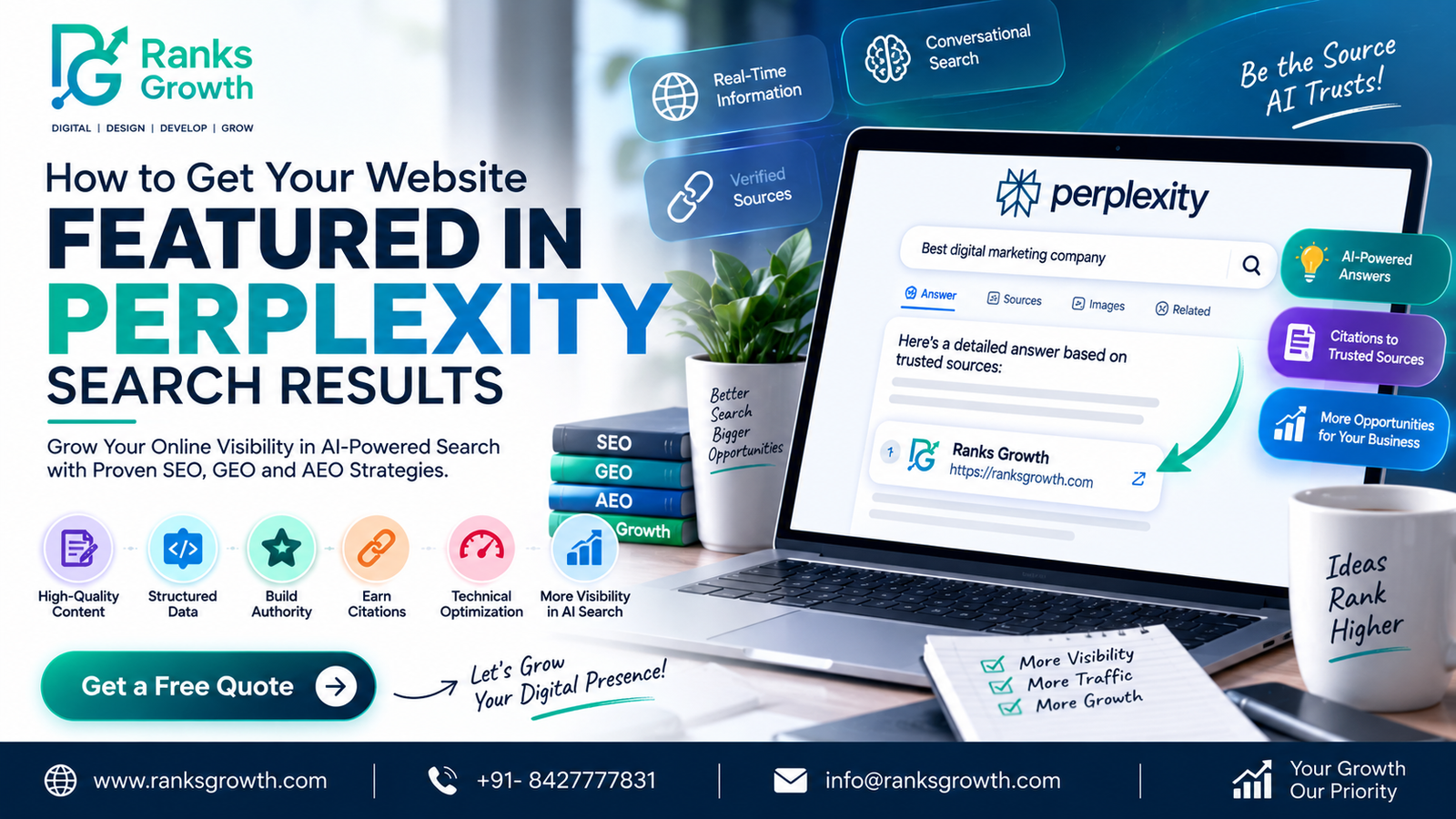
How to Get Your Website Featured in Perplexity Search Results
Overview: Why Perplexity Visibility Matters for Modern SEO
Perplexity AI disrupts how people find information online by integrating web search and AI that provides answers and shows source citations. Rather than merely providing a list of web results like other search engines, Perplexity’s technology researches information across the web, then provides a synthesized response and sources.
Because of this technology, there is a new business opportunity: making your business be one of the sources that AI search engines understand, discover, and cite when a user asks a question regarding your product, service, or industry.
Get a Free Quote
Want to improve your visibility across traditional search engines and AI-powered search platforms?
Contact Ranks Growth for a Free Quote and explore SEO services and online marketing solutions designed for modern search.

Introduction: Why Traditional SEO Alone Is Not Enough
While traditional SEO is critical, mastering AI search visibility requires careful consideration of how your content presents answers and your content’s credibility.
Ranking pages for keywords has been an important strategy for some time, but the search landscape is now more dynamic.
Search engines are evolving. Users no longer need to scroll through dozens of search engine results pages. Instead, users have the option to formulate a question in natural language and receive a single, concise answer. One example of this technology is Perplexity. It uses real-time search to synthesize and cite information to users.
Optimizing for keywords is not enough.
- Easy for search systems to discover
- Easy for AI systems to understand
- Directly useful to the reader
- Supported by credible information
- Structured around real search intent
- Strong enough to be considered a reliable source
This is the framework of modern SEO, AEO, and GEO.
What Is Perplexity AI and How Does It Search the Web?
Perplexity AI is an AI search and answer engine. They claim to give users answers in a natural language format. Perplexity also claims to use real-time web search, synthesize information, and provide sources.
The main steps in the process are as follows:
User question → Query understanding → Web retrieval → Source analysis → Answer synthesis → Citations
Unlike conventional search result pages, users will get answers that are formed from relevant information, with cited sources so users can check the answer or continue their research.
Perplexity evaluates sources and gives source labels, which include Government, Academic, or Trusted in certain contexts. Source evaluation looks at authorship, correction of mistakes, and if a site separates editorial content and advertising clearly.
The lesson here is that website owners just need to make sure their content is useful as a source, not if it is optimized as a web page.
How Perplexity Differs from Traditional Google Search
When users think of search, they think about finding pages. With Perplexity, we have found a great tool that can search and synthesize information to provide us with an answer, supported by sources.
When you Google something, you often get multiple answers that you need to compare. Instead of that, Perplexity goes and compiles answers from many sources, synthesizes the information, and provides it in a conversational answer.
This shifts the content optimization paradigm.
For example, for a query like “how does technical SEO improve website performance?” you can’t just write your article describing “technical SEO” numerous times.
It should quickly explain:
- What technical SEO is.
- What technical issues of a website matter.
- Why those issues are bad for search visibility.
- How businesses deal with those issues.
- What evidence or experience shows that those issues matter.
Clear answer-based content gives users and AI systems better, more defined, structured information.
Core Ranking Factors Perplexity Considers
Since Perplexity doesn’t publish a straightforward ‘how-to’ ranking formula that guarantees citation, in the absence of a ranking formula, businesses should consider what makes a source useful, credible, accessible, and relevant.
Content Clarity and Prompt Answers
Answer the main question promptly and clearly explain the answer.
Don’t make readers wade through a bunch of convoluted explanations. Start each main idea/section with a brief explanation of the main idea/section, then fill in the details, description, example, and context.
E-E-A-T, Authorship, and Credibility
Experience, expertise, authoritativeness, and trustworthiness strengthen the credibility of content.
Where relevant, name the author, explain how you have the relevant experience, provide accurate contact information for the business, and back your claims with reliable sources.
Fresh and Factual Content
Relevant and recently published content is more valuable when new facts and data can change answers to questions about regulations, statistics, products and industry news.
Rather than abandoning and letting the page become old and stale, review and update older articles and pages.
Structured Data and Clear Page Organization
Schema in combination with structured markup and design helps search engines interpret the elements of the page.
Schema should represent visible page information and design elements. Use relevant schema such as Article, Organization, etc.
Technical Website Health
Technically optimal pages provide better opportunities for search engines to index the page’s content.
Here are some elements to look at:
- Crawlability and indexability
- Page speed
- Mobile usability
- Broken links
- JavaScript rendering
- Canonicalization
- XML sitemaps
- Secure HTTPS implementation
Brand Mentions and Third-Party Citations
Trust can be built when a brand is cited by other sources. This demonstrates that a brand and its expertise do not reside on their website.
This can be achieved through citations or mentions of a brand by reputable directories, industry publications, professional organizations and memberships, coverage of the brand, interviews, research, or accepted guest contributions.
Step-by-Step: How to Optimize Your Website for Perplexity
The best method is to ensure every single page is simple to interpret, verify, discover, and reference.
-
Write Direct-Answer Content
The mostSkip important page answered. Opthy page address by Clear responses. For example:
What is technical SEO? Technical SEO encompasses the technical aspects of a website to improve its crawlability and indexability by search engines.
Then give examples, steps, benefits, and backup data.
-
Use Structured Headings, FAQs, and Schema
Use H2 and H3, where appropriate, to break down content.
Consider using H2 sections that mirror questions.
Include a structured FAQ.
Also, add schema if it corresponds to the page.
-
Build Topical Authority
Write connected articles rather than unrelated articles and publish content around a single central idea or subject.
Contextual connections can be made through an SEJ hub page to technical SEO, content optimization, external links, local SEO, AI SEO, GEO, AEO, and more.
This establishes a clear connection to related topics.
-
Earn Credible Third-Party Mentions
Generate authority with digital PR, expert positions, industry write-ups, partnerships, and useful case studies.
The goal is not amassing random backlinks. Relevance is the goal. If your brand or your expertise is relevant, you will get those references.
-
Make Claims Verifiable
Think of reasons you shouldn’t publish. Publish anyway, but this time, do it with evidence.
Use published studies, official records, truthful data, industry reports, original research, and documented case studies when necessary.
This is imperative when you talk about stats, rules, medically related info, finances, technology, silicon-based stuff, etc.
-
Maintain a Fast, Mobile-Friendly Website
Clunky websites bury good content.
Optimize your web pages and content for mobile users. Evaluate site performance and your site’s overall functionality on a frequent basis. Regularly investigate broken links, and review site crawls and internal linking.
-
Publish and Refresh Content
AI and search trends are best used for ongoing evaluations as opposed to one-time access and optimization.
Maintain the visibility of your site for important pages. Update your site when you notice changes in facts, technology, services, regulations, or practices in an industry.
Why GEO and AEO Matter for Perplexity Visibility
GEO and AEO develop content under search and AI frameworks.
Generative Engine Optimization modifies how Search Engines understand and represent your Brand and its content within generative Search environments.
Answer Engine Optimization concentrates on summarizing user questions and providing responses.
For Perplexity, these methods, under the umbrella of SEO, encourage businesses to:
- Answer questions directly
- Demonstrate expertise
- Structure information clearly
- Strengthen topical authority
- Use trustworthy sources
- Improve technical accessibility
- Build broader brand credibility
GEO and AEO services can be one aspect of an overall AI search strategy for a business.
How an SEO Services Company Can Help You Get Featured
In contrast to treating AI visibility as a single, separate element, an experienced SEO services firm would integrate technical SEO, content strategy, GEO, and AEO services to strengthen Trust, Credibility, and Authority.
For clients in the USA, Europe, Canada, and Australia, this integrated approach facilitates the alignment of Web page content to the various search intents and competitors.
Ranks Growth provides marketing services for SEO, AI SEO, AEO, GEO, digital marketing, Web design, and Web development. It has a unique approach to SEO that focuses on technical Web site improvements, Keyword research, and analysis of search intent.
The relevant services include:
- SEO Services
- AI SEO
- Website Design Services
The main advantage of this approach is that the same improvements can enhance traditional search, enhance AI Search visibility, improve user experience, and increase Conversions.
Contact Ranks Growth Today
Being cited by an AI search platform is not a shortcut, so don’t consider it so. It should be the result of consistently building a credible, useful, and accessible website.
Should your business aim to enhance its traditional search and new AI search market territories, the starting point can be organized approaches to SEO, GEO, and AEO.
Get in touch with us at Contact Ranks Growth today for a chance to discuss how we can help prepare your website for the next generation of search. We have free consultations and quotes.

FAQs
1. What is Perplexity AI?
Perplexity AI is an AI-powered search and answer engine that searches the web and generates conversational responses supported by source citations. It is designed to help users find and understand information without manually reviewing every search result.
2. How is Perplexity different from Google?
Google traditionally presents search results that users can open and compare, while Perplexity searches the web and synthesizes information into a direct conversational answer with citations. The two platforms have different search experiences, although traditional SEO remains relevant to overall online visibility.
3. Can SEO improve Perplexity visibility?
Yes, strong SEO fundamentals can support Perplexity visibility by making content discoverable, accessible, relevant, and well structured. However, SEO does not guarantee that Perplexity will cite a specific page. Content quality, relevance, credibility, freshness, and source selection also matter.
4. What is GEO?
GEO, or Generative Engine Optimization, is the practice of optimizing digital content and brand information for AI-powered search and generative answer experiences. GEO focuses on making information clear, credible, contextually relevant, and easier for AI systems to understand and reference.
5. How long does it take to get cited by Perplexity?
There is no guaranteed timeframe for earning a Perplexity citation. Visibility can depend on factors such as content relevance, technical accessibility, authority, freshness, competition, and the specific question being searched. Consistent publishing and ongoing optimization are more sustainable than expecting an immediate citation.
6. Do backlinks matter for Perplexity ranking?
Backlinks can contribute to a website’s broader authority and discoverability, but there is no public Perplexity formula stating that a particular number or type of backlinks guarantees citations. Focus on earning relevant, credible mentions and links from websites that genuinely support your expertise.
7. How can I optimize my website for AI search?
Start with clear answers, descriptive headings, strong topical coverage, credible sources, accurate information, internal linking, appropriate structured data, technical SEO, mobile usability, and regular content updates. Combine these practices with GEO and AEO to build a broader AI-search optimization strategy.