
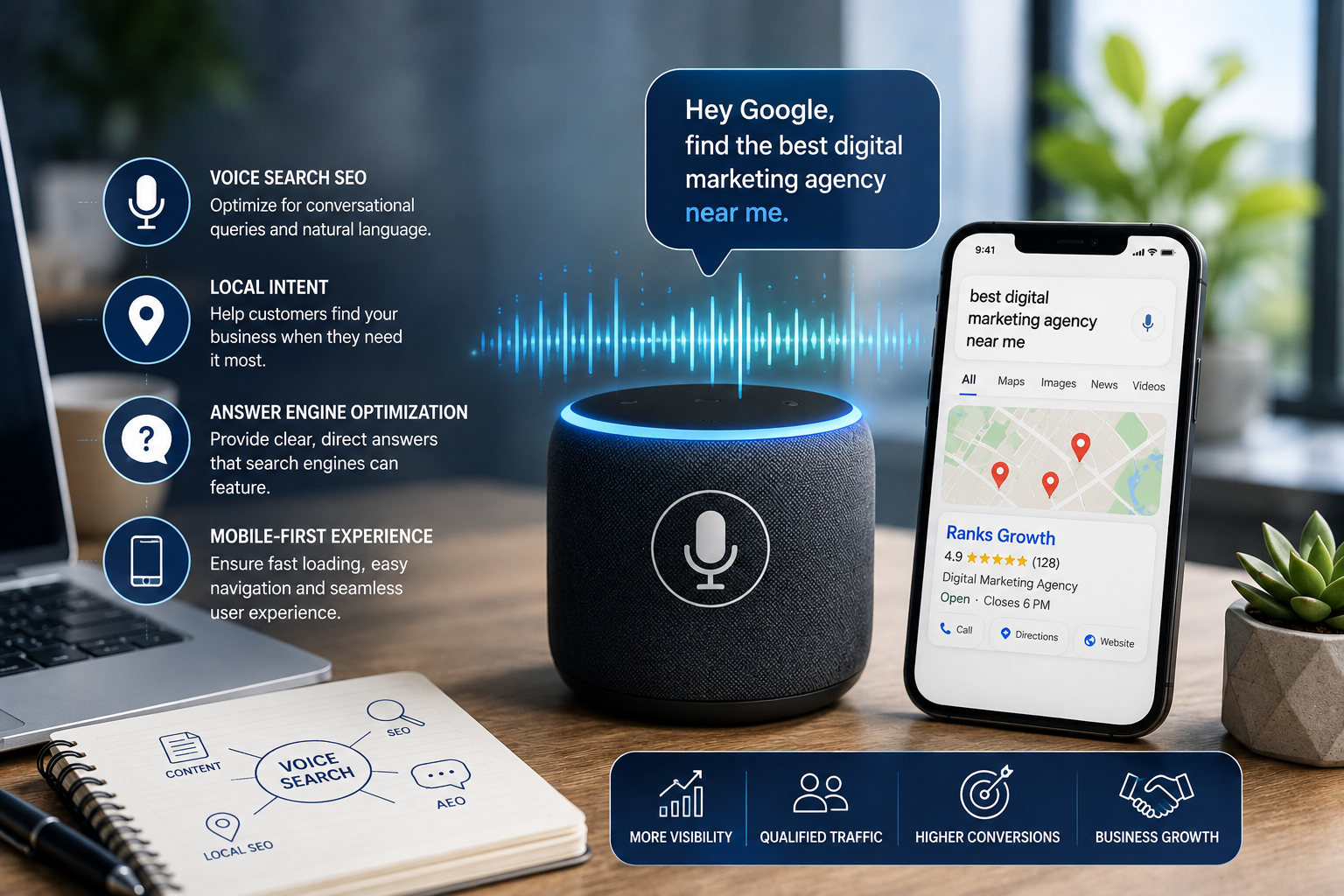
Voice Search Optimization: How to Make Your Business the Answer
“Near me,” “best,” “open now,” and “how do I…” used to be phrases typed only into search engines. Now those phrases are vocal searches made on smartphones, smart speakers, and other IoT devices. For businesses, this is an incredible opportunity. Voice search optimization enables your business to become the answer customers hear when they ask those queries verbally.
At Ranks Growth, we assist businesses to develop search tactics for adaptability and flexibility. Through our voice search optimization service, companies can enhance their opportunities for more visibility for queries that offer considerable buying intent such as local searches, questions, and even conversations.
What Is Voice Search Optimization?
Voice search optimization means making changes to your website and business to rank higher in searches made by voice assistants.
Voice search queries tend to be:
- More conversational
- Longer and usually more specific
- Question-based
- Meant to satisfy a need with immediacy
- Oftentimes will include local intent
For example, someone may search “Italian restaurant Chicago,” while others may search for “What’s the best Italian restaurant near me that’s open tonight?”
Answering these search queries will directly influence your rankings and profits. Effective Voice search SEO is hinged on direct answers to the natural language questions.
Why Voice Search Matters for Businesses
People expect quick results when they speak their searches. Instead of long lists of search result pages for users to go through, devices should be programmed to give one of the most relevant result(s) to the search query.
This is important for businesses as it has the potential to appear before their competitors.
Some actions that can be completed through voice search include:
- Finding Local Businesses
- Checking Operating Hours
- Getting Directions
- Comparing Prices of Products/Services
- Getting Contact Information
- Researching Answers to Questions
- Making a Purchase
- Booking an Appointment
- Getting Answers to Commonly Asked Questions
Optimizing website content to align with the behaviors associated with voice search can yield results and lead to opportunities that are highly valuable to the business.
1. Target Conversational, Question-Based Keywords
Voice searches place more focus on the intent of the question instead of the keywords.
Answer the kinds of questions your users ask. Think about how you would phrase those questions to a phone or voice assistant. Some examples include the following:
- How much does a roof repair cost?
- Who are emergency plumbers near me?
- What is the best accounting software for small businesses?
- How long does professional carpet cleaning take?
- Who offers digital marketing services near me?
It is best to create content that answers the questions directly. Great places to host this content include an FAQ section and a blog, but you can even create service pages.
2. Optimise for Local Search Intent
Locally relevant search plays an essential role in voice search. Mobile devices are used to search for local businesses, products, services and places.
Mobile voice search SEO and local SEO complement one another.
All your local business data must be the same on your site and crucial local web directories. This includes your business name, address, phone number, opening hours, service areas and all other relevant data.
Your site also needs location targeted content. A service business, for example, could publish pages that address customer needs in the places served by the business.
Optimizing for expressions like “near me,” “open now,” and “nearby” should not involve sticking these terms everywhere on your site. What you can do instead is develop local SEO and maintain local service directory information for local search.
3. Make Your Website Easy to Understand
Search engines will understand what your business is, where it is, and the answers to the questions your content provides.
A good site structure will help.
Your site can be organized around core categories of:
- Services
- Products
- Locations
- FAQ
- About the company
- Contact
- Help Section
Use clear answers and headings on your relevant pages and keep them concise and informative. Avoid hiding important information behind tedious navigation.
The aim is to make your content informative and easy for users and search engines.
4. Use Structured Data and Entity Optimisation
Voice search is closely related to how search engines engage with entities, that is, businesses, people, products, services, locations, and organizations.
When appropriate, relevant structured data should be added to assist search engines with understanding the core aspects of a business, in the absence of which it might be organization, local business, products, services, reviews, events or FAQs.
At this stage, Answer Engine Optimization (AEO) is useful.
AEO seeks to give answers to common asked questions in a precise manner. As opposed to focusing on keywords, you assist search systems to understand the contextual question, the proper answer, and the overall meaning.
5. Improve Page Speed and Mobile Experience
As most voice searches happen on the go, search speed and provided mobile experience improve usability. Poor site performance after a customer discovery of your business can be frustrating.
Your mobile website should:
- Have fast load times.
- Be easy to navigate.
- Use larger readable text.
- Clearly show contact options.
- Have simple forms.
- Avoid intrusive elements.
- Put important information front and center.
Mobile optimization is about more than just rankings. It’s about turning the visitor that comes from a search into a lead or a customer.
6. Create Content That Gives Direct Answers
One of the best ways to design for voice search is to provide direct answers.
Consider creating FAQ sections within your content, with answers to questions your customers have, and problems they experience.
To do this, you can use the following template:
Question: How long does professional website development take?
Answer: The time it takes to develop a website really depends. If it is a possibly a small business site, this could take a several weeks or less. For a larger site, and especially for a custom E-Commerce site, this would most likely take much longer.
This template provides extra information in a concise format.
How Ranks Growth Can Help
You don’t need to develop voice search SEO in a silo. The best approach is to integrate voice search into a broader digital strategy that involves technical SEO, content optimization, local SEO, AEO, and UX.
Ranks Growth takes a broad approach to voice search optimization, helping businesses find conversational search opportunities and strengthen the signals that can help them be visible across modern search environments.
Our voice search optimization service includes:
- Keyword research in a question-answering context
- Formulation of content strategies centered around questions
- Local SEO
- Optimization of mobile search
- On-page optimization
- FAQ and answer focused content
- Structured data recommendations
- AEO and entity optimization
- Technical SEO audit
- Monitoring and analyzing performance and visibility
Our goal is not to rank for more keywords, but rather to present our clients as helpful and trustworthy answers for our users when they are looking for information.
Turn Voice Searches Into Business Opportunities
People search for information and so do businesses. These means of searching are gradually shifting to verbal commands. Businesses must have search content developed to meet the needs of their customers’ verbal search commands.
The ideal positioning for this shift is characterized by businesses that provide clear answers, have accurate local information, have topical relevance, optimize for mobile users, and let search engines easily understand their business and services.
Voice search optimization, especially, can serve businesses focused on local search, lead generation, and visibility within the varied search ecosystem in general.
To help your business become the answer, look into our voice search optimization services from Ranks Growth. We can help you with your business through voice search SEO, local optimization, AEO, and other services geared for the changing search ecosystem.
Do you want to be the answer to voice searches? Discover Ranks Growth voice search optimization and learn how with the right combination of voice search SEO, mobile optimization, AEO local search tactics, and improved mobile usability you can improve your search engine ranking now.
FAQs
1. What is voice search optimization?
Voice search optimization is the process of improving your website and online presence so your business can appear for conversational, question-based searches made through smartphones, smart speakers, and voice assistants.
2. Why is voice search optimization important for businesses?
It helps businesses reach customers who use voice commands to find products, services, answers, and local businesses. Optimising for conversational queries can improve visibility and help attract high-intent searchers.
3. How does voice search SEO differ from traditional SEO?
Voice search SEO focuses more heavily on natural language, longer conversational queries, questions, local search intent, mobile usability, and concise answers. Traditional SEO still provides the foundation, but voice optimisation adapts it to how people speak rather than simply how they type.
4. How can businesses optimise their websites for voice search?
Businesses can optimise for voice search by creating question-based content, improving local SEO, maintaining accurate business information, using relevant structured data, optimising website speed and mobile usability, and providing clear, direct answers to common customer questions.
5. Can voice search optimization services help improve local visibility?
Yes. Effective voice search optimization services can incorporate local SEO strategies that help businesses target searches involving phrases such as “near me,” “open now,” and location-specific questions. This can make it easier for potential customers to discover relevant businesses when they are ready to take action.