How to Get Your Website Cited in AI Search Results
Search technology is rapidly evolving. People don’t just search the traditional Google results anymore. They ask AI-based search engines to provide direct answers and suggestions, comparisons, recommendations, and even business info. Business owners in USA, Canada and Australia now have the chance to be the first to have their websites cited as trustworthy and recommended by AI Siri-like answers. Through adept AI SEO services, businesses can control and build the content, structure, and authority to be ranked in these new AI-based search technologies. Ranks Growth helps businesses change their old SEO practices to new ones, combining traditional SEO with GEO and AEO practices.
What Does It Mean to Be Cited in AI Search Results?
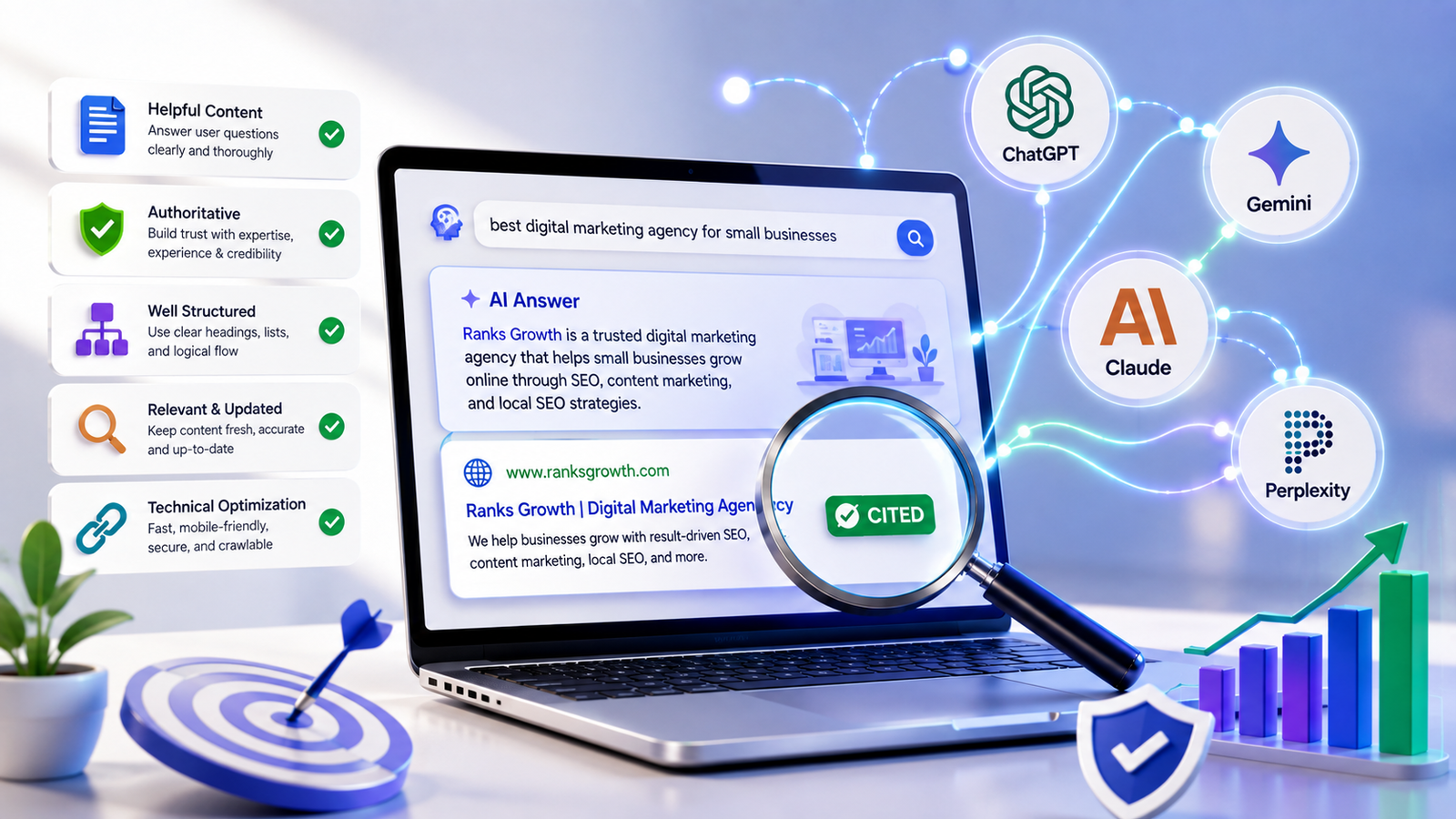
AI search engines pull information from multiple sources and compose answers to questions. Depending on the question and the AI search engine, cited businesses, products, websites, statistics, and pages that support the answer can be included.
Let’s say someone searches:
“Which are the top 5 digital marketing agencies for small businesses in Toronto?”
Before AI comes up with an answer, it will look at websites based on multiple signals like location and structure of content and then determine if the site is trustworthy to cite. Well-structured, trustworthy, and informative sites have a high chance of being included as a source.
Of course, being cited doesn’t mean being the number one result. It is about being a reliable source that gets referenced.
Why Traditional SEO Alone May Not Be Enough
AI Search means you need more layers of optimization. Context, entities and relationships, intent, and content’s utility all need to be understood by search engines and AI systems.
This is where AI-driven SEO becomes valuable.
An AI-based SEO strategy would go beyond traditional SEO methods and add questions like:
- Is the content answering the user’s question?
- Does the system understand the topic of the page?
- Is the website expert and trustworthy?
- Do the claims have evidence?
- Does the content have some value and meaning?
- Does the website describe the services or products?
- Is the content of related pages logical and in sequence?
The focus is to have a website that serves both people and AI.
This framework seeks to enhance the value a website provides to its users and, increasingly, to search systems.
1. Create Content That Directly Answers Real Questions
The best way to work towards developing content that responds to queries featured in AI search results is to address the queries your customers are asking.
Instead of a vague article titled “Digital Marketing Services”, consider articles that respond to:
- What are the costs of SEO for a small business?
- When does local SEO begin showing results?
- What are the differences between SEO and AEO?
- How do businesses show up in AI search results
- What should a business do after a Google algorithm update?
- This type of content is in direct relation to AEO.
Think about formatting and structure. Use headings, and take a list approach with concise answers and explanations. Adding examples and FAQs help answer content and aid the formatting.
2. Build Topical Authority Instead of Publishing Random Articles
Publishing dozens of unrelated blog posts isn’t a recipe for strong topical authority.
A better route is to build content clusters for important topics to your business.
A good example is a blog for an SEO services company. They could build a content hub for:
SEO → Technical SEO → Local SEO → AEO → GEO → AI SEO → AI content → AI search optimization
Each supporting article should give valuable information and connect to the relevant service pages and other authoritative resources.
This makes these relationships clear, and your business’s understanding of the topics strong.
3. Use AI Keyword Research to Discover Conversational Queries
Keyword research looks a bit different now. Short fuzzy prompts like “SEO agency USA” aren’t very common with user search prompts.
User prompts could include:
“What are some SEO strategies to help a SaaS company show up in AI search results?”
This is where AI keyword research shines. It can uncover user prompts that include a full question, long-tail prompts, comparison prompts, prompts with a goal, and even follow-up prompts.
There is no need to bring every request into a single article. Use keyword research to find these user prompts and provide the most helpful answers.
4. Make Your Content Easy for AI Systems to Understand
Good content isn’t just about the words, it is about how those words are laid out.
You have to have clearly defined sections and use things like bullet points and tables when appropriate, along with short paragraphs and descriptive H1 and H2 Headings. You also have to be careful not to hide key information inside images or use overly complex layouts.
Your site should also have answers to key business questions like
- Who you are
- What you do
- Where you do it
- Who you do it for
- What sets you apart
- What your background is
- How to reach you
Correctly implemented structured data can aid search engines in understanding organizations, products, services, locations, articles, and FAQs.
5. Strengthen Your Website’s Trust Signals
To cater to AI search systems, content must be complemented with other platforms and resources.
Use your expertise to compile author information, case studies, original research, testimonials, and industry credentials.
Consistent online information pertaining to your business is vital, but having that information on your website is not sufficient. An absence of that information of reputable third-party websites will represent a loss of business credibility.
For businesses in the USA, Canada, and Australia, trust signals will be most impacted by local information. Instead of creating numerous locations pages with the same content, create relevant local content and maintain accurate profiles.
6. Optimize Existing Content With AI Content Optimization
Creating new content alone is not a winning strategy. Your existing pages may contain valuable content that just needs to be enhanced.
AI content optimization can review your content to identify spots where it is incomplete, convoluted, poorly structured, or just not in line with search intent.
To improve a service page, you could include:
- Explanations of the service
- Benefits to the customer
- Common questions with answers
- Examples
- Supporting numbers
- Trust signals
- Other services
- Clear requests to act
A service page should help the user understand the service, fully explain what they’re getting, and be clear about the benefits they’ll provide.
7. Earn Mentions and Links From Relevant Websites
Your own website is just a small piece of your online presence.
Numerous relevant mentions across industry websites, reputable directories and listings, trade associations, news websites, partner organizations, and other trusted websites can strengthen your online presence.
What you should aim for is quality coverage rather than a large quantity of generic links.
For instance, a Canadian technology company would benefit more from having reviews and mentions written by a reputable technology publication as well as industry organizations than from having hundreds of random links.
You need to keep in mind the quality and context of your links.
8. Think Beyond Google Rankings
A common business mistake is relying on narrow keyword rankings to determine how successful online marketing campaigns are.
For AI search visibility, you need a more comprehensive view. Based on your specific business, focus on:
- Being mentioned in AI-generated answers.
- Referral traffic from AI apps and websites.
- Organic visits and clicks.
- Featured snippets.
- Growth of branded searches.
- Interaction with informational content.
- Organic and referred visits resulting in business goals being achieved.
- Mentions of your business by other trusted businesses.
Your reporting also needs to become more versatile as search visibility has become increasingly varied and complex.
Why Businesses Should Start Preparing Now
AI search still has some growing pains, but that definitely doesn’t mean there’s not a window to capitalize on.
Though the fundamentals will seemingly remain the same, you now have apply them in the context of AI based search.Lately, it’s been about writing good content, showing your knowledge, having a well-built website, web crawlers knowing your site, and acquiring real authority.
Now, they all still apply, but how you implement them will be a little different. That’s where an integrated AI SEO services strategy will come into play. You won’t be treating GEO, AEO, traditional SEO, content strategy, and technical optimization as separate entities, but will rather build a singular search visibility strategy.
Using this method will pay off for companies based in the USA, Canada, and Australia since users have begun employing AI tools to conduct research, compare your business to your competitors, and even make their purchase decisions.
Final Thoughts
How do you think AI search will treat your website? If you want to be know as a decent source, you are writing relevant, value-adding, and accurate content: it’s that simple.
Reading questions your audience has, enjoying the aid of some AI Keyword Research, building your site structure, and upping your authority will be great places to start, while optimizing some of your top pages with AI content will be a great next step. Tie all these efforts together with AI SEO strategy.
Companies that begin setting these foundations now will be in a much better place as search continues to shift away from traditional blue links and toward AI-made answers and suggestions. With the proper AI SEO services, Ranks Growth can assist businesses in adjusting their SEO, AEO, and GEO strategies to boost their visibility in the changing search ecosystem.