How to Optimize for Google AI Mode and AI Overviews
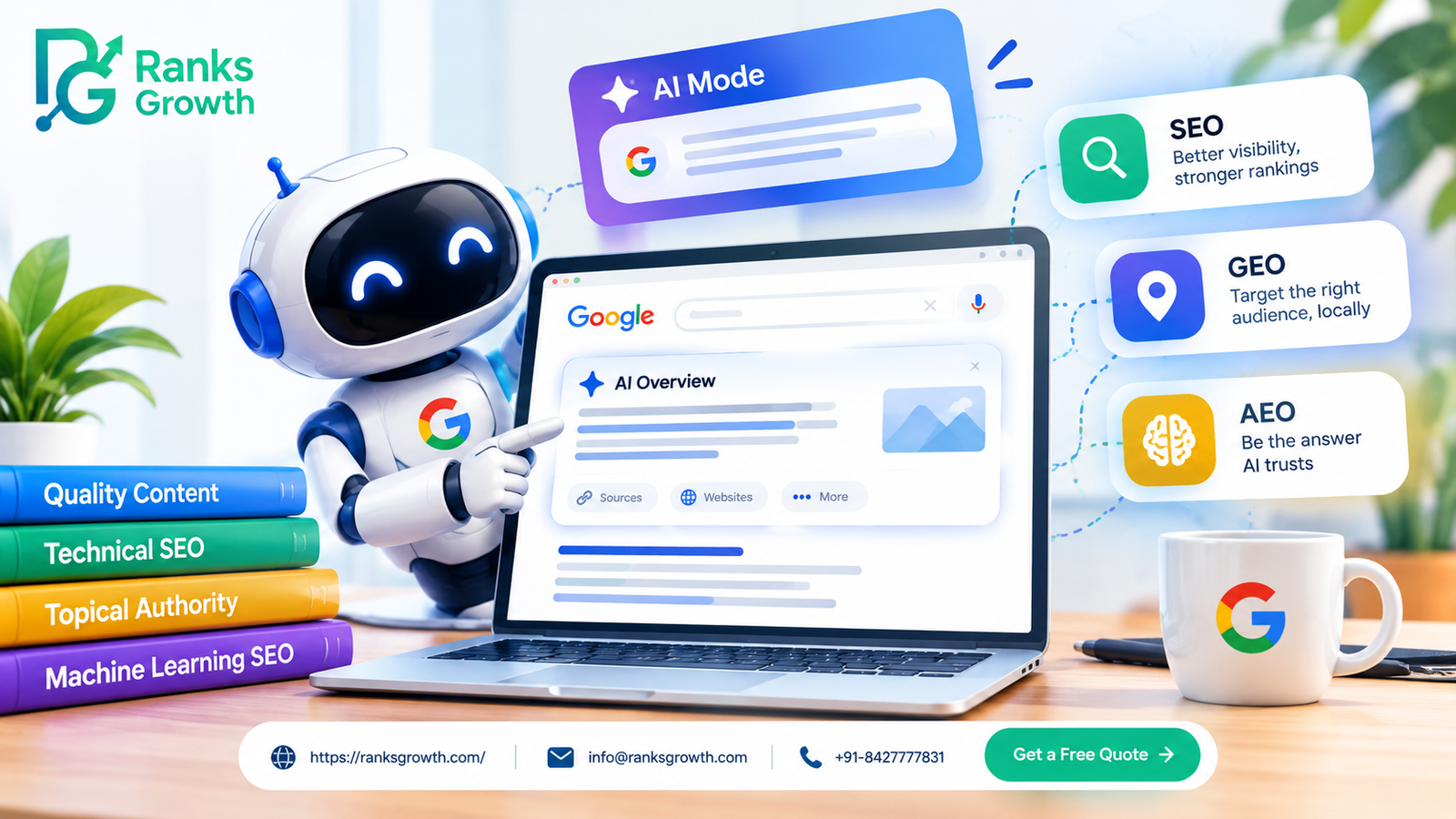
Google search is changing how people discover information, compare services, and make purchasing decisions. Instead of relying exclusively on traditional search results, users can now encounter AI-generated summaries that bring together information from multiple websites. For businesses, this creates a new opportunity: becoming a trusted source that Google’s AI systems can understand, reference, and recommend when relevant.
However, appearing in AI Overviews or AI Mode requires more than adding keywords to existing pages. Websites need helpful content, strong technical SEO, credible expertise, and answers that match what users actually want to know. A well-planned strategy can help businesses strengthen their visibility across both conventional search results and AI-powered experiences.
Get a Free Quote
Want to improve your website’s visibility across traditional and AI-powered search? Ranks Growth offers tailored AI SEO services to help businesses strengthen content quality, technical performance, topical authority, and search visibility.
Visit https://ranksgrowth.com/ to request a free quote and discover opportunities to improve your AI search performance.

Introduction
Google’s AI Overviews and AI Mode represent an important development in the search experience. AI Overviews provide AI-generated summaries for eligible searches, while AI Mode offers a more conversational experience that can help users explore complex questions and follow-up topics.
These features influence how users interact with search results. Someone researching a service may receive a summary before visiting individual websites, while another user may ask several related questions in an AI-powered conversation.
For businesses, the objective is not simply to rank for a particular keyword. It is to publish reliable, relevant information that search systems can discover and use when responding to appropriate queries.
The fundamentals of SEO remain essential. Crawlability, useful content, relevant internal links, and website performance still matter. The difference is that businesses must also consider how their information answers questions, demonstrates expertise, and fits into broader topics.
1. Create Content That Directly Answers Search Intent
One of the most effective ways to improve AI search visibility is to address the user’s question clearly and accurately.
Start by identifying what your audience wants to learn, compare, or accomplish. A business offering SEO services, for example, should answer questions about SEO costs, expected timelines, technical improvements, and the differences between traditional SEO and AI search optimization.
Organize your content around these needs.
- Use descriptive headings that reflect real customer questions.
- Provide concise answers near the beginning of relevant sections.
- Follow short explanations with detailed examples and practical guidance.
- Cover related questions without repeating the same information unnecessarily.
- Include relevant qualifications, limitations, and supporting evidence.
This approach supports Answer Engine Optimization (AEO) by making information easier to locate and interpret. It also improves the experience for readers who want quick answers before exploring a topic in greater depth.
2. Strengthen Traditional SEO Foundations
AI-powered search does not eliminate the need for conventional SEO. Search engines still need to discover, crawl, understand, and evaluate web content.
Check that important pages are accessible to search crawlers, return the correct HTTP status codes, and use appropriate canonical tags. Review your robots.txt file and page-level indexing directives to ensure valuable content is not accidentally blocked.
Additional priorities include:
- Improving mobile usability and page-loading performance.
- Using descriptive title tags and meta descriptions.
- Creating logical internal links between related pages.
- Fixing broken links, redirect chains, and duplicate-content issues.
- Submitting an accurate XML sitemap.
- Implementing relevant structured data where appropriate.
These improvements help establish a dependable technical foundation. Structured data can clarify specific details about a page, but it does not guarantee inclusion in AI Overviews or AI Mode.
3. Demonstrate Experience, Expertise, and Trust
AI search visibility depends partly on whether information can be understood and considered useful and reliable. Businesses should therefore make their expertise clear rather than publishing generic articles that simply repeat existing information.
Google’s quality guidance emphasizes experience, expertise, authoritativeness, and trustworthiness, commonly described as E-E-A-T.
To strengthen these signals, publish original insights, explain your methodology, identify qualified authors, and support factual claims with credible references. Case studies, customer examples, original research, and documented results can help demonstrate practical experience.
For example, an SEO agency could explain how resolving indexing issues improved a client’s search visibility, describe the steps taken, and distinguish observed results from expected outcomes.
Effective AI driven SEO focuses on creating content that deserves attention because it provides genuine value, not merely content designed to attract an algorithm.
4. Build Topic Clusters Instead of Isolated Pages
A single article rarely addresses every question a potential customer might have about a complex subject. Topic clusters help businesses build depth across related searches.
Start with a comprehensive pillar page, then create supporting articles covering narrower questions. Connect these pages through relevant internal links so readers can move naturally between related topics.
For example, a website focused on AI SEO could develop supporting content about:
- Optimizing content for Google AI Overviews.
- Understanding AI Mode and conversational search.
- Measuring AI search visibility.
- Improving content structure for answer engines.
- Building topical authority and trustworthy backlinks.
This is one of the most practical smart SEO strategies for establishing subject relevance. It also helps search engines understand the relationships between your pages and the broader expertise your website offers.
Every page should contribute distinct information rather than repeating the same advice with slightly different keywords.
5. Use Clear Structure and Natural Language
AI systems need to interpret information accurately. Clear organization helps both automated systems and human readers understand the main point of each section.
Use descriptive H2 and H3 headings, short paragraphs, meaningful lists, and straightforward explanations. Define industry terminology when necessary and avoid unnecessary jargon.
Consider adding FAQs when they address genuine customer concerns. Include comparisons, step-by-step instructions, and examples where they make a topic easier to understand.
Do not sacrifice depth for brevity. A concise answer followed by a thorough explanation often serves readers better than either a one-line response or a long introduction that delays the useful information.
These practices can support AI visibility, although no particular content format guarantees selection in an AI-generated response.
6. Apply Geographic Optimization for Local Visibility
For businesses serving specific cities, regions, or countries, Geographic Optimization (GEO) is an important part of an AI search strategy.
AI-powered search experiences may consider location when answering queries involving nearby services, regional regulations, or local business options. Your website should therefore communicate clearly where your business operates and which audiences it serves.
Practical steps include:
- Create useful location pages for the areas you genuinely serve.
- Include locally relevant services, examples, and customer information.
- Maintain accurate business details across your website and Google Business Profile.
- Use consistent name, address, and phone information where applicable.
- Collect authentic customer reviews and respond professionally.
- Explain regional service availability, pricing factors, and requirements where relevant.
Avoid producing dozens of nearly identical location pages with only city names changed. Useful local information is more valuable than repetitive geographic keyword insertion.
7. Understand the Role of Machine Learning SEO
Machine learning SEO involves understanding how data-driven search systems interpret relevance, content quality, relationships, and user intent. Google uses multiple automated systems, but website owners do not need to reverse-engineer individual models to improve performance.
Instead, analyze real search data and use it to make better decisions.
Google Search Console can reveal queries, impressions, clicks, click-through rates, and average positions. Google Analytics can help identify how organic visitors engage with your website and whether they complete meaningful actions.
Use these insights to identify unanswered questions, declining pages, content gaps, and opportunities to improve existing resources. AI tools may assist with research and analysis, but human review remains essential for accuracy, originality, and strategic judgment.
The strongest approach combines reliable data with editorial expertise rather than relying on automated content production alone.
8. Measure AI Search Performance Beyond Rankings
Traditional rankings remain important, but they do not capture every aspect of visibility in AI-powered search experiences.
Track organic traffic, relevant search queries, conversions, engagement, and the performance of pages targeting important topics. Where reliable reporting or manual checks are available, monitor whether your brand is referenced or cited in relevant AI responses.
Remember that AI answers can vary by query, location, context, and time. A single observation does not establish consistent visibility.
Use a repeatable measurement process, document your findings, and connect improvements to business outcomes. This helps you evaluate whether your SEO strategy is attracting qualified visitors and generating leads, rather than focusing exclusively on appearances in search features.
Content Ranks Growth Today
At Ranks Growth, we believe sustainable search visibility begins with useful content, sound technical SEO, and a clear understanding of customer intent. Optimizing for Google AI Mode and AI Overviews builds on these fundamentals rather than replacing them.
Our approach combines AI SEO services, content optimization, technical improvements, topical authority development, AEO, and geographic targeting to help businesses strengthen their online presence.
The process starts with understanding your current website performance, identifying gaps in your content, and prioritizing improvements according to their potential business value. From there, we develop a strategy that supports discoverability, credibility, and meaningful user engagement.
No agency can guarantee placement in AI Overviews or AI Mode. However, investing in high-quality content and a technically sound website creates a stronger foundation for organic search performance and long-term growth.
Ready to improve your AI search visibility? Contact Ranks Growth for a tailored SEO strategy designed around your business goals.
FAQs
1. What is the difference between Google AI Mode and AI Overviews?
AI Overviews provide AI-generated summaries within eligible search results. AI Mode offers a more conversational search experience for exploring questions and follow-up topics.
2. How do I optimize my website for Google AI Overviews?
Publish accurate, helpful content that answers relevant questions, strengthen technical SEO, demonstrate expertise, use clear page structures, and build relevant internal links.
3. Do keywords still matter for AI search?
Yes. Keywords help identify search intent, but they should be supported by relevant topics, natural language, useful explanations, and comprehensive coverage of user needs.
4. Does Google require special schema markup for AI Overviews?
No specific schema type guarantees inclusion in AI Overviews. Use supported structured data when it accurately describes your content, and follow Google’s general search guidelines.
5. Can small businesses appear in Google AI Mode?
Yes. Small businesses can improve their chances of being discovered by publishing useful content, maintaining accurate local business information, demonstrating expertise, and addressing specific customer needs. Inclusion is never guaranteed.
6. How long does AI SEO take to show results?
There is no fixed timeline. Results depend on factors such as website authority, competition, technical health, content quality, and how quickly search systems process changes. Monitor performance over time and refine your strategy using reliable data.