How to Build a Content Strategy That Drives Organic Traffic
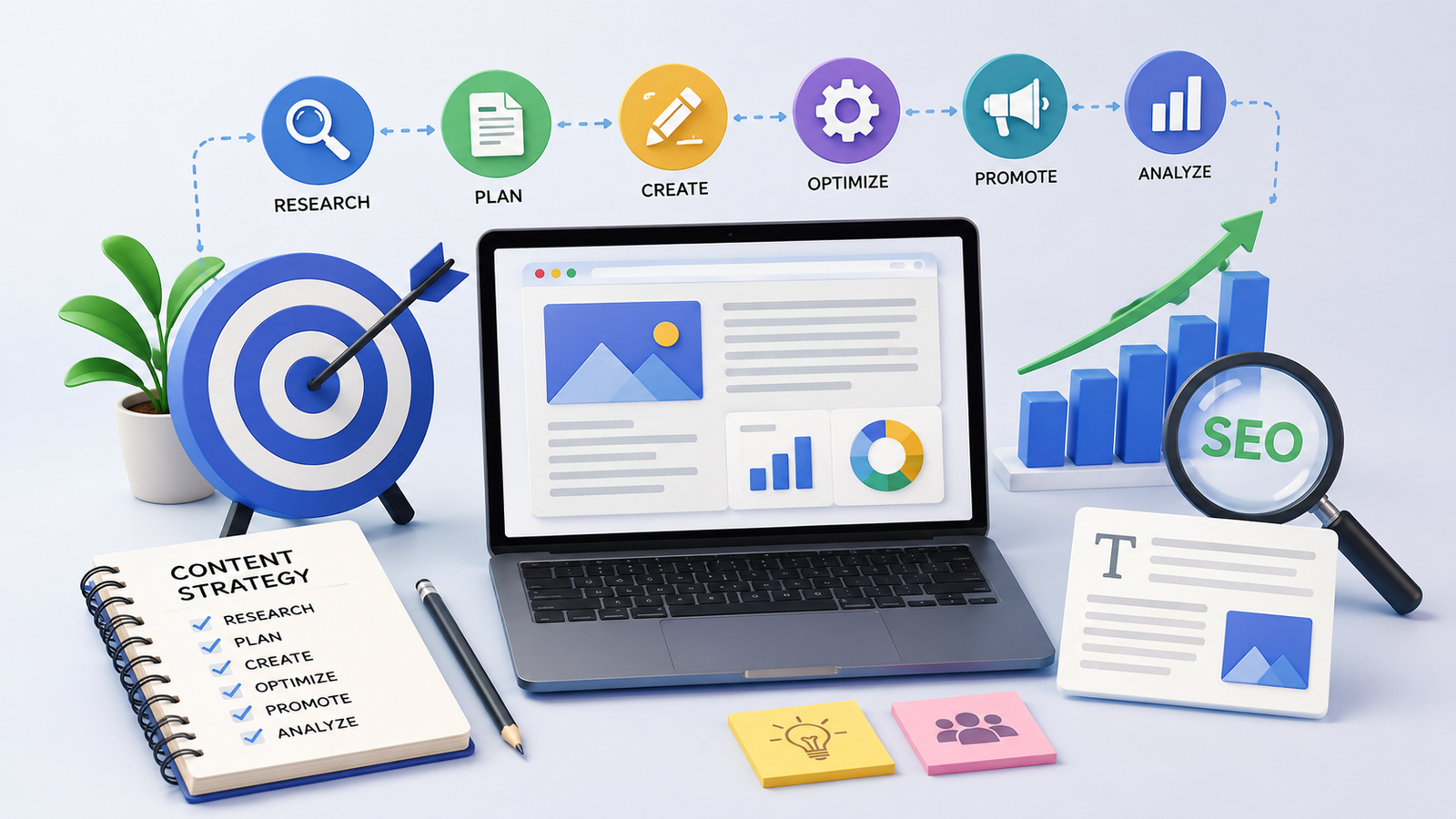
The days of aimlessly posting blogs to get traffic are over. Having a strategy to create content that generates organic traffic is essential for advertisers to acquire their target audience, rank on searches, and obtain leads without over-dependence of ads.
Here at Ranks Growth, we support companies in developing a long-term and sustainable SEO strategy by leveraging their content and combining it with technical SEO. Content strategy is vital for homeowners who are struggling to find reputable local businesses, as well as business owners who are trying to expand their business.
Why a Content Strategy Matters
A content strategy is a tool used to identify the audience, the content to be created, and the location of that content in order to meet the objectives of a business.
When content is created without a strategy, that content is often inconsistent and outdated. Additionally, that content never focuses on the topics that will drive traffic. But with a strategy, content will drive traffic and improve rankings and engagement.
The following are benefits of a content strategy:
- Enhanced Rankings on Searches
- Consistent Traffic to Website
- Greater Trust in the Brand
- Quality Leads
- Customer Trust
- Increased Conversion Rate
The most beneficial part of a content strategy is that it enables all the content on the website to boost the website’s authority.
Step 1: Understand Your Target Audience
Before you even start writing, make sure you get the demographics for who you will be writing for.
Consider the following:
- What questions are they trying to answer?
- What are their pre-purchase queries?
- What are they in search of?
- What are the decision-making factors for them?
For example, if your audience is homeowners, you can give them ideas on how to save money on home maintenance, or offer them ideas on how to hire the right home maintenance professionals.
If your audience is business owners, you can offer them ideas on how to grow their business using online tools or how to use digital marketing and SEO.
The more you understand your audience, the more you can create useful and engaging content.
Step 2: Perform Smart Keyword Research
Keyword research is the backbone of SEO. Avoid targeting only high-volume keywords. Consider the search intent.
Utilize a balanced combination of:
- Primary keywords
- Long-tail keywords
- Question-based keywords
- Local keywords
- Semantic keywords
Utilizing professional services in keyword optimization can be helpful in discovering keywords your competition may have missed and keywords that will be searched for your business.
Focus on intent-based keywords. This will get you found for keywords that are relevant.
Step 3: Build Topic Clusters Instead of Individual Blogs
Search engines are moving to favor topical authority
Instead of writing random articles, optimize writing around one concept that can be broken down into several articles.
Examples include:
Main Topic: Content Strategies
Supporting articles:
- How to research keywords
- SEO content planning
- Internal linking strategies
- Content audits
- Content refresh techniques
- Optimizing search with AI
- Content promotion methods
Search engines will easier understand your content and your expertise while showing your audience the best path to take.
Step 4: Create Helpful, SEO-Friendly Content
Publishing content does not automatically lead to better search engine rankings.
Publishing better content does lead to better rankings.
Focus on SEO friendly content writing that genuinely answers user questions instead of simply targeting keywords.
Real content does the following:
- solves real concerns
- is simple to read
- contains headings
- has short paragraphs
- includes examples
- provides advice that can be acted upon
- matches the intent of the search
Don’t write content with the sole goal of pleasing search engines. Strive for content that is helpful. Quality content is rewarded by search engines.
Step 5: Optimize Content for AI Search
AI is changing how content is searched for. A content strategy for the future of search engines should optimize for AI in addition to traditional SEO.
AI content optimization consists of the following:
- structure
- factual accuracy
- clarity
- logically supported
- easy to summarize
- headings
Adding FAQs, definitions, step-by-step instructions, and comparison tables improves the probability that AI will cite your content.
This method greatly enhances your content’s AI search visibility.
At Ranks Growth, we combine AI optimization and SEO standards for all organic content strategies so that our clients are always ahead of the competition.
Step 6: Focus on Content Optimization
Just because you publish content does not mean you can stop working on it.
Regular content optimization ensures older pages remain accurate, competitive, and valuable.
Regularly review the content you have published to:
- Add new insights
- Replace old or irrelevant statistics
- Refresh images
- Optimize internal links
- Improve content that is lacking
- Improve content readability
- Change the metadata
Google rewards high-quality content that is regularly reviewed.
Step 7: Build Internal Links Strategically
Internal linking helps your website visitors find related information. Internal linking helps search engines understand the layout of your website.
Each important page should link naturally to other relevant pages.
Examples of links include:
- Blog Posts → Service Pages
- Service Pages → Case Studies
- FAQs → Guides
- Pillar Pages → All Other Supporting Content
The right internal links will give authority to the pages you link to and keep your visitors active and engaged.
Step 8: Follow GEO and AEO Best Practices
The new SEO is beyond just ranking on Google.
Generative Engine Optimization (GEO) and Answer Engine Optimization (AEO) are new optimization techniques that make content rank on search engines that use AI to provide answers and on search engines that use voice search.
Some of the techniques are:
- Providing a direct answer to the question being asked
- Writing clear and descriptive headings
- Writing a brief summary
- Writing in an FAQ format
- Answering questions in a conversational tone
- Using proper formatting and being an expert on the subject
These practices may be beneficial for AI searches as well as traditional searches.
Step 9: Measure Performance and Improve Continuously
A successful content strategy evolves.
Some things to pay attention to are:
- Organic traffic
- Keyword positions
- Click-through rates
- Time spent on page
- Bounce rate
- Conversion rate
- Number of pages indexed
- Number of backlinks
Analytics helps you track which pages need improvement and which pages were the most successful.
At Ranks Growth, we focus on advanced analytics to modify every content strategy. Published content is meant to bring traffic, and we ensure businesses are improving long after we have published the content.
Common Mistakes to Avoid
Most businesses that fall short of their potential have one or more of these characteristics.
- Publish content without performing keyword research
- Don’t consider search intent
- Write content primarily for Search Engines
- Ignore older content
- Don’t use internal links
- Use duplicate content
- Are inconsistent with their content
- Don’t consider Search Engine Optimization (SEO) with Artificial Intelligence (AI)
If these SEO blunders can be mitigated, it sets the groundwork for long-term business success.
Why Professional SEO Support Makes a Difference
A Content Strategy that commands its place at the top of the Search Engine Results Pages (SERPs) demands advanced skills, plans, research, and professional knowledge of the most effective and latest Search Engine Optimization (SEO) tactics.
Professional SEO services include, but are not limited to, keyword research, technical SEO, content strategy, on-page SEO, link-building techniques, and performance metrics.
Professional SEO Services create content that is optimally placed, considering the most effective tactics, instead of relying on chance.
No matter if the business is local, service, or product-based, it is to the advantage of the business to partner with professionals in the field.
Conclusion
Getting organic traffic to your website is not about writing as much content as possible. It is about understanding your audience, writing quality content, doing keyword research, and using SEO practices to discover AI content.
At Ranks Growth, we offer solid planning and strategies using SEO content writing, advanced Keyword Optimization, and Comprehensive SEO Services, to help businesses establish authority, improve rankings, and acquire long-term organic traffic. The smart content strategy of today provides the foundation for stronger visibility, high-quality leads, and lasting online success.
FAQs
- What is a content strategy for organic traffic?
A content strategy for organic traffic is a structured plan for creating, publishing, and optimizing content that helps your website rank higher in search engines and attract visitors naturally without relying on paid advertising. It focuses on delivering valuable information that matches user search intent.
- How does SEO-friendly content help increase organic traffic?
SEO-friendly content improves your website’s visibility by using relevant keywords, answering user questions, maintaining a clear structure, and providing valuable information. This helps search engines understand your content and rank it for relevant searches, leading to more qualified organic visitors.
- Why is AI content discoverability important for SEO?
As AI-powered search experiences become more common, AI content discoverability helps your content appear in AI-generated answers, search summaries, and voice search results. Optimizing for AI search ensures your content remains visible alongside traditional search engine rankings.
- How often should I update my website content?
It’s recommended to review and update your important pages every 3–6 months. Refreshing outdated information, adding new insights, improving internal links, and optimizing content for current search trends can improve rankings and maintain strong organic traffic.
- Can Ranks Growth help build a content strategy for my business?
Yes. Ranks Growth offers comprehensive search engine optimization services, including content strategy development, keyword optimization services, SEO friendly content writing, content optimization SEO, and AI search optimization. The goal is to help businesses improve rankings, increase organic traffic, and generate qualified leads through a long-term SEO strategy.