
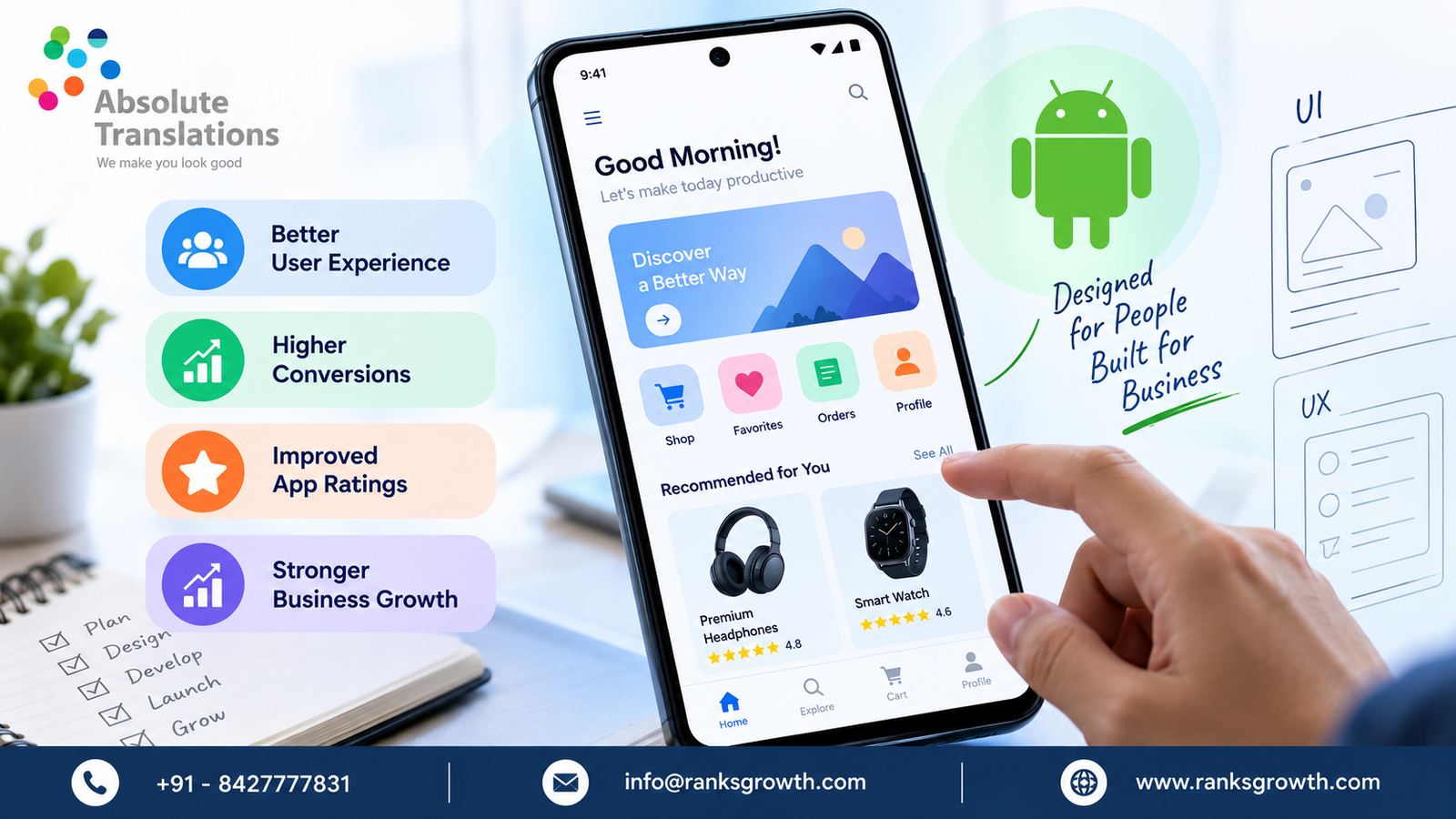
Why Is UI/UX Design Important for Android Apps?
Overview
UI/UX design plays a critical role in how users experience an Android app, from the first screen they see to the moment they complete an action. A well-designed interface can improve engagement, retention, conversions, ratings, and overall business ROI.
For businesses investing in Android app development, combining strong functionality with thoughtful Android app UI UX design is essential for creating an app that users want to keep using.
Get a Free Quote
Planning a new Android app or improving an existing one? Ranks Growth can help you create an intuitive, user-focused app experience aligned with your business goals.
Request a free consultation and get a tailored quote for your Android app project.

Introduction
Imagine downloading an app because it promises to solve a real problem, only to find confusing menus, slow interactions, tiny buttons, or a checkout process that feels unnecessarily complicated. Most users will not spend time figuring it out. They will simply close the app and look for another option.
This is why UI/UX design should not be treated as a cosmetic part of Android app development. It directly influences how easily people understand your app, how confidently they use it, and whether they return after their first visit.
For businesses, professional Android app development services should therefore include much more than coding features. The user journey, navigation, visual hierarchy, accessibility, performance perception, and conversion paths all need to work together.
What Does UI/UX Design Mean for Android Apps?
UI stands for User Interface, while UX means User Experience. Although the two disciplines are closely connected, they focus on different aspects of an app.
User Interface (UI)
UI design focuses on what users see and interact with, including:
- Buttons, icons, forms, and menus
- Typography and visual hierarchy
- Colors and spacing
- Screen layouts
- Images and interactive elements
- Consistent design patterns
A good UI makes an app visually clear and helps users understand what they can do next.
User Experience (UX)
UX design focuses on how the entire experience feels and functions. It considers questions such as:
- Can users complete important tasks quickly?
- Is navigation logical?
- Is information easy to find?
- Are there unnecessary steps?
- What happens when something goes wrong?
- Does the app meet the user’s expectations?
In simple terms, UI makes an app easier to see and interact with, while UX makes the overall journey easier and more useful.
Professional Android app development brings these elements together so design and functionality support each other rather than working independently.
Why Is UI/UX Design Important for Android Apps?
1. It Improves User Retention
Getting someone to install an app is only the beginning. The bigger challenge is convincing them to continue using it.
A confusing interface can create friction within seconds. On the other hand, a clean navigation structure and predictable interactions make users more comfortable exploring the app.
Effective UI/UX can help businesses:
- Reduce user frustration
- Make key features easier to discover
- Shorten task completion time
- Encourage repeat usage
- Build familiarity and trust
When an app feels effortless to use, users have fewer reasons to abandon it.
2. It Supports Higher Conversions
Whether the goal is making a purchase, submitting a form, booking a service, requesting information, or subscribing to a plan, UI/UX can influence whether users complete the desired action.
For example, a complicated checkout process may cause users to abandon their purchase. Simplifying the flow, presenting relevant information clearly, and reducing unnecessary fields can make the process more efficient.
This is where design becomes a business tool rather than simply a visual exercise.
3. It Can Influence App Store Performance
App store visibility depends on multiple factors, and UI/UX is not a standalone ranking guarantee. However, user experience can indirectly support app performance through engagement, retention, reviews, ratings, and user satisfaction.
When people consistently have positive experiences, they are more likely to continue using an app and leave favorable feedback.
That creates a stronger foundation for long-term app growth.
4. It Builds Trust in Your Brand
Users often form an opinion about a business based on the quality of its digital experiences.
An app that looks outdated, behaves inconsistently, or makes basic tasks difficult can make the business appear less reliable. A polished and intuitive experience, by contrast, can communicate professionalism and attention to detail.
Your app is not just a product. It is also an extension of your brand.
Common UI/UX Mistakes Businesses Make
Many app problems are not caused by a lack of features. They come from making the experience unnecessarily complicated.
Designing Around Features Instead of Users
Businesses sometimes start with a list of features and build screens around them without considering how customers will actually use the app.
A better approach is to start with user goals and journeys, then determine which features genuinely support those goals.
Overloading the Interface
Too many buttons, menus, pop-ups, or visual elements can overwhelm users. Good design prioritizes the most important actions instead of trying to display everything at once.
Ignoring Different Screen Sizes
Android devices come in many screen sizes and configurations. A layout that works well on one device may feel awkward on another if responsive behavior has not been properly considered.
Creating Inconsistent Navigation
If buttons, icons, menus, and navigation patterns behave differently across screens, users have to relearn the interface repeatedly.
Consistency reduces cognitive effort and makes an app easier to navigate.
Skipping Usability Testing
A design may look excellent to its creators but still confuse actual users. Testing with representative users can uncover problems that are difficult to identify internally.
How Professional Android App Development Services Solve These Problems
Professional Android app development services typically approach design and development as an interconnected process rather than separate stages.
A strong team can help businesses move through several important steps:
- Understand the business objective
Define what the app needs to accomplish and how success will be measured. - Research the target users
Identify customer needs, expectations, behaviors, and common pain points. - Map user journeys
Determine how users move from opening the app to completing important actions. - Create wireframes and prototypes
Test layouts and interactions before investing heavily in development. - Develop the visual design system
Establish consistent typography, spacing, components, icons, and interaction patterns. - Build and test the application
Combine the approved design with reliable Android development and functionality. - Analyze and improve
Use user feedback, analytics, reviews, and business metrics to identify opportunities for improvement.
Businesses looking for a dedicated team can explore Android app development services from Ranks Growth to see how development and UI/UX can be approached as part of one broader digital strategy.
UI/UX Design and Website Redesign: How Are They Connected?
For many businesses, the app is not the only digital touchpoint customers use. They may discover the company through its website, interact with a mobile app, contact customer support, and eventually return to the website.
If each platform provides a completely different experience, the overall customer journey can feel fragmented.
This is why UI UX website redesign and Android app design can benefit from a coordinated approach. Businesses can establish consistent branding, messaging, navigation principles, and interaction patterns across their digital products.
For companies whose website also needs improvement, professional website redesign services can help align the website experience with the expectations created by the app.
The goal is not to make every platform identical. It is to make the overall brand experience feel connected and intentional.
The Real-World Business Benefits of Good UI/UX
Investing in UI/UX can deliver benefits that go well beyond visual appeal.
Better Engagement
When users can quickly understand an app and find useful features, they are more likely to explore and interact with it.
Better Ratings and Reviews
A smoother experience can contribute to greater user satisfaction, which may encourage more positive feedback and ratings.
Lower Abandonment
Removing unnecessary steps and reducing friction can help keep users moving through important journeys.
Higher ROI
An app that users actually adopt and continue using has greater potential to generate revenue, leads, subscriptions, or other measurable business outcomes.
Stronger Brand Perception
A consistent, modern, and intuitive digital experience can reinforce professionalism and make a business easier to trust.
Ultimately, the value of UI/UX comes from connecting design decisions with measurable business objectives.
Contact Ranks Growth Today
A successful Android app needs more than attractive screens. It needs a thoughtful experience that makes sense to users and supports the goals of the business.
Ranks Growth combines Android app development services, UI/UX thinking, and broader digital experience strategies to help businesses create more effective digital products. Whether you are launching a new app, improving an existing application, or considering a UI UX website redesign, the right strategy can turn design into a meaningful growth opportunity.
If your current app feels difficult to use, receives poor feedback, or fails to convert users effectively, it may be time to rethink the experience.
Contact Ranks Growth today to discuss your project and request a free consultation or quote.

FAQs
Why is UI/UX design important for Android apps?
UI/UX design is important because it determines how easily users understand, navigate, and interact with an Android app. Good design can improve usability, engagement, retention, conversions, satisfaction, and brand perception.
How does UI/UX affect Android app conversions?
UI/UX affects conversions by reducing friction during important user journeys. Clear navigation, simple forms, visible calls to action, and streamlined checkout or signup processes can make it easier for users to complete desired actions.
Can good UI/UX improve an app’s ratings?
Yes. While ratings depend on many factors, a smooth and intuitive user experience can improve satisfaction. Satisfied users may be more likely to leave positive reviews and continue using the application.
Should UI/UX be considered before Android app development?
Yes. UI/UX planning should begin early because user journeys, navigation, screen structures, and interaction patterns can influence development decisions. Identifying usability problems before development can also reduce costly changes later.
When should a business consider an app or website redesign?
A redesign may be appropriate when users struggle to navigate the product, engagement or conversions are declining, the interface feels outdated, branding has changed, or user feedback consistently identifies usability problems. An app redesign and UI UX website redesign can also be coordinated when a business wants a more consistent digital experience.