How to Find and Fix Website Issues That Hurt Google Rankings
Overview
Problems may exist with your website that your clients are not seeing. For example, important pages on your site may be blocked from being listed by search engines, issues with your site may prevent Google from understanding your content, or the pages on your site may not be relevant to the query potential clients are searching.
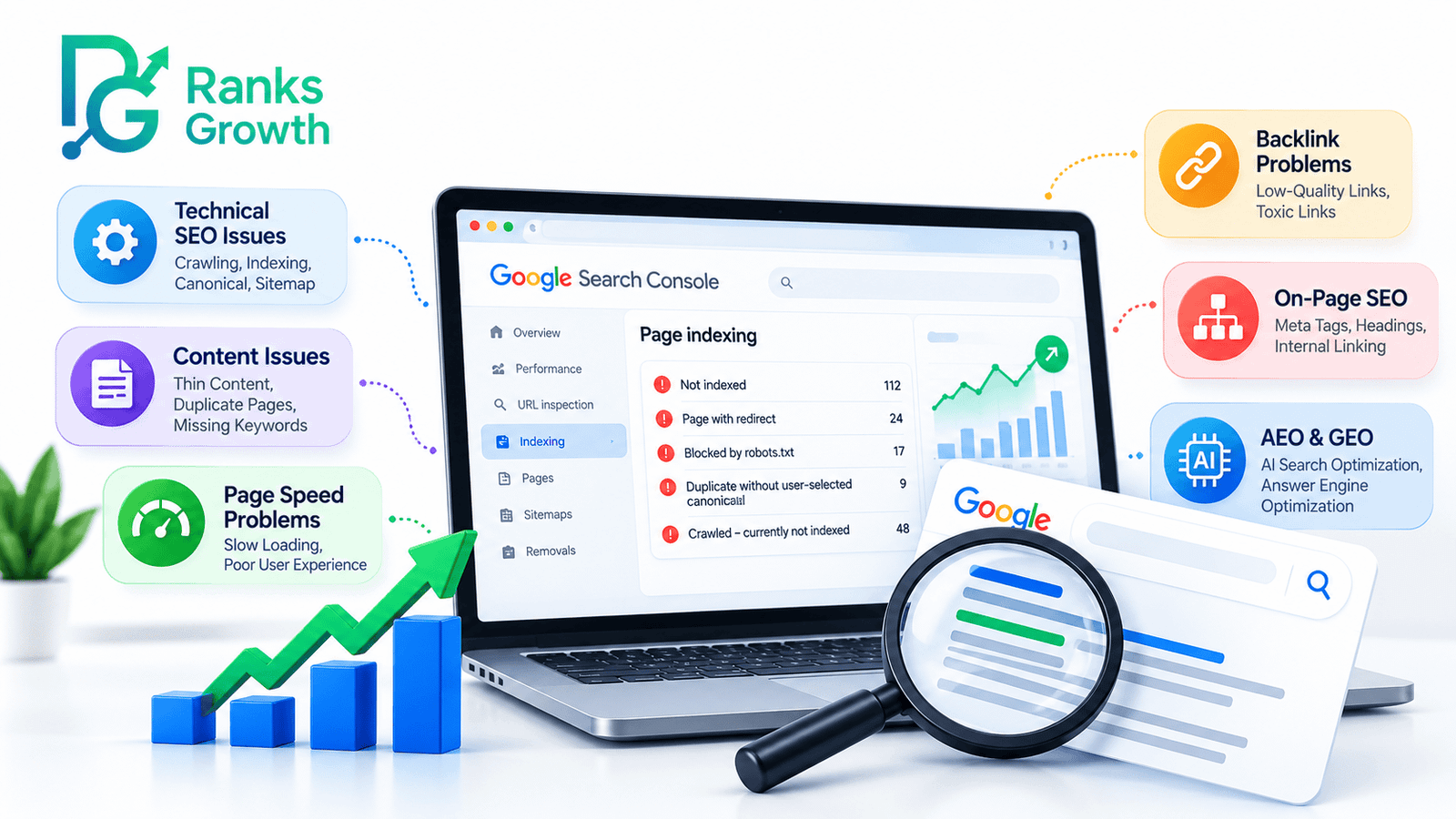
A professional website SEO analysis helps identify these problems before they continue costing your business valuable traffic and leads. Ranks Growth looks beyond basic keyword rankings to examine technical SEO, Google Search Console data, content quality, website performance, backlinks, AEO, GEO, and AI search visibility.
We determine the site issues that may be impacting your business and design solutions to improve your site and increase organic business opportunities.
Get a Free Quote
Not sure why your website is not ranking for important keywords?
Ranks Growth can analyze your website and identify technical, content, indexing, performance, and authority issues that may be limiting your search visibility.
Get a Free Quote today and discover what could be holding your website back.
Introduction
Organic search traffic is made up of visitors who come to a site via unpaid or earned results. This includes visitors who come from organic search engine results pages (SERP), direct traffic, or a bookmark.
With a drop in organic search traffic, the focus is usually on off-page or on-page optimization.
Sometimes this is the case. Often the issue lies in the site’s design, implementation, and/or configuration.
Because of a lack of time or resources, important site pages (i.e. service or landing pages) may not be search engine indexable. Website development and design cycles often create transitional and broken navigation. Often the XML sitemap is not cared for and includes thousands of URLs, many of which do not need to be indexed.
Because of a focus on the bottom line or time constraints, designers and developers may omit best practices for canonical URLs, and/or page content may address a keyword, but not the search query.
AI and other supporting technologies are often used to perform a comprehensive website search engine optimization analysis, but Ranks Growth focuses on search engine and search engine result page interaction to provide actionable recommendations.
Here are the most common issues and how to solve them.
Why Websites Lose Google Visibility
Sometimes it is difficult to identify the reason for a decline in search visibility. Most of the time, there are multiple related factors that contribute to the issue.
Let’s say there is a page on a website that contains useful information and content that is relevant to a user query. Furthermore, the page has relevant backlinks. However, the page has a ‘noindex’ directive.
The page will be of no use if the directive is in place.
On the other hand, a different site may have hundreds of pages that are relevant and useful to users, but the pages are of low quality and do not provide relevant information to the users.
This is why SEO should be approached as a system.
Technical accessibility + useful content + strong site structure + authority + search intent = a stronger foundation for organic visibility.
Google Search Console Errors You Should Check First
Google Search Console is a valuable resource to review various issues related to a website’s presence and performance in Google’s search results.
The “URLs which are not in Google” report shows a list of pages that Google has determined will not be indexed, along with the reasons for the exclusion. Google warns users of the report that ‘not indexed’ does not necessarily mean that there is an issue, as pages can be deliberately excluded if they are duplicates of other pages, contain a ‘noindex’ directive, or if the page is unavailable.
It is important to review common issues related to a website’s presence in search results. However, some issues do not always require an immediate review.
However, some issues deserve immediate investigation.
Crawled – Currently Not Indexed
A page has been crawled but not included in the Google index.
Don’t just keep asking for the page to be indexed. The reason the page has not been included may be that it is low quality, is duplicate or redundant, or is not properly linked to other pages.
Discovered – Currently Not Indexed
The Google index does not include a page about which Google is aware.
Google may not have crawled the page recently or at all. Check that the page is properly linked and that it is in your sitemap.
URL Marked “Noindex”
This status may occur on important pages. To check why this is the case, review the meta robots directive on the page.
If you find that a page has been inadvertently marked noindex, remove this from the page and, if appropriate, request that Google re-index the page.
Blocked by Robots.txt
Google will not crawl a page about which there is a directive in robots.txt.
Make sure that important pages are not in robots.txt by mistake.
Page With Redirect
The page that has been redirected is not the page that should be indexed. The important question is whether the final page that is reached after the redirects is appropriate.
Duplicate and Canonical Issues
Google identifies one of multiple equivalent pages as the canonical version. Google may choose a different canonical version than what a webmaster has defined.
Keep consistent signals regarding the primary version of a page by evaluating your canonical tags, sitemap, internal links, and page content.
Server Errors and 404 Issues
500 Server errors and 404 errors may prevent Google from accessing pages. 404 errors should be analyzed and addressed if they appear in internal page links, sitemaps, or if the page should be redirected.
The URL is presented in the URL Inspection Tool. You can also see what Google has indexed for that page.
Fix Technical SEO Problems
Search Console is only one part of a technical SEO investigation.
In addition to Search Console, the following areas must also be analyzed:
- XML Sitemap
- Robots.txt
- Canonical tags
- Redirects
- Broken links
- Mobile
- JS & CSS
- Structured data
- URLs
- Duplicate content
- Orphan pages
- Server response codes
- Other issues impacting site speed
Keep in mind what Google calls ‘The Long Tail’ – rather than focus on a few high traffic pages, address the many low traffic pages.
Improve On-Page SEO and Content
Address issues such as poor-quality, outdated, or irrelevant content.
Make sure each page serves a purpose and is easy to understand.
Ask:
- Does the page satisfy the user’s search intent?
- Is the main topic immediately obvious?
- Does the introduction answer the visitor’s need?
- Are headings logically organized?
- Are important questions answered?
- Does the page provide original value?
- Are relevant internal links included?
- Is the information current?
Before creating new content to target a keyword, research if the keyword has search intent and whether there is user demand.
Rather than creating multiple pages to target the same keyword, determine the purpose of each and create pages to serve user needs.
Fix Website Speed and Page Experience
There are many elements of technical SEO that go beyond crawling and indexing.
Fast loading times help your users and potential customers interact with your business. Consider all of the following as they relate to your site’s speed and performance: image optimization, server and software responses, scripts, Caching, CSS and JS, add-ons and extensions, and mobile and user experience performance.
Do this for your most valuable pages first.
A page with a long load time and a destination of an even more unrelated page creates a frustrating and poor user experience. So does a beautifully designed page with a long load time.
It’s better for your pages to load quickly and for your site to be stable and usable than to have pages score perfectly in Google’s Page Speed insights.
Strengthen Internal Linking and Site Architecture
Internal links allow users to navigate related content and assist search engines in discovering and understanding the structure of your website.
Internal links on a service page could go to content such as:
- Service pages
- Supporting content
- FAQs
- Case studies
- Contact and/or quote pages
Always think about why you are linking pages, and if there’s a reason, it’s probably alright to do so.
If page A is linking to page B, it likely means that Page B has something to do with the topic of Page A. This allows page B to also have some context around the topic of page A.
Review Your Backlink Profile
There are numerous factors that determine a backlink’s value, and quantity does not always increase a website’s overall value.
Look through your backlink profile and see if there are any links on sites that are:
- Relevant to your industry
- Edited or guest posted on
- Authoritative
- Irrelevant
- Using unnatural or excessive anchor text
- Part of a negative SEO campaign
- Paid or link directories
- Take into account your competitors’ backlinks.
The main goal of Ranks Growth is to build links that are relevant to your site and, therefore, valuable to your customers.
Use AEO to Capture More Direct Answers
So many people use search engines to ask questions. Some questions related to search engine optimization (SEO) include:
“What is the cost of technical SEO?”
“Why is my site not indexed by Google?”
“When will I see results from my SEO efforts?”
Replying directly to questions is one way of using Answer Engine Optimization (AEO).
Zero-click search SEO focuses on making information useful when searchers want an answer directly within the search experience rather than immediately clicking through to a website.
Being helpful to your target audience means providing detailed, well-organized responses to questions they have. Some of the formats you can use to respond to questions and be helpful to your audience include:
- Frequently Asked Questions (FAQs)
- Step-by-step guides
- Definitions
- Comparisons
- How-to responses
- Other responses may also include organized lists or charts.
Ultimately, your goal ought to be providing answers in a manner that is helpful to your audience and also answering search queries.
Build a Stronger GEO and AI Search Strategy
Traditional search engines are not the only search options available to the public.
For example, Google provides an AI performance report in Search Console. The report shows how pages on a site are performing with regard to various Generative AI functionalities. The report shows trends in Generative AI performance and shows pages that are performing poorly.
Also, site owners can use a setting in Google Search to control how their content is shown in Generative AI functionalities.
Thus, site owners can implement strategies to be visible to Generative AI search options.
Improve AI Content Discoverability
To improve AI content discoverability, start by improving how your website communicates about your company. The better your website is at communicating this information, the easier it will be for potential customers to gain an understanding of your company before they reach out to you.
To improve AI content discoverability, start by improving how your website communicates about your company. The better your website is at communicating this information, the easier it will be for potential customers to gain an understanding of your company before they reach out to you.
It is important to include information about:
Clearly communicate:
- What your company does
- Which services you provide
- Who you serve
- What problems you solve
- Where you operate
- What makes your offering different
- Answers to common customer questions
- Evidence supporting your expertise
To help you answer the questions that your potential customers may have and to help put relevant content on your website, you should use:
Strengthen AI Search Optimization
AI search optimization is not about exploiting loopholes to get an AI system to say your business’s name.
Here are the core elements of an optimal website:
Relevant content, Accessibility, Depth, Clarification, Credibility, and Trust.
Working on these elements improves the performance of your business site in the prevalent search modes as well as future advanced search modes.
Create an SEO Roadmap Instead of Fixing Problems Randomly
Once the audit is complete, the next challenge is deciding what to fix first.
This is where SEO roadmap planning becomes valuable.
Instead of presenting business owners with hundreds of technical warnings, organize the work according to impact.
Phase 1: Critical Technical Fixes
Resolve indexing blocks, server errors, broken redirects, major canonical problems, and important sitemap issues.
Phase 2: Website Experience
Improve speed, mobile usability, navigation, and conversion barriers.
Phase 3: Content
Strengthen important service pages, remove unnecessary duplication, update outdated information, and fill genuine content gaps.
Phase 4: AEO and GEO
Create clear answers, improve topical coverage, and strengthen the website’s ability to communicate useful information across modern search environments.
Phase 5: Authority
Build relevant backlinks, strengthen digital authority, and develop useful partnerships and mentions.
Phase 6: Measurement
Monitor Search Console performance, indexing, organic traffic, conversions, and emerging AI search visibility.
Google’s standard Search Console Performance report can be used to monitor clicks, impressions, CTR, average position, queries, and pages in Google Search.
Contact Ranks Growth Today
Finding issues in SEO is easy. Determining the impact of those issues and implementing an appropriate solution is the hard part. That’s where we come in.
Ranks Growth provides SEO services to businesses in a number of areas, from technical SEO to content creation and optimization to performance improvement to backlink and internal linking, to name a few. Ranks Growth also offers services to help clients identify and capitalize on opportunities in the field of AEO (Alternative Equivalent Offerings) and GEO (Geographic) searches. Lastly, they assist their clients in developing strategies to provide the best AI content and search services.
An in-depth analysis of your website by the Ranks Growth team will help you identify where your website is failing to provide opportunities.
They can also create a detailed plan, outlining the most essential changes that need to be made to ensure your website provides the best opportunities and remains competitive.
In addition to the above mentioned services, they can provide exceptional customer service to help you address the above issues. Don’t let your competitors gain more visibility while you sit back and do nothing.
FAQs
1. What is a website SEO analysis?
A website SEO analysis is a detailed review of a website’s technical SEO, indexing, content, site structure, performance, internal links, backlinks, and search visibility. It helps identify issues that may be preventing important pages from performing effectively.
2. Are all Google Search Console “Not indexed” pages a problem?
No. Google specifically explains that a page can be excluded for a valid reason, such as being a duplicate, intentionally marked noindex, or removed from the website. The specific reason should be reviewed before deciding whether action is necessary.
3. What should I do if a page says “Crawled – currently not indexed”?
Review the page’s quality, uniqueness, search intent, internal links, canonical signals, and overall usefulness. Google says there is generally no need to repeatedly resubmit such URLs for crawling.
4. What is AEO?
Answer Engine Optimization, or AEO, focuses on structuring useful information so it can clearly answer users’ questions in search and answer-driven experiences. FAQs, direct answers, definitions, comparisons, and well-organized explanations are common AEO formats.
5. What is GEO?
Generative Engine Optimization, or GEO, focuses on improving how clearly and reliably a business’s information can be understood and surfaced within generative search experiences.
6. Does AI search mean traditional SEO is no longer important?
No. Google’s current documentation continues to emphasize existing search fundamentals. Technical accessibility, useful content, clear structure, and overall search quality remain important as search experiences evolve. Google’s generative-AI reporting also now gives site owners more visibility into performance in AI Overviews and AI Mode.
7. How can I improve AI content discoverability?
Start with strong SEO fundamentals. Make important pages crawlable, provide original and useful information, organize content logically, answer relevant customer questions, use clear internal links, and make your business and services easy to understand.
8. Can backlinks fix a website with technical SEO problems?
Backlinks cannot compensate for fundamental technical problems such as important pages being blocked from crawling or accidentally marked noindex. Technical accessibility, content quality, site architecture, and authority should work together.
9. How often should a business perform an SEO audit?
A comprehensive audit is particularly valuable after a website redesign, migration, major technical change, significant traffic decline, or indexing problem. Ongoing monitoring should then be used to identify new issues as the website develops.
10. Can Ranks Growth help with Google Search Console, AEO, and GEO?
Yes. Ranks Growth can combine technical SEO, Google Search Console analysis, content optimization, backlink strategy, AEO, GEO, and AI search optimization into a unified SEO strategy designed around your website and business objectives.