Do You Need an App or a Website? How to Decide
Overview
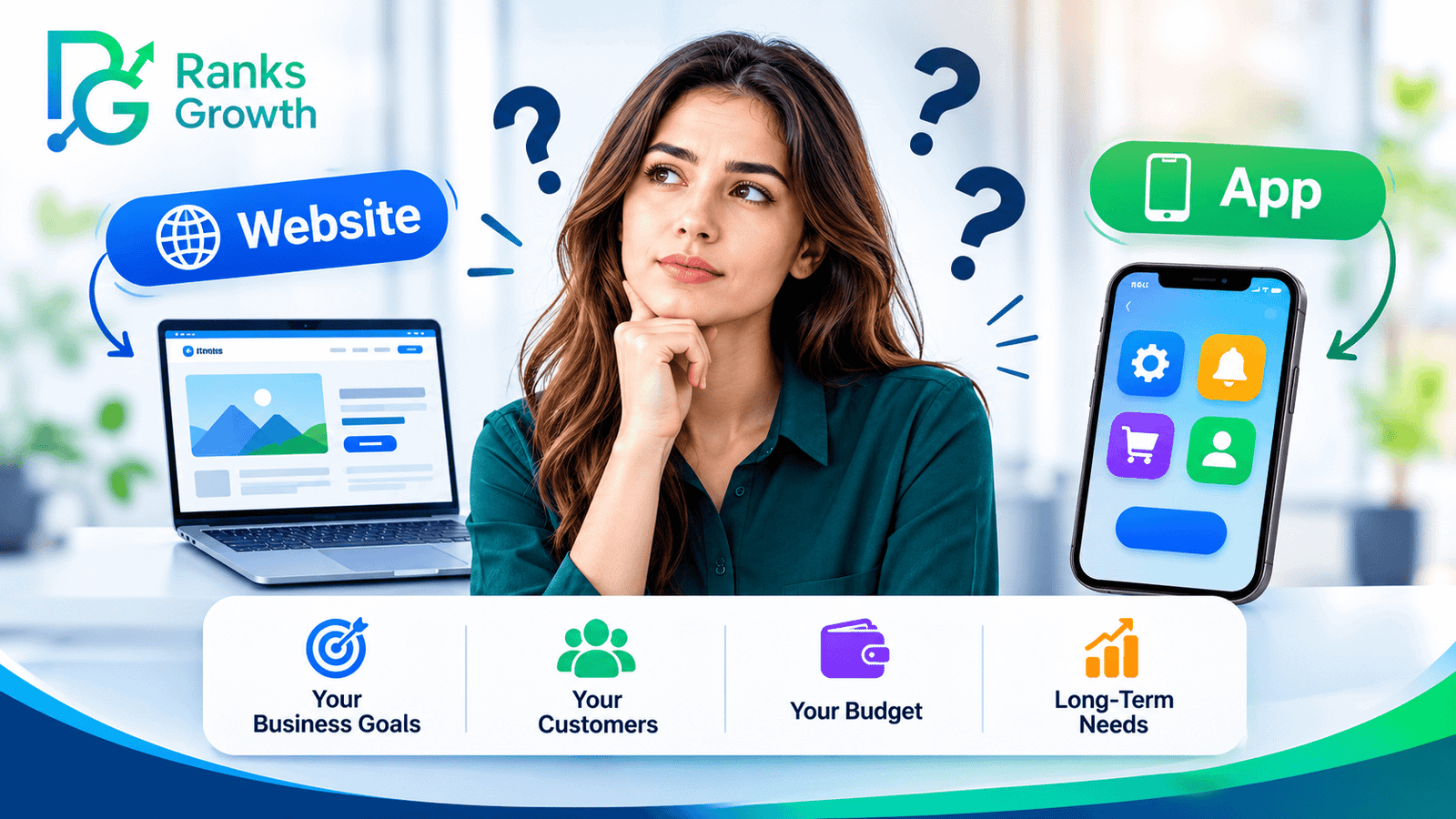
Whether you should create a website or a mobile app depends on the goals of your business and the needs of your customers. Understand the similarities and differences of each to help you decide when it’s prudent to create each for your business.
Get a Free Quote
Not sure which your business needs most? Contact Ranks Growth for a free consultation to get expert advice on app and web development.

Introduction: Making the Right Digital Investment
When starting a new digital project, potential customers often ask which is more beneficial to create first: a website or a mobile app? Often with limited funds to invest on a new business venture, deciding on the best use of that capital can be difficult.
At Ranks Growth, we take a different approach to app development and design compared to other companies. From a business perspective, under what circumstances would it be beneficial for customers to use your app vs. website to interact with your business?
Do You Need an App or a Website?
Generally, a company should create a website first. Customers can use the website to locate and learn more about a company and its services. Apps should be used to provide customers with frequent and easy access to business features and functions, or to provide personalized experiences.
From a customer’s point of view, an app is generally not necessary unless the customer would be using the app features frequently.
What Is the Difference Between an App and a Website?
Customers access a website through a browser using a given website’s address. Customers decide how, when, and for how long they use a website. Customers ‘install’ an app on their device to gain access to the app.
| Comparison |
Website |
Mobile App |
| Access | Opens through a web browser using a URL. | Opens through an installed application. |
| Installation | No download or installation required. | Usually requires downloading and installing. |
| Features | Supports forms, payments, videos, bookings, and interactive content. | Can use device features such as cameras, GPS, biometrics, and push notifications. |
| Updates | Changes can be published directly to the website. | Updates may require a new app version and user installation. |
| Accessibility | Accessible across devices with a compatible browser. | Designed for supported mobile operating systems. |
| Best For | Online visibility, lead generation, business information, and customer enquiries. | Repeat engagement, loyalty programmes, personalised experiences, and regular bookings. |
The key difference is that a website makes your business accessible online, while an app provides a dedicated experience for customers who interact with your business regularly. Neither is automatically better; the right choice depends on your requirements.
When Is a Website the Better Choice?
When you need to make your business publicly accessible, reply to customer enquiries and supply information about your business, creating a website would be the best option. Clients can access information about your business and the services you offer without the need to install any software on their computers.
You should create a website if:
- You need your business to show up on Google. The best way to achieve this is to have search engine optimised web pages.
- You need to increase the number of customer enquiries. Including contact forms on the website would achieve this.
- You need to post information about the services offered by your business.
- You have restricted financial means. Compared to developing and maintaining a mobile app, creating a website is a more cost-effective means of achieving the same outcome.
A professional web design company can create a website that enables clients to easily access information about the services you offer and answer regular questions.
When Is an App the Better Choice?
An app is appropriate when users of your service would benefit from using it frequently. Apps have features and functionalities greater than websites and give users easier, quicker access to these features to increase user engagement.
It’s appropriate to create an app if users:
- Frequent the service regularly. Examples include users of an online shop, fitness service, or membership service.
- Would find push notifications useful. Notifications can be used to remind users of upcoming class or session times or to alert them of order or booking confirmations.
- Would find integration of device features useful to the service. Example features could include a device’s camera or location services.
- Would find a membership or loyalty program to be of benefit to them.
- To set and manage regular appointments and bookings.
Prior to developing an app, these usage scenarios should first be identified and evaluated. At Ranks Growth, we work with clients to define these usage scenarios and build apps to meet those needs, as opposed to needlessly adding features to an app.
Website vs App: How Do Cost, Time, and Maintenance Compare?
The final cost and level of difficulty is determined by many factors, including the level of functionality and integrations needed for each option. In general, creating a website costs less and takes less time than creating an app of comparable functionality.
|
Factor |
Website |
Mobile App |
| Development Cost | Usually more affordable for basic business websites. | Often requires a higher investment due to platform-specific development and additional features. |
| Development Time | A simple website can be developed with fewer technical requirements. | Requires additional planning, development, and testing, particularly for multiple platforms. |
| Maintenance | Requires hosting, security updates, backups, and content improvements. | Requires bug fixes, compatibility checks, security updates, and platform maintenance. |
| Updates | Changes can generally be published directly without user installation. | Some updates require users to download a newer version. |
| Ongoing Improvements | Focuses on content, SEO, performance, accessibility, and user experience. | Focuses on new features, app performance, device compatibility, and user experience. |
| Long-Term Support | Requires reliable hosting and regular technical support. | Requires continued support for operating systems, integrations, and app functionality. |
The right investment depends on what your customers need. Compare the complete ownership cost of both options rather than focusing only on the initial development expense.
Should You Build for iOS or Android First?
Deciding which platform to release your app on first is determined by where your customers are located, what devices they own, and the needs of your business. Don’t choose a platform simply because you prefer that platform.
Prior to launch, consider…
- What device do most customers use?
- What platform do most customers use to make purchases?
- What level of complexity would each version of the app have?
- Would it be more efficient to create a separate app for each platform, or to use a cross-platform app development framework?
If the majority of customers use Apple products, it would make sense to create an iOS app first. Android app development can be implemented later.
Can You Start With a Website and Add an App Later?
Yes. From a business’s point of view, it’s better to create a website first and add an app later if app development is cost-prohibitive.
To begin, create a robust website to sell your product or service and gain customers. Once customers start using your site, identify which site functionalities customers would most benefit from using in an app.
If your current website is outdated, you may want to use website redesign services to improve it prior to adding additional features.
What Questions Should You Ask Before You Decide?
Prior to investing in a website or app, you should consider the following questions:
- Do my customers actually require a mobile app?
- What goal am I achieving by developing a mobile app?
- How much of an investment would I be comfortable with?
- Through what methods do customers use to locate and contact my business?
- Would my mobile app allow customers to make bookings or payments?
- Would it be possible to implement these features on a website instead?
Knowing the answers to these questions may help you save money by avoiding unnecessary app development costs.
How to Choose the Right Development Partner
Prior to presenting potential solutions, a development partner should first gain a deep understanding of your business to define the scope of the product. Look for:
- Relevant Portfolio: Sample projects relevant to your needs.
- Defined Processes: Processes in place for each step of the product development cycle from planning and design to implementation and testing.
- Post-launch Support: Assistance with product updates and use once the product has been released.
- Search Engine Optimization: Knowledge and implementation of best practices to improve a website’s mobile friendliness and search visibility.
When considering options, keep in mind that honesty is the best policy. Products and features should be explained along with their associated pros and cons.
Contact Ranks Growth Today
A well-designed website is a practical and cost-effective starting point for building your online presence. It helps customers discover your business, explore your services, and get in touch easily. As your business grows, you can consider adding an app to support more advanced customer needs. Ranks Growth offers website design services and app design and development to help you build the right digital solution for every stage of your business. Contact Ranks Growth to discuss your project.

FAQs
1. Is an app better than a website for my business?
Not necessarily. A website is usually a better starting point for businesses that want online visibility, customer enquiries, and a place to showcase their services. An app is more suitable when customers need frequent access to specific features, personalised accounts, or regular interactions.
2. Can a website work like an app?
Yes. Modern websites can provide app-like experiences through responsive designs, interactive features, online payments, customer accounts, and Progressive Web App (PWA) technology. Some websites can even be installed on compatible devices and support selected offline features.
3. Which costs more, an app or a website?
A mobile app generally requires a higher investment than a basic business website because of additional development, testing, and maintenance requirements. However, the actual cost depends on the features, integrations, complexity, and functionality your business needs.
4. Should I build an iOS app or an Android app first?
Choose the platform based on the devices your target customers use most. Review your audience data, customer preferences, and business requirements before deciding. If you need to reach users across both platforms, cross-platform development may also be worth considering.
5. Do I still need a website if I have an app?
Yes. A website helps potential customers discover your business through search engines, explore your services, and contact you without downloading an application. Having both platforms allows you to reach new visitors through your website and provide existing customers with additional features through your app.