
Voice Search Keyword Research: How to Find Conversational Queries
Overview
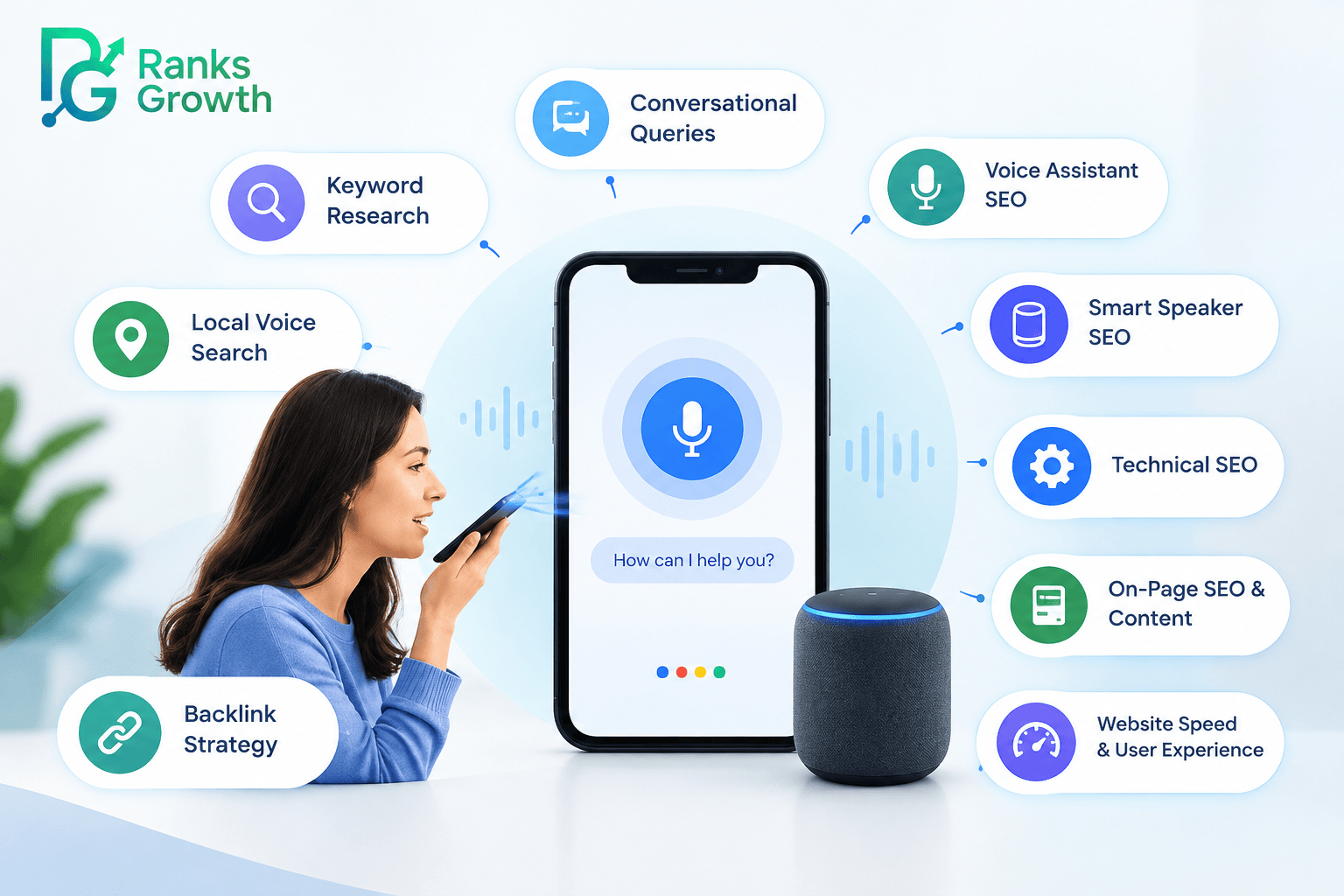
Voice search is changing how people discover businesses, products, and services online. Instead of typing short keywords, users ask complete questions through smartphones, smart speakers, and voice assistants. For businesses, understanding these conversational searches is essential for improving visibility on Google. With effective voice search SEO, Ranks Growth helps businesses identify relevant search queries, create helpful content, and reach potential customers at the right moment.
Get a Free Quote
Want to improve your website’s visibility in voice search results? Ranks Growth can help you develop a strategy tailored to your business goals. Explore our voice search optimization services and request a free quote to discover opportunities for improving your search performance.

Introduction
Voice search allows users to find information online by speaking naturally rather than typing queries into a search engine. People might ask, “Where can I find the best digital marketing agency near me?” instead of typing “digital marketing agency near me.”
This shift makes keyword research an important part of modern SEO. Businesses must understand how their customers speak, what questions they ask, and which answers they expect. At Ranks Growth, we recognize that voice search SEO, voice search optimization services, voice assistant SEO, smart speaker SEO, and local voice search optimization can help businesses build a stronger search presence when implemented alongside a comprehensive SEO strategy.
How to Find Conversational Queries for Voice Search
1. Understand Your Customers’ Natural Language
Start by thinking about how customers describe their problems and ask for solutions. Voice queries often include question words such as who, what, where, when, why, and how.
For example, someone searching for an SEO agency might ask:
- How can I improve my website’s Google rankings?
- Which digital marketing company offers SEO services?
- How much does voice search optimization cost?
- Where can I find an SEO agency near me?
These questions reveal the user’s intent and help you create content that answers specific needs. Use customer conversations, sales enquiries, support messages, and frequently asked questions to discover authentic search phrases.
2. Use Keyword Research Tools
Keyword research tools can help you identify relevant search terms, related questions, and long-tail keywords. Platforms such as Google Keyword Planner, Google Search Console, and keyword research tools can reveal opportunities based on search demand and existing website performance.
Focus on longer, question-based phrases rather than relying only on broad keywords. For example, instead of targeting “voice search SEO,” consider queries such as “How do I optimize my website for voice search?”
Review Google’s autocomplete suggestions and the People Also Ask section to discover related questions. These insights can guide your content strategy and help you understand what information users expect to find.
3. Analyze Search Intent and Long-Tail Keywords
Every voice query has a purpose. Some users want information, while others are comparing services or preparing to make a purchase.
Organize conversational keywords into three categories:
- Informational: How does voice search optimization work?
- Commercial: What are the best voice search optimization services?
- Transactional: How can I hire a voice search SEO agency?
This classification helps you create content for different stages of the customer journey. Blog posts can answer educational questions, service pages can explain your offerings, and contact pages can encourage enquiries.
Long-tail keywords are particularly useful because they often express a more specific need. However, prioritize relevance and intent rather than assuming every conversational phrase has high search volume.
4. Optimize for Local Voice Searches
Many voice queries have local intent, particularly when users search for nearby businesses, services, or opening hours. This makes local voice search optimization valuable for companies serving specific cities or regions.
To improve local visibility:
- Create and maintain an accurate Google Business Profile.
- Keep your business name, address, phone number, and opening hours consistent.
- Include relevant location-based keywords naturally in your website content.
- Encourage genuine customer reviews and respond professionally.
- Create useful pages for the locations you actually serve.
For example, a customer might ask, “Which digital marketing agency near me helps small businesses?” Clear local information can help search engines understand whether your business is relevant to that query.
5. Improve Technical SEO and Website Speed
Finding the right keywords is only one part of voice search optimization. Search engines must also be able to crawl, index, and understand your website.
Improve your technical foundation by ensuring that important pages are indexable, internal links work correctly, and XML sitemaps are maintained. Fix broken links, resolve duplicate-content issues, and use canonical tags appropriately.
Website speed and mobile usability also matter. Compress images, reduce unnecessary scripts, enable browser caching where appropriate, and use responsive page layouts. A fast, accessible website provides a better experience for users who arrive through mobile voice searches.
Use structured data, such as appropriate Organization, LocalBusiness, Article, and FAQPage markup where eligible, to help search engines interpret page content. Structured data does not guarantee a voice search result or a featured snippet, but it can support clearer content understanding.
6. Create Helpful, Conversational Content
Once you identify relevant queries, build content around them. Use natural language, descriptive headings, and concise answers to common questions. A practical approach is to place a direct answer near the beginning of a relevant section and then provide supporting details.
For example, a heading such as “How can businesses improve voice search rankings?” can be followed by a short explanation and actionable recommendations.
Strong on-page SEO remains essential. Optimize title tags, meta descriptions, headings, image alt text, and internal links without forcing keywords into every sentence. Build trustworthy content that demonstrates relevant expertise and satisfies the reader’s needs.
Earn quality backlinks through useful resources, industry partnerships, and original research. Although backlinks are not a direct guarantee of voice search placement, authoritative links can support broader SEO performance.
Together, these practices strengthen voice assistant SEO and smart speaker SEO by making your content accessible, relevant, and easy to understand across different search experiences.
Contact Ranks Growth Today
Ready to make your website more discoverable through conversational search? Ranks Growth provides strategic guidance to help businesses improve keyword targeting, technical SEO, content quality, and local search visibility.
Explore our voice search optimization services and contact Ranks Growth today to discuss a strategy suited to your business.

FAQs
1. What is voice search SEO?
Voice search SEO optimizes website content to match spoken queries and improve search visibility.
2. How do I find keywords for voice search?
Use Google Autocomplete, People Also Ask, keyword research tools, and customer questions to identify conversational keywords.
3. Does voice search optimization improve Google rankings?
Voice search optimization supports SEO performance through relevant content, better usability, and strong technical SEO, but rankings are not guaranteed.
4. Why is local voice search optimization important?
Local voice search optimization helps businesses reach nearby customers searching for relevant products and services.
5. Can Ranks Growth help with voice search optimization?
Yes, Ranks Growth offers SEO strategies to help businesses improve conversational keyword targeting, website performance, and search visibility.