
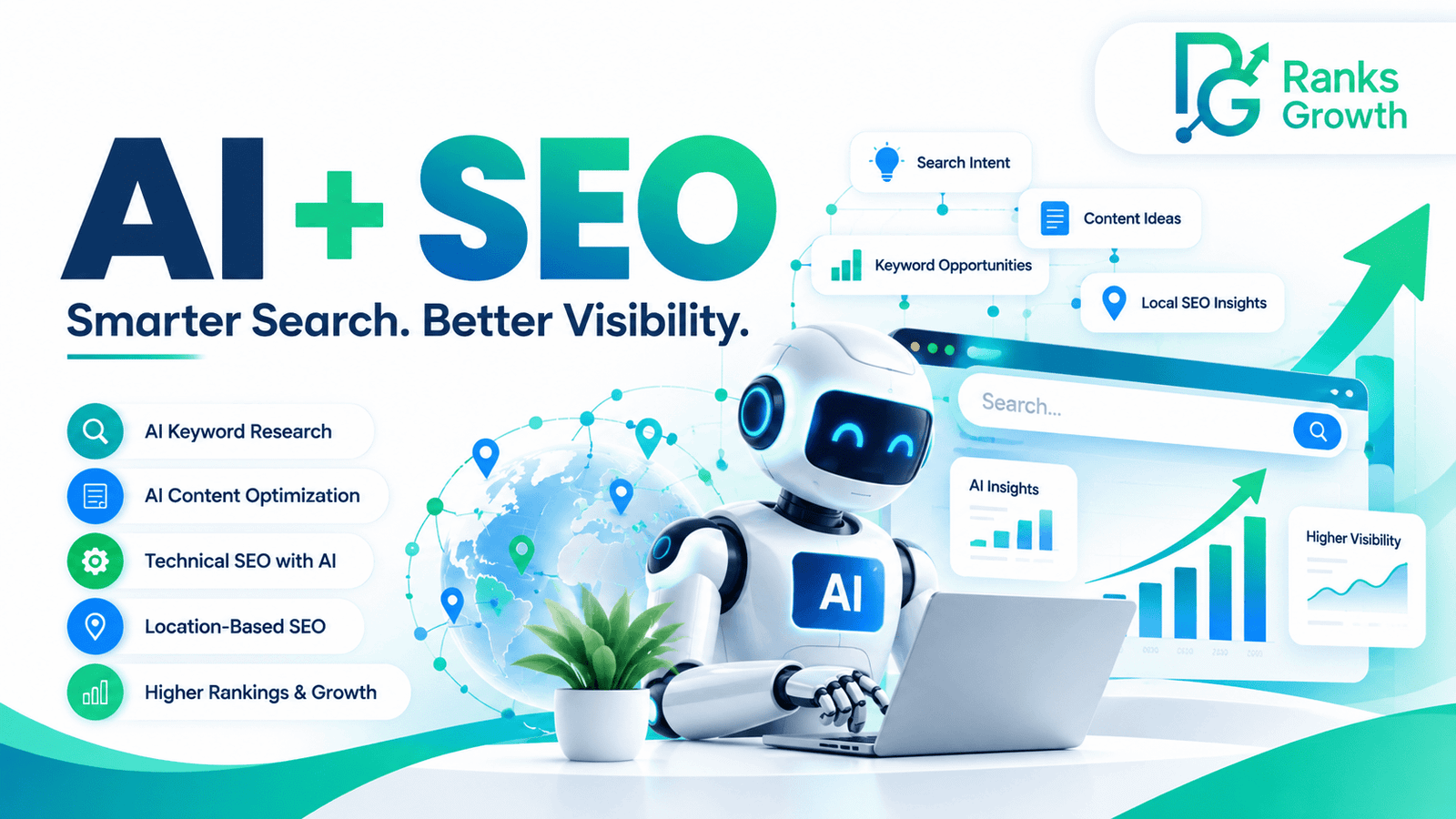
Search Engine Optimization with AI: How to Use AI for SEO
Overview
AI is fundamentally altering how businesses perform search engine optimization by automating keyword research, content optimization, search intent analysis and performance tracking. When combined with traditional SEO practices, AI can help businesses gain organic visibility and understand user behavior. Furthermore, businesses can develop and optimize content to satisfy user intent.
Get a Free Quote
Want to improve your search rankings with AI-powered strategies? Ranks Growth helps businesses strengthen organic visibility through intelligent keyword research, technical SEO, content optimization, and location-focused strategies. Explore our AI SEO services to discover how AI can support your business growth.

Introduction
AI is playing an increasingly large role in shaping the future of search engine optimization by changing the way data is analyzed and opportunities are discovered. While traditional SEO practices will still play a large role, new opportunities will emerge to create and present search results in new ways.
New AI capabilities will allow SEO professionals to quickly make better-informed decisions. Moving away from traditional, labor-intensive SEO will allow businesses to focus on other, more valuable areas of their business.
AI plays an equally large role in combination with traditional SEO by understanding what the audience needs and how search behavior changes over time.
Emotional intent and location targeting will become more approachable as AI is used more thoughtfully in search engine optimization. Valuable content will be created and presented to help fulfill the needs of the right audience in the right location.
How to Use AI for Search Engine Optimization
1. AI Keyword Research and Search Intent Analysis
AI is accelerating keyword research and analysis of search intent. Both of these are core aspects of an effective SEO strategy. Traditionally, keyword research has focused on determining search volume. Selecting keywords based on search volume alone can lead to oversights on search intent, competition, and the issue users want to resolve. AI can research numerous variations of keywords, answer related search queries, and identify topic and search pattern relationships to find opportunities that are not evident with conventional research.
Improving keyword research with AI includes:
- Identifying relevant opportunities: Finding long-tail keywords and questions, and other keywords related to the services and products the business offers.
- Understanding search intent: Classifying user queries as informational, navigational, commercial, and transactional.
- Creating topic clusters: Relating keywords and topics to build subject authority.
- Evaluating competition: Recognizing content gaps and unanswered questions where the current search results do not offer sufficient or the best answers.
- Prioritizing content: Determining the level of focus an SEO content strategy should have on a given keyword based on business goals and whether the opportunity is relevant and realistic to target.
Continuing with our AI SEO example, an online marketing agency could use AI to recognize related opportunities in machine learning SEO and other AI applications in SEO and content and technical audits.
AI can mine data to identify trends and opportunities. However, it is up to the SEO expert to identify whether there is commercial value in the opportunity.
2. Machine Learning SEO for Smarter Decisions
Machine Learning optimizes systems to recognize patterns, and make predictions based on these patterns, all without being explicitly programmed.
In the realm of SEO, machine learning can be used to read and analyze large sets of data, diagnose website performance and detect ranking and user engagement signals.
Some examples of use cases include:
- Forecasting website performance using past data. Identify and interpret seasonal patterns and trends.
- Anomaly detection. Alert users to deviations from normal performance.
- Opportunity identification. Determine opportunities where content can be created and/or optimized and/or linked to improve performance.
- Prioritizing. Classify and diagnose website issues.
- Audience segmentation. Identify interests, behaviors, and patterns.
One example where machine learning can provide insight is with declining organic landing page traffic. If a number of critical landing pages started losing organic traffic, machine learning can be used to diagnose the issue. Possible causes could be a competitor updating content or changing search intent, declining content quality, or indexing issues. While diagnosis can be incredibly helpful, predictions should be considered a guidance and not an absolute.
3. AI Content Optimization for Better Search Visibility
Content that ranks doesn’t simply contain keywords in heading or paragraphs. Keywords should be treated as a guideline to what content should be written. Search engines strive to offer results that satisfy the needs of users.
AI content optimization helps writes to evaluate what is currently on a webpage, and find what is missing, and improve readability and content organization.
With the help of AI, one can identify:
- What questions remain unanswered, and content gaps?
- What entities, terminology, and topics, should be included?
- Where is a repetitive or similar content?
- Are there areas where content is lacking, and what should be included?
AI can help to restructure content to answer questions at different stages of the consumer’s journey.
There is a fine line between creating a huge amount of automatically generated content, and creating content that is useful to the consumer, provides relevant information, and satisfies the needs of the consumer.
The content should be crafted with a strong approach that incorporates the use of AI for research, but includes human-edited writing that is integrated with the expertise and insights of subject-matter specialists.
Businesses can retain their brand voice while utilizing this approach to ensure content is crafted with long-term SEO goals in mind.
4. Artificial Emotional Optimization (AEO) and User Intent
Artificial Emotional Optimization, as used in this strategy, refers to applying AI to understand the emotional context behind search queries and create content that responds appropriately to users’ concerns, motivations, and expectations.
It is important to distinguish this concept from Answer Engine Optimization, which is also commonly abbreviated as AEO in digital marketing.
People search for information for different reasons. A customer looking for emergency water damage restoration may feel anxious and need immediate reassurance. Someone comparing marketing agencies may be looking for confidence, transparency, and evidence of results.
AI can help analyse customer reviews, support enquiries, survey responses, and search queries to identify recurring concerns and communication preferences.
Businesses can use these insights to:
- Understand customer pain points: Identify common questions, objections, and frustrations.
- Improve content tone: Create clear, reassuring, informative, or action-oriented content according to the situation.
- Strengthen engagement: Address important concerns early instead of burying answers beneath lengthy introductions.
- Improve conversion pathways: Match calls to action with the visitor’s stage in the decision-making process.
- Personalise messaging responsibly: Adapt relevant information to audience needs without making intrusive assumptions about individuals.
For effective emotional optimization, AI should support empathy rather than simulate it superficially. Content must remain accurate, respectful, and genuinely helpful.
5. Geographic Optimization (GEO) with AI
Geographic Optimization, as used here, means tailoring SEO strategies to specific cities, regions, or service areas. This should not be confused with Generative Engine Optimization, another common meaning of GEO in digital marketing.
For local and regional businesses, geographic relevance has a huge impact on search visibility and lead generation.
With the help of AI, identifying regional search demand and local competition becomes much easier. In addition, based on the region and customer behavioral differences, there are questions people ask in different regions. Using AI for geographic optimization helps you find these differences.
Some ways to do this are
- Locally focused keyword research. Identify region or service area focused keywords.
- Locally focused content development. Create locally helpful content and landing pages.
- Analyze local competition. See how local competitors vary in terms of content and service coverage, and assess their search visibility.
- Find local interest and demand. Determine seasonal and location-focused customer needs.
An example of a business that can use this type of research is a restoration company that serves Albany and Saratoga counties in New York. Using AI-assisted geographic research, the business can identify the types of water, fire and mold damage restoration services that have local demand in their service area.
Rather than creating dozens of almost identical location pages, the company should create helpful local content that people in that area are really searching for. AI can help find these local opportunities, but companies have to confirm these local facts and avoid making up local business information (fake addresses, service areas or customer feedback).
6. AI for Technical SEO and Website Audits
Technical SEO helps search engine bots to crawl and extract the required information to understand the importance of website pages. AI-powered tools can reduce the time required for a full-fledged audit by classifying repetitive problems and analyzing a huge set of URLs.
A few use cases can be spotting inconsistent canonical tags, identifying broken links, duplicate metadata, and indexing anomalies.
AI can also help prioritizing issues based on different parameters like importance of the page, potential traffic, and impact.
In one such use case, the SEO team members can perform an automated analysis to group pages based on indexing issues, and figure out why pages are grouped instead of looking at every page individually.
However, problems require technical validation. A page that is not getting indexed by the search engines is not necessarily causing an error. Not all duplicated URLs require the same solution.
Using AI-based diagnostics in conjunction with Google Search Console, website crawlers, and analytics, along with expert review, gives a strong foundation for technical SEO.
7. Measure Results and Continuously Improve Your Strategy
AI-augmented SEO should be judged on the outcomes it drives for the business instead of the number of automated tasks it accomplishes.
Evaluate organic clicks, impressions, and keyword visibility. For leads, evaluate conversion rates, track qualified leads, and review landing page performance. For local businesses, evaluate local visibility and enquiries. For e-commerce sites, review product page performance and organic revenue.
An AI partner may help digest and draw conclusions from performance and underlying opportunities. Regular reviews help determine whether improvements are in the right direction.
Rankings and traffic change for many reasons, like seasonality, algorithm changes, and shifts in search demand. Measuring performance over long periods can give a misleading indication of success.
Conclusion
Artificial intelligence is impacting SEO in several important ways. It’s making the process of optimization more data-driven and efficient and enabling us to better understand search behavior.
AI is touching almost every aspect of SEO. From keyword research to content optimization, from analyzing emotional intent to geo-targeting to technical audits, AI is vastly improving decision-making.
In addition, to successful implementation of AI in SEO, there are other key ingredients. These include quality data, technical savviness, exceptional content, and understanding of the audience. AI in SEO must be complemented by these other factors to ensure sustained growth.
AI SEO services provide many opportunities for a business to optimize its content and improve its relevance. Use of AI in SEO must be strategic and responsible in order to better the user experience. It must also benefit the business and give it a competitive edge.
Contact Ranks Growth Today
Ready to make AI a valuable part of your SEO strategy?
Ranks Growth helps businesses combine proven SEO fundamentals with AI-powered research, content optimization, and technical analysis to strengthen their online presence.
Get a Free Quote today and discover new opportunities to improve your search visibility.

Frequently Asked Questions (FAQs)
1. What is AI SEO?
AI SEO uses artificial intelligence to improve keyword research, content quality, technical SEO, and search visibility.
2. How can AI improve SEO rankings?
AI identifies content gaps, analyses search intent, and uncovers optimization opportunities to support better SEO performance.
3. What are AI SEO services?
AI SEO services combine AI tools and SEO expertise to improve website visibility, traffic, and organic growth.
4. Can AI-generated content rank on Google?
Yes! AI-assisted content can rank when it is helpful, original, accurate, and created for people.
5. What is AI keyword research?
AI keyword research discovers relevant search terms, related topics, and user intent to guide smarter content strategies.
6. Can AI help with local SEO?
Absolutely! AI helps identify location-based keywords, analyse local competitors, and improve regional search visibility.
7. Will AI replace SEO experts?
No. AI assists with data and automation, while SEO experts provide strategy, creativity, and human judgment.