How to Stop Guessing Keywords and Design a Data-Backed Content Roadmap
Traditionally, content teams guess keywords and hope for the best. This usually results in wasted time and effort creating content that doesn’t move the needle for the business. There is a better way. By analyzing search data, user intent, competitor content, website performance, and business goals, content teams can better prioritize efforts and spend time creating valuable content resources.
A data-backed content roadmap shows teams what people are searching for and what the business is positioned to provide. With an integrated approach to organic SEO, AI keyword research, and content optimization, teams can stop creating content in the dark and start amplifying their search presence.
At Ranks Growth, we have a similar goal. It’s not enough to simply pull keywords with search volume. We want to know what people are searching, why people are searching, what information people need, what competitors are doing, how each piece of content can further the business’s goals, and how to best structure content to achieve business success.
Get a Free Quote
Want to stop guessing what content your audience needs?
Contact Ranks Growth for a free consultation and quote for SEO, content strategy, technical SEO, keyword research, and AI-focused optimization solutions.

Introduction: Why Keyword Guessing Is No Longer Enough
A basic starting point for many businesses developing their content strategy is, “What keywords should we target?”
Identifying keywords is beneficial when formulating a starting point for your strategy; however, it doesn’t provide a long-term edge for your SEO strategy.
Just because a keyword is popular and searched for thousands of times doesn’t mean it attracts people who are looking to buy. Alternatively, a keyword with far less search volume might draw qualified buyers who want to compare and evaluate various alternatives, or are ready to make a purchase.
There are several other aspects that need to be included in addition to keywords to develop a robust content strategy.
Search intent is one such factor that influences a content strategy. Others include what the competition is doing, what is the customer’s question, what is the conversion potential, what is the site’s authority and relevance, and how are search queries evolving to include longer, more conversational questions.
The objective for any business investing in SEO should be to answer the right questions for the target audience at the right stage of the buyer’s journey with the right content.
1. Start With Business Goals, Not Keywords
Before opening a keyword research tool, decide what the content must accomplish.
What are your business goals?
- Are you looking for more qualified leads?
- Are you looking to increase product sales?
- Want to increase brand visibility?
- Are you launching a new service?
- Looking to create and establish authority for a particular topic?
- Are the existing visitors to your site not converting?
Answering these questions will indicate the types of keywords you need to prioritize.
For example, an informational keyword like “what is technical SEO” may help build awareness for your business, while a keyword like “technical SEO services” may indicate commercial intent.
Both keywords may be valuable, but serve different purposes.
When writing content for your business, you don’t want your content team focusing on attracting traffic just for the sake of having traffic.
2. Use Search Data to Discover Real Opportunities
After you have defined your goals and have a general idea of what your opportunities are, the next step is to look at actual search data.
Search Data can come from Google Search Console, your site analytics, keyword research tools, your competitors, and your site’s search performance.
Some things to look for are:
- Queries generating impressions
- Keywords ranking on pages 2-3
- Queries resulting in clicks, but no conversions
- Frequently asked questions by your customers
- Keywords your competitors are ranking for that you are not
- Related searches for your core business offerings
- Long-tail keywords
The best opportunities are usually right in front of you.
A page that is ranking around positions 8-20 for a query that is relevant to your business may not need a new page. It may need improvements to content, links and/or alignment to search intent.
3. Map Keywords to Search Intent
Search intent is the reason a user performs a query.
Generally speaking, keywords can be grouped into the following categories:
Informational: Queries made to gain knowledge.
Commercial: Queries made before making a purchase.
Transactional: Queries made to buy, sign up, book, contact, etc.
Navigational: Queries made to locate a specific website or resource.
It’s important to have a balance of these intents in your sitemap.
For example, a business offering SEO services could create the following content:
- “What is Technical SEO?” (Informational)
- “Best SEO Strategies for Growing Businesses” (Commercial)
- “SEO Services for Businesses” (Transactional)
- “Ranks Growth SEO Services” (Navigational)
This creates a journey for the user instead of random pieces of content.
4. Build Topic Clusters Instead of One-Keyword Pages
Assigning one keyword to one page creates an unrelated, fragmented site.
Rather, create content based on broader topics.
Let’s say your main topic is Technical SEO. Related topics could be:
- Technical SEO Basics
- Website Crawlability
- Indexing Issues
- Page Speed
- Core Web Vitals
- Canonical Issues
- XML Sitemaps
- Mobile SEO
- Structured Data
- Technical SEO Audit
A central service or pillar page can link related content through contextual links.
This provides search engines with a better understanding of the topic and a path for related content for the user. It helps further satisfy AEO and GEO.
5. Use AI Keyword Research to Find Patterns
Modern tools can help analysis of keywords faster and in more depth.
One use of AI is in semantic analysis. It can help describe related questions, variations in search intent, topic clusters and other patterns. At Ranks Growth, we rather look at keywords in the context of a bigger picture and incorporate AI approaches to broader search tactics as opposed to looking at keywords in isolation.
Instead of targeting “SEO audit” keywords, you may discover questions like:
- How often should a website get an SEO audit?
- What is included in an SEO audit?
- Why are pages not getting indexed?
- What are the best ways to fix technical SEO issues?
- What should I work on after an SEO audit?
You can create articles, sections, FAQs, and resources dedicated to these questions.
The general idea is to identify opportunities using AI and analyze search data and business expertise to decipher patterns and opportunities worth pursuing.
6. Turn the Research Into a Content Roadmap
Once opportunities are identified, organize them into a practical publishing plan.
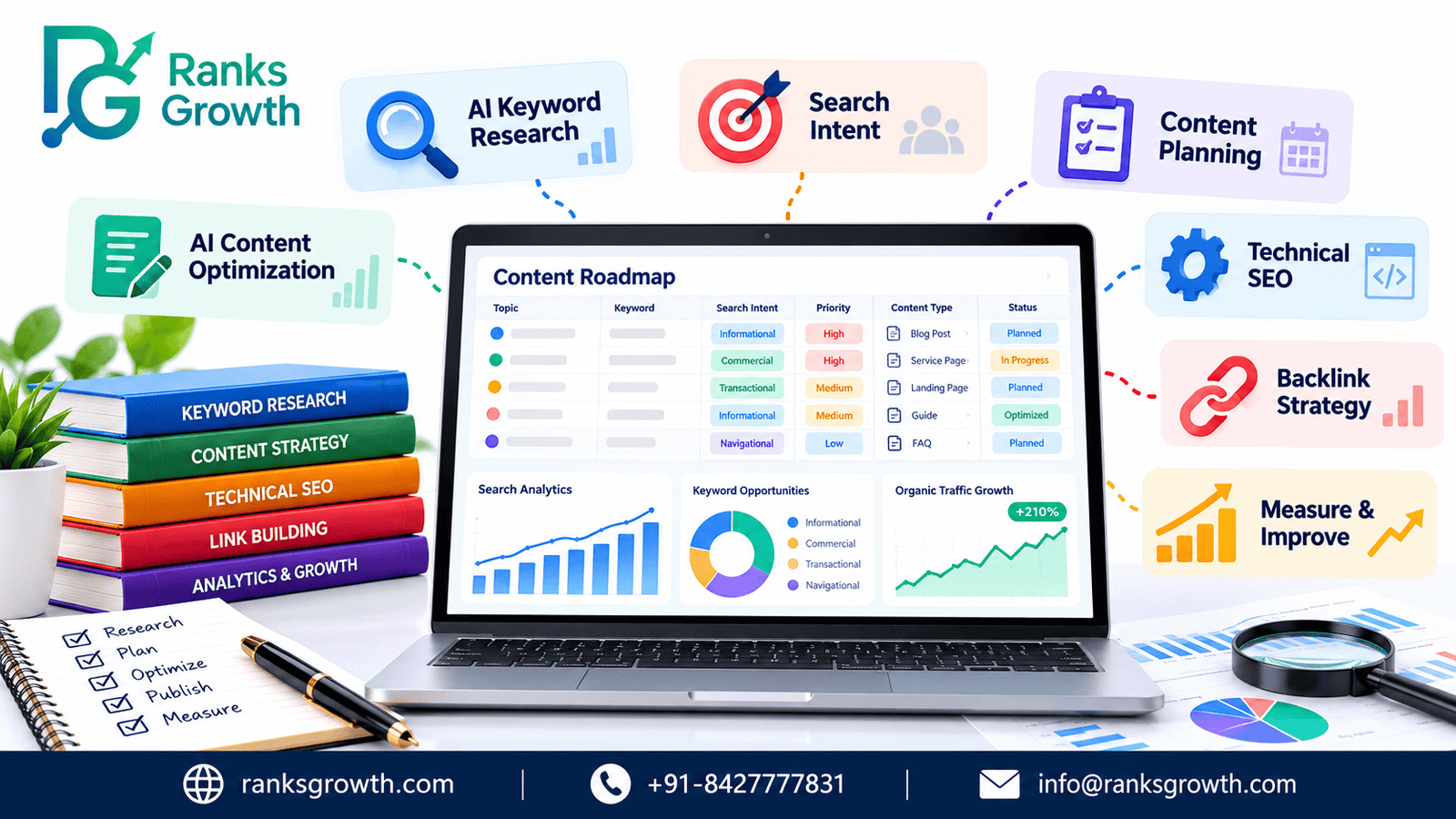
A useful roadmap can include these columns:
| Content Topic | Search Intent | Business Value | Priority | Target Page | Next Action |
| Core service topic | Transactional | High | High | Service page | Optimize |
| Beginner question | Informational | Medium | Medium | Blog | Create |
| Comparison query | Commercial | High | High | Blog/landing page | Create |
| Customer FAQ | Informational | High | Medium | FAQ section | Add |
| Supporting technical topic | Informational | Medium | Medium | Blog | Create |
Prioritize content based on business value and ranking opportunity, not search volume alone.
A practical scoring system can consider:
Opportunity = Relevance + Intent + Ranking Potential + Conversion Value + Topical Importance
This makes your roadmap easier to explain, manage, and measure.
7. Optimize Existing Content Before Publishing Everything New
Creating a data-backed roadmap shouldn’t mean publishing dozens of new articles.
Sometimes your best opportunity is sitting on your website.
Pages to review include:
- High impressions/low clicks
- Positions 5-20
- Declining organic traffic
- Outdated information
- Thin/incomplete sections
- Weak/no internal links
- Poor title/heading structure
- No answers to user questions
Addressing the above issues can prove more beneficial in the short term than publishing new content.
AI content optimization can help find content gaps and identify semantic relationships. It can help find structural and readability issues, as well as other opportunities where a page may not be satisfying search intent. A human should still largely dictate strategy, but where appropriate, AI can be a tool to assist.
8. Include Technical SEO in Your Roadmap
Content can not perform consistently if search engines can not access or understand your site.
Technical priorities for your roadmap should include:
- Crawling and Indexing
- Health of the XML sitemap
- Canonicalization
- Management of redirects
- Broken links
- Mobile Usability
- Page Speed
- Core Web Vitals
- How JS renders
- Structured data
- Site architecture
A technically sound site gives your content the opportunity to perform better.
This is one reason comprehensive organic SEO services should combine content strategy with technical and on-page optimization rather than treating blogging as an isolated activity.
9. Strengthen Internal Links and Backlinks
Each content asset should be connected to others that are contextually relevant.
Use internal links to connect:
Pillar Page → Supporting Article → Related Service → Conversion Page
Of course, backlinks also play a role.
A site shouldn’t focus on gaining backlinks haphazardly. Instead, a site should work to gain quality backlinks and/or mentions from reputable publications and/or resources.
It’s not about the quantity of backlinks, but the quality.
10. Design Content for AEO and GEO
As search becomes more conversational, content should contain and organize answers to questions.
To design content for AEO, consider the following:
- Answers placed at the beginning of the relevant sections
- Question-based sections
- Brief answers
- Easy-to-read lists and/or tables
- Useful FAQs
- Appropriate structured data.
- For GEO content, concentrate on information that’s easy to understand and/or verify.
Demonstrate real expertise, and explain concepts with supporting evidence. Maintain complete and up-to-date information about your business. Earn quality backlinks on your site and other trusted sites.
With the above strategies in mind, you can build and strengthen site content for both search results and AI-based discovery.
11. Measure the Roadmap and Adjust It
A content roadmap can and should change regularly.
You should look at the following as regular intervals to determine performance.
- Organic Impressions
- Click-Through Rate
- Keyword Visibility
- Organic Traffic
- Conversions
- Leads
- Engagement
- Assisted Conversions
- Indexed Pages
- Backlinks and Referring Domains
If an article is performing well with impressions but has a low click-through rate, adjust the title and content to optimize presentation in the search results.
If it has good traffic but is missing conversions, assess if there are obstacles in the conversion journey.
If it has low or zero impressions, assess its relevance, whether it effectively indexed, is there good technical accessibility, what does the competition looks like, and is there sufficient content authority.
Use data and insights to inform your content creation.
Contact Ranks Growth Today
There are several reasons why you should not guess which keywords to target and build your content strategy around them. Sometimes keywords you think are good do not work. Other times, keywords work, and you do not know about them. There are many variables to take into consideration when analyzing content and search behavior. Some of these variables are your audience, your website, search opportunities, and trends.
Ranks Growth helps eliminate the guessing game and simplifies the process by fusing organic and technical SEO services with content strategy, optimization, and AI.
Does your content strategy lack structure and feel scattered? Do you feel lost and unmotivated publishing content and see little to no impact? You have to take a step back and think about what your end goal is before implementing a strategy to get there.
Contact Ranks Growth for your free consultation and see what they can do to help get you to your end goal!
FAQs
1. How do I know which keywords my business should target?
Start with your business goals, products or services, customer questions, existing search performance, search intent, competition, and conversion potential. The best keywords are not necessarily those with the highest search volume; they are the ones that connect relevant searches with valuable business outcomes.
2. What is a content roadmap?
A content roadmap is a prioritized plan showing what content should be created, updated, optimized, and internally linked over a specific period. It connects topics with search intent, business objectives, target pages, and measurable SEO opportunities.
3. Is keyword search volume the most important metric?
No. Search volume is useful, but it should be evaluated alongside relevance, search intent, competition, ranking potential, conversion value, and topical importance.
4. How can AI keyword research improve SEO planning?
AI keyword research can help uncover related queries, semantic connections, topic clusters, search patterns, and potential content gaps more efficiently. It works best when combined with real search data, business knowledge, competitor analysis, and human judgment.
5. What is AI content optimization?
AI content optimization uses intelligent analysis to identify opportunities involving content structure, topic coverage, related concepts, search intent, readability, and potential content gaps. It should support a broader SEO strategy rather than replace expertise or editorial judgment.
6. Should I create new content or update existing pages?
Both can be valuable. If an existing page already receives impressions or ranks for relevant queries, improving it may be more efficient than creating another page. New content is appropriate when an important topic or search intent is not adequately covered.
7. Do backlinks still matter for a content strategy?
Yes. Relevant, credible backlinks and brand mentions can support authority and discoverability. However, link quality and relevance are more important than simply accumulating large numbers of links.
8. How often should a content roadmap be reviewed?
Review performance regularly and make larger strategic adjustments periodically. Search behavior, competitors, rankings, website performance, and business priorities can change, so your roadmap should evolve with the available data.
9. Can professional SEO services help create a data-backed content roadmap?
Yes. Professional SEO services can combine technical audits, keyword and intent research, competitor analysis, content optimization, internal linking, authority building, and performance tracking to create a roadmap aligned with business goals.