Why “One Keyword, One Page” No Longer Works in AI Search
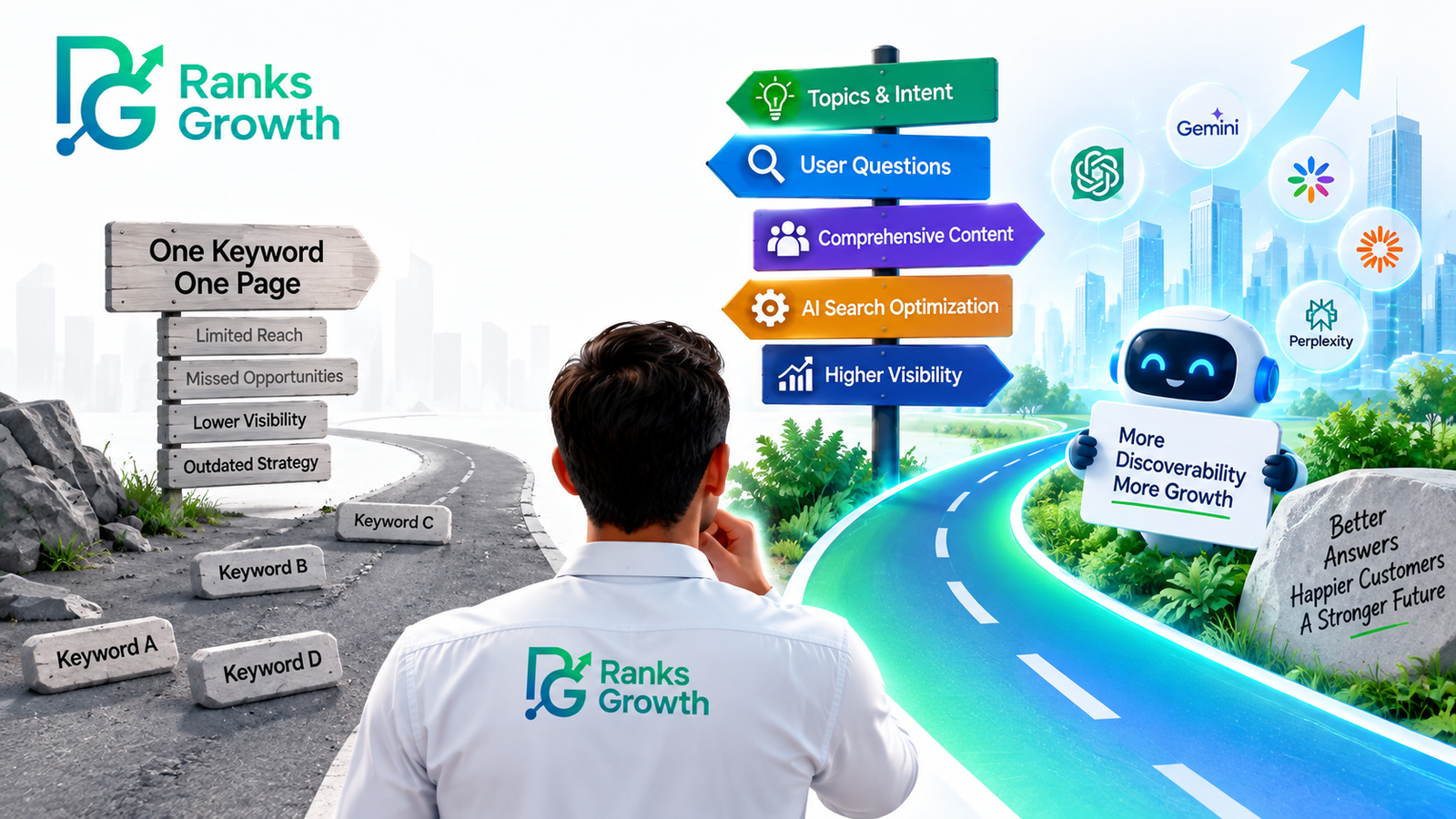
Search is no longer about associating a keyword with a page. AI in search engines helps to understand the context of a query and provides relevant results based on different ways of interpreting the query. This means that pages optimized for a query may not show up for that query. Businesses need to look beyond the “one keyword, one page” framework to rank for a wider variety of queries.
Incorporating AI in search engines means that search results are ranked based on so many factors, including the query context and other results. Therefore, organizations need to move beyond creating pages for each query and focus on creating authoritative content for a particular topic. This means that organizations need to adopt a framework for search beyond the traditional SEO and Algorithm-based frameworks. Ranks Growth has adopted this framework to offer different services, including SEO, AEO, and GEO.
Ultimately, the focus of businesses should be to achieve content discoverability for queries beyond the core set of queries that the business targets.
More natural language is used in search. Search queries are longer and more conversational. AI search systems allow users to make follow-up questions and comparisons. Thus, the focus of search systems is shifting from keyword searches to meaning or intent searches.
Get a Free Quote
Want to make your website more visible across traditional search and AI-powered discovery?
Get a Free Quote from Ranks Growth and discover how a strategic combination of SEO, AEO, GEO, content optimization, and technical improvements can strengthen your search presence.
Visit https://ranksgrowth.com/ to discuss your business goals and create a search strategy designed for the way people discover information today.

Introduction
For a while, the strategy for SEO was to have “one keyword, one page.” A business would find a keyword, make a page containing that keyword, or edit a page to include that keyword, make supporting text if needed, and ultimately put the page in the results to be ranked.
This worked because search engines, to find results, looked for pages containing keywords.
Recently, the means and ways in which people search have evolved.
People have moved past simple keyword searches and began using complex searches, i.e., comparisons and questions. Additionally, with the advancement of artificial intelligence and its integration into search, search has evolved from looking for results containing a keyword to interpreting the meaning and intent behind the search.
With that being the case, having a page for every single variation of a keyword becomes pointless.
For example, having a page each for “accounting software,” “small business accounting software,” and “best accounting software” would be unnecessary and would make the website difficult to manage. Additionally, the pages would have significant, if not complete, overlapping content.
A page that covers the core of accounting software would cover and answer related questions, uses, and help make a well-informed decision.
In effect, targeting specific keywords has become less relevant, and covering topics and answering search intent has become more relevant.
Why the “One Keyword, One Page” Strategy Is Outdated
AI Search Understands Topics, Not Just Keywords
Search engines can understand synonyms and relate different phrases to the same concept.
Consider a user searching:
- What is the average cost to hire a company to build a website for us?
- What is the price of website development?
- What is the cost of website development?
- What are the factors that determine the cost of website development?
These queries have similar meanings and introduce the same topic. Therefore, covering the first of the aforementioned queries will also answer the others.
This is particularly important for AI search visibility optimization, where content may be evaluated based on its usefulness and contextual relevance rather than the presence of one exact phrase.
Conversational Search Creates Hundreds of Possible Queries
Traditionally, covering topics in-depth increased the chances for page rankings.
However, recently there has been a shift toward the number of page rankings, especially in relation to AI search. Thus, covering many queries may improve page rankings.
Manyrestoration-related questions stem from water damage restoration. For example, users may search:
- How long does it take to remove the water?
- How long does it take to clean up the water?
- What are the risks of delaying a professional restoration service?
These examples may all be covered on the same page dedicated to water damage restoration. The page may also cover other questions related to water damage restoration.
Thus, a topic-centered page focusing on a single query may also cover many related queries. Therefore, pages no longer need to be created to cover every possible query.
Search Intent Matters More Than Exact-Match Keywords
Keywords are important for businesses to understand how the public makes requests and what demands the public has.
Problems occur when keywords become the foundation of a business’s content strategy.
It is important for companies to understand search intent.
Examples of search intent include:
- Finding information about a particular problem
- Determining the best option of a group of solutions
- Choosing which solution provider to use
- Determining the price of a solution
- Learning about the features of a solution
- Figuring out the instructions on how to use a solution
- Checking the qualifications of a solution
- Making a purchase of a solution
Using AI to optimize a website for search engines should consider search intent instead of using keywords verbatim.
Topic Authority Is More Valuable Than Keyword Isolation
There are several ways to structure and provide in-depth information about important subjects for a business.
For example, a business in the translation services industry can create multiple resources about the translation services industry, such as:
- Translation services
- Certified translation
- Document translation
- Machine translation
- Translation quality
- Industry-specific translation
- Translation costs
- Frequently asked questions
- Choosing a translation provider
These resources can be interconnected with reference to one another.
Creating a structured content ecosystem helps search engines and Artificial Intelligence (AI) determine the business’s area of specialization and expertise.
AI Content Discoverability Depends on Context
AI content discoverability is not simply about placing keywords in headings.
To address the AI systems’ confusion, businesses should create clear, pertinent, and related information including:
- What the business provides
- To whom the service is provided
- The service’s advantages and benefits
- The service’s differentiators
- The service’s process
- What to expect from the service
- Frequently asked questions about the service
All of the aforementioned information should be presented and explained throughout the website using a variety of content including: Service description pages, Frequently Asked Questions pages, case studies, comparison pages, tutorials and how to’s, guides, and other resources.
How Businesses Should Adapt Their Content Strategy
1. Build Topic Clusters Instead of Keyword Lists
Select a primary topic and create a cluster of related content. You can create topic clusters around questions, content, services, issues, and examples of usage.
Topic clusters can include:
Core service page → Supporting guides → FAQs → Comparison content → Case studies → Related service pages
This approach creates depth without unnecessarily publishing multiple pages targeting nearly identical queries.
2. Consolidate Overlapping Content
Review existing pages and identify URLs competing for similar search intent.
If several pages provide substantially similar information, consider whether they should be consolidated into one stronger resource.
The objective is not to maximize the number of URLs. It is to maximize the usefulness and clarity of the website.
3. Write for Questions and Follow-Up Queries
You should include content that helps your audience answer questions that you expect they may have about your service offerings.
These questions may include:
- What is it?
- Who needs it?
- How does it work?
- How much does it cost?
- How long does it take?
- What are the benefits?
- What are the limitations?
- How does it compare with alternatives?
- What should customers look for in a provider?
This is where AEO services from Ranks Growth can complement conventional SEO by helping businesses structure information for answer-focused search experiences.
4. Strengthen Entity and Contextual Signals
AI is increasingly using connections and relationships to understand meaning and context.
Your site should logically connect your business to:
Brand → Services → Locations → Industries → Expertise → Problems → Solutions
Of course, a cybersecurity company will want to describe the various cybersecurity services it offers, the types of problems and risks it addresses, the industries it operates in, the technologies it utilizes, and the types of questions it is able to answer.
5. Optimize Content for AI Search Without Abandoning Traditional SEO
Traditional SEO and AI search work hand in hand.
Traditional SEO strategies cover various areas, including site structure, site speed, and quality content.
The main difference from a conventional SEO standpoint is placing less emphasis on exact-match keywords.
A modern approach combines traditional SEO + AEO + GEO + entity-focused content + strong topical coverage.
Ranks Growth offers various services to assist clients in implementing generative search and AI strategies.
The Future Is Topic-Centered, Not Keyword-Centered
There are situations where the “one keyword, one page” methodology is accurate. Dedicated pages are ideal for different services, audiences, locations, products, and/or on-page sources that satisfy different search intents.
There are issues, however, when pages are created for minor variations in wording for a given keyword.
A better question is,
“What are the elements of the information that the user needs to know, and what is the most effective page content structure for providing that information?”
This improves the quality of content created.
If a business has a clear picture on the types of questions users are asking in a search environment due to keyword research, they can build content to cover those questions in depth.
This is the foundation of sustainable AI search visibility optimization.
Contact Ranks Growth Today
AI is rapidly changing how users find and engage with content. To be successful, a business’s content should focus on a single topic and be structured to help users engage with that topic. This content should cover the topic in depth and address the questions users have about that topic. Additionally, the content should be structured to help users engage with the topic at different stages of their purchase journey.
At Ranks Growth, we help businesses improve their engagement with users through search engines, to include the use of AI to optimize content, structure, and other elements of a business’s online presence.
We believe the time has come for businesses to focus on AI content and search engine optimization. To learn more and to get a free consultation, visit us at https://ranksgrowth.com/
FAQs
Is “one keyword, one page” completely dead?
No. Dedicated pages remain useful when keywords represent genuinely different search intents, services, products, or audiences. The outdated part is creating separate pages solely for minor keyword variations.
How does AI search change keyword research?
AI search makes it more important to understand relationships between queries, topics, entities, and user intent. Keyword research should help identify topic opportunities rather than dictate a separate page for every phrase.
What is AI search optimization?
AI search optimization is the process of making a website’s content, structure, expertise, and contextual information easier for AI-powered search systems to understand, retrieve, and potentially use when responding to relevant queries.
What is AI content discoverability?
AI content discoverability refers to how easily useful website information can be identified and understood within AI-driven discovery environments. Clear structure, comprehensive topic coverage, contextual relevance, and authoritative information can all contribute to discoverability.
How do AEO and GEO fit into an SEO strategy?
AEO focuses on making information suitable for answer-oriented search experiences, while GEO focuses on visibility within generative and AI-driven search environments. Both can complement traditional SEO when incorporated into a broader search strategy.
Should businesses stop targeting keywords?
No. Keywords remain valuable for understanding audience demand and search behavior. The key change is using keywords as part of a broader topic-and-intent strategy rather than treating every keyword variation as a reason to create another page.
How can Ranks Growth help with AI search?
Ranks Growth can help businesses develop integrated SEO, AEO, and GEO strategies, including topic research, content planning, technical optimization, internal linking, and content improvements designed to strengthen visibility across traditional and AI-powered search.