What Happens When Google Finds Your Pages but Doesn’t Index Them?
Overview
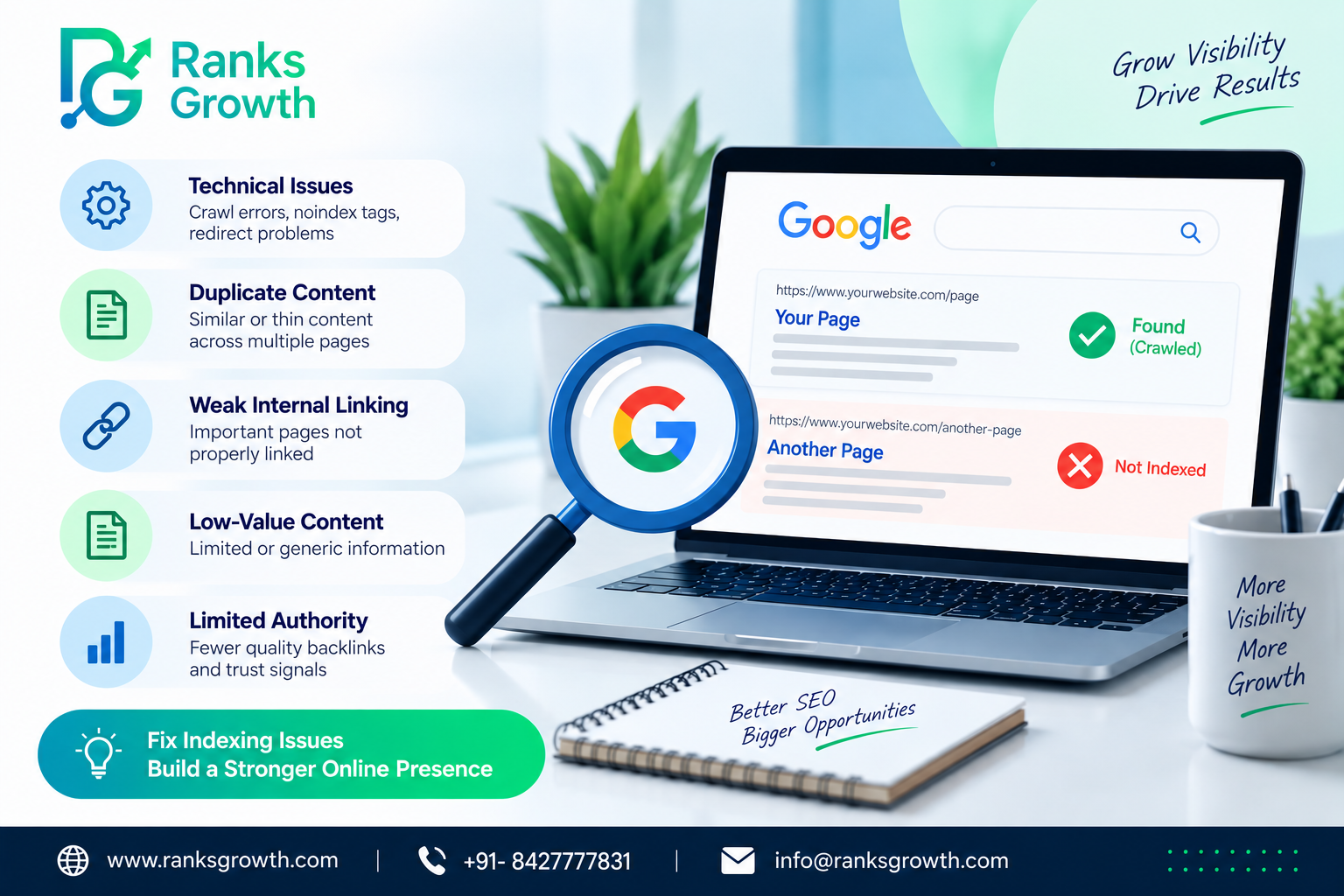
A fast, user-friendly website with strong SEO services has a better chance of gaining visibility and attracting qualified visitors. However, Google may discover your pages without adding them to its search index. Technical issues, duplicate content, weak internal linking, and low-value pages can all affect indexation and organic search performance.
Get a Free Quote
Are important pages on your website discovered but not appearing in Google Search?
Ranks Growth can help identify technical SEO issues, content quality problems, internal linking gaps, and authority-related challenges affecting indexation.
👉 Get a free SEO consultation and quote today to discover what may be preventing your pages from being indexed.

Introduction
Bad design and slow web pages that can’t even generate leads or sales? Design services address this.
Design issues can also include pages that are difficult to use, and visitors tend to leave without completing a goal. If things on your website are working well, such as high speed, easy navigation (UX) and a good design (UI), then you should be concerned about SEO.
A good website design combined with a good SEO service helps your business attract customers, leads, and visibility. SEO and UI/UX help with attracting and generating business.
There’s still the issue of a website that is optimized and designed, but Google finds pages and doesn’t index them. Your page rankings are low, and so is your indexation. This can really hurt a business that is reliant on free traffic. The reason behind this can help improve search presence.
What Does Found but Not Indexed Mean?
There are many ways Google can discover a page. For instance, Google can discover a page through internal links, an XML sitemap, a navigation menu, other websites, authority backlinks, or previously crawled URLs.
Just because Google discovers a page doesn’t mean Google will add the page to its search index.
Typically, a page goes through the following steps:
Discovery → Crawling → Processing → Indexing → Ranking
Google would discover a page, and even crawl it, but would choose not to index it.
When a page is not indexed, it won’t generate any organic search visibility through Google Search.
Crawling vs Indexing: Understanding the Difference
What is Crawling?
When Google’s systems visit a page, crawling evaluates the page and its content and incorporates a variety of technical signals.
Google may analyze:
- Content on the site
- Internal links
- Page structure
- Mobile experience
- Technical accessibility
- Structured data
- Relationships of pages
What is Indexing?
Indexing is when Google decides to keep a page in its searchable database.
A page can be crawled but not indexed.
Google may choose not to index a page if they consider the page:
- Duplicate
- Of low quality
- Thin or lacking
- Technically challenging
- Restricted
- Of less value in comparison to other pages
This is why, in Google Search Console, submitting a URL does not guarantee page visibility in Google Search.
Why Google Finds Pages but Does Not Index Them
Thin or Low-Value Content
Many pages that contain low or thin value may struggle to get indexed.
This includes:
- Short pages
- Generic pages
- Pages created automatically
- Pages that contain little original information
- Content that has been created to primarily target keywords
- Content that is essentially the same or very similar to other content
It is very important for Google to provide search results that are helpful and helpful for users.
Rather than creating pages to target keywords, businesses should create pages to offer useful information and answer user questions.
Strong SEO and AI search visibility arise from easy-to-read content that offers useful information formatted around the intent of the search.
This content often offers:
- Clear answers
- Useful examples
- Helpful explanations
- Practical solutions
- Comprehensive Headings
- Appropriate formatting
Duplicate or Similar Content
Google may choose not to index multiple identical or similar pages.
This affects the following:
- Service Pages
- Location Pages
- Product Variations
- Category Pages
- Tag Pages
- Filtered URLS
For businesses targeting multiple geographic locations, GEO-focused content must provide local value.
Duplicating a single page with multiple cities may appear to Google as similar/threshold content.
Location-based pages should provide local city- or region-specific value through additional local content.
Weak Internal Linking
Internal links show search engines how one page relates to the rest of your website. If a page has little to no internal links, it may be harder for search engines to find and prioritize that page.
Pages should be cross-connected from other parts of the site.
These pages may benefit from Ranks Growth’s:
A proper internal linking structure makes your website navigation better and tells search engines about relationships between website pages.
Technical Issues That Affect Indexing
Technical SEO problems can keep a particular page from getting indexed.
Common issues in indexing include:
-
- Improper noindex tags
- Blocked rules for crawling
- Improper canonical tags
- Redirect issues
- Server errors
- Soft 404s
- Broken URLs
- JavaScript rendering issues
GSC can assist you in locating problems with specific URLs that are related to indexing.
Common indexing statuses of pages can be:
- Crawled — Not indexed
- Discovered — Not indexed
- Excluded by noindex tag
- Duplicate — No user-selected canonical
Each status can indicate a different issue, so website owners should review the affected pages individually.
Content Quality and Google Indexing
Typically, Google desires to index content that has value to users.
A quality page should provide a valuable experience by being:
- Relevant to the search query
- Well structured
- Easy to read
- Helpful
- Original
- Accessible across all devices
This is important for AEO and AI-powered search experiences.
With clear formatting, content can be useful for both users and search systems.
Headings that encourage readers to take part in answering questions
- Short, specific answers
- Bullet points
- Instructions that are laid out step by step
- Definitions that are clear
- FAQ sections that are relevant
By incorporating these elements, you can enhance readability, accessibility and user experience.
How to Fix Pages That Are Not Indexed
Step 1: Review Google Search Console
Review Google Search Console
The URL Inspection tool in Search Console can provide information on the indexing status of the troublesome page.
Review signals including
- Crawl Status
- Indexing Status
- Canonical
- Sitemap
- Mobile
This can help diagnose whether the issue is technical or content.
Step 2: Improve the Page Content
Content without value means little to page rankings.
Consider adding
- Relevant and original content
- Expertise or profession insight
- Helpful examples
- Updated content
- Solutions
Avoid creating multiple pages targeting similar keywords, but different variations, and providing duplicated content.
Step 3: Strengthen Internal Linking
Important site pages should be linked from relevant site sections.
- Blog Posts
- Service Pages
- Category Pages
- Resource Pages
- Other Navigation Links
Page Content should be described in the linked text.
Step 4: Review Technical SEO Signals
Other technical elements to review can include
- Robots directives
- Canonical tags
- HTTP Status codes and responses
- XML sitemaps
- Mobile Usability
- Page Loading performance
- JavaScript rendering
After optimizations, page rankings should be unblocked.
Step 5: Build Website Authority
Trust and Authority will attract more users from search results.
Trustworthy backlinks from reputable sources can help you communicate to search engines that you have valuable content on your webpage.
Manual Link building aids in valuable backlinks and not just increasing the number of backlinks.
Quality links should come from relevant websites.
A balanced off-page approach combined with technical and content optimization will play a large part in improving long-term SEO.
How Ranks Growth Can Help
Issues with indexing can have many contributing factors.
A page can remain unindexed due to:
- Poor website structure
- Inadequate content
- Crawlability problems
- Duplicate content
- Technical SEO errors
- Limited or weak internal linking
Ranks Growth can resolve these issues through their thorough professional SEO services.
As a full digital service agency, we can assist our clients with developing high quality sustainable growth SEO services.
Our SEO services may include:
A thorough SEO analysis
- Website optimization
- Improving on-page elements
- Optimizing content
- Developing an internal linking structure
- Indexing analysis
- Developing a strong off-page SEO strategy
- Building links through established malas
- Creating links of high authority
Real users should be able to access important pages. This is the goal of an effective SEO strategy.
Contact Us Today
Are important pages on your site indexed by Google but not appearing in search results?
Our services address issues that cause poor search performance related to poor content, technical challenges, and authority issues, respectively.
From technical optimization and content improvements to manual link building and off-page strategies, our team can help create a stronger foundation for organic growth.
Contact us for a custom SEO solution to improve your search visibility.
FAQs
Why does Google find my page but not index it?
Google may discover a page but choose not to index it because of low-quality content, duplicate information, weak technical signals, accessibility issues, or limited overall value.
What does “Crawled – currently not indexed” mean?
This status means Google has visited and crawled your page but has not currently added it to the searchable index.
Review the page’s content quality, uniqueness, technical setup, and internal linking.
What does “Discovered – currently not indexed” mean?
This means Google knows that the URL exists but has not yet crawled or indexed it. This may happen because Google has not prioritized crawling the page yet.
How long does Google take to index a page?
There is no fixed indexing timeline. Some pages may be indexed quickly, while others may take longer depending on website quality, crawlability, technical factors, and content value.
Does submitting a sitemap guarantee indexing?
No. An XML sitemap helps Google discover URLs, but it does not guarantee that every page will be indexed.
Can backlinks help pages get indexed?
Relevant authority backlinks can help search engines discover pages and may support website credibility. However, backlinks alone cannot guarantee indexing.
Can I force Google to index a page?
You cannot guarantee indexing. You can request indexing through Google Search Console and improve the page’s technical accessibility, content quality, internal links, and overall usefulness.
Should I delete pages that Google does not index?
Not always. Valuable pages should usually be reviewed and improved. Duplicate, outdated, or low-value pages may need to be consolidated, redirected, or removed depending on their purpose.
How can professional SEO services help with indexing issues?
Professional SEO services can identify technical errors, content problems, internal linking gaps, duplicate pages, and other factors that may affect indexing and search visibility.