How to Recover Organic Traffic After a Sudden Google Ranking Drop
Overview
It’s very disconcerting to see your Google traffic suddenly decrease. Here I’ll cover what to look at first, how to identify a real rankings drop versus a fluctuation, and what to do to fix it.
Get a Free Quote
Not sure what caused the drop? We at Ranks Growth will take a look with you for free and provide a quote for SEO services.

Introduction
On Monday morning, you open up Google Analytics and a graph resembling a ski slope looks back at you. The phone is quieter than usual, and you start wondering what you did wrong.
Don’t worry and don’t panic. More times than not there’s an easily identifiable reason for the drop in your rankings. At Ranks Growth, our organic SEO services always first diagnose the issue before implementing any corrective measures. Whether you fix things yourself or hire search engine optimization services, the checks below show you where to start.
Why Do Google Rankings Drop Suddenly?
Rankings decrease for various reasons, including algorithm updates, user error on a website, inadequate content, lost backlinks or outperforming competition. It’s often a combination of these factors.
- Algorithm update: ‘Borderline’ pages are those that Google ranks comparatively low.
- Technical error: ‘Noindex’ tags tell search engines not to list the page. If these tags are erroneously left on the site during a website update, the page will not be listed.
- Inadequate content: Old, outdated guides are still installed on the site.
- Lost backlinks: A site that previously linked to you removed their post.
- Competitor outperformance: A more thorough and more relevant post has been created by a member of the competition.
How to Confirm the Traffic Drop Is Real
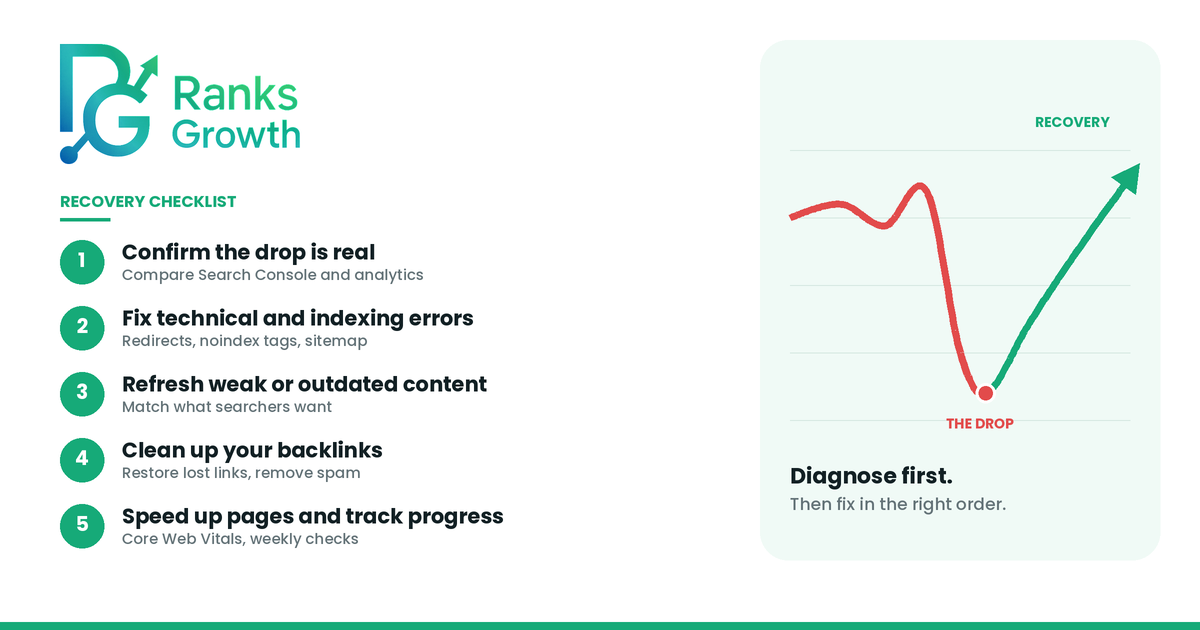
To verify a traffic drop, open Google Search Console and your analytics tool of choice side by side. If both show a decline at the same time, the decline is real.
- Next, look at the Performance report and check impressions and clicks to determine the reason for the drop.
- Lastly, check your organic users and set the date range to match that of the other tools. A decline in users of a florist’s site post Valentine’s Day, for example, is to be expected.
- To figure out the reason for the traffic loss in more detail, sort the Performance report by search query or by page.
- Figure out whether other pages on the site also lost traffic or if the change was isolated to just one page.
How to Fix Technical SEO Issues
Begin here, as fixing these issues will have the most impact and be the easiest to implement.
- Fix broken links on previously popular pages to gain users.
- Check the destination of your redirects and remove long, unnecessarily complex redirect chains.
- Review robots.txt and noindex tags. Settings from previous versions of a site may prevent Google from accessing any of the pages on the site.
- Test the mobile site on a real device.
- Correct any security issues, like expired SSL certificates.
How to Fix Indexing and Crawl Problems
To improve a site’s ranking, first make sure Google is indexing the site’s pages. To verify this, and for other information regarding excluded pages, go to the Pages report in Search Console. Once there, take corrective action to address the issues highlighted in the report.
- Provide and submit a new XML sitemap to Search Console.
- Correct any server errors returning a 500 code that are blocking access to pages.
- Remove any blocks on pages that should be accessible to users.
- Eliminate duplicate content.
- Verify each page’s canonical tag points to the correct version of that content.
How to Fix On-Page SEO and Content Issues
Focus on the most relevant search results to understand why your pages lose position. Address these within your content.
- Include the most recent and relevant examples and data.
- Review old content for thinness. If applicable, expand thin content or merge similar thin content pages.
- Look at search intent. Someone searching “how to fix a leaking tap” is not looking for a plumbing company’s sales page.
- Bold or underline key phrases in your content.
- From strong, relevant pages on your site, link to the pages you are trying to raise in rank.
This can be time-consuming to do for your entire site. Professional SEO services have the time and resources to conduct a complete review and prioritize necessary changes.
How to Improve Page Speed and User Experience
Long load times and choppy pages drive users away, including Google users. Address the basics first.
- Pages can also be optimized by using more efficient image formats and smaller image file sizes.
- Caching can improve page speed.
- Use the Core Web Vitals report in Search Console. Layout shifts occur when something suddenly changes position on a page. For example, if a button shifts position just as a user attempts to click it.
- Fixing these issues can improve user experience and page speed.
How to Fix Backlink Problems
Backlinks act like references. Lose good ones and pick up bad ones and rankings can be negatively impacted.
- Look for lost links. If a partner redesigned their site and dropped yours, politely ask for it back.
- Review your link profile for spammy links, and disavow only the clear cases.
- Earn quality links with useful guides, original data, and honest outreach to relevant sites.
Many SEO services include a link audit, so ask before you pay for one separately.
When to Seek Professional Help
Call an expert if you can’t find the cause, if the drop is hurting revenue, or if your own fixes haven’t helped. Ranks Growth offers affordable SEO services and organic SEO services that start with a full audit. Good search engine optimization services explain findings in plain words and never promise guaranteed results.
How to Check Progress and Prevent Further Drops
It can take some time to see progress. Google has to recrawl and re-assess your pages to update its search results. Depending on what is affecting your rankings and how quickly you can address those factors, this process could take some time.
- Track your rankings and clicks in Search Console each week.
- Conduct a technical audit on your site every few months.
- Keep the pages on your site that are most relevant and time-sensitive to your business.
- Keep track of your backlinks and disavow bad links.
Ranks Growth offers organic SEO services to perform these tasks for you.
Contact Ranks Growth Today
The faster you look into a traffic drop, the easier it is to diagnose and remedy. Ranks Growth will check your site to find the reason for your drop and create a recovery plan at no cost to you. We offer affordable and transparent SEO services for business owners.

FAQs
Why did my Google rankings suddenly drop?
Most sudden drops come from an algorithm update, a technical error, lost backlinks, weak content, or competitors improving. Check Search Console for errors, then see which pages lost traffic. The pattern of losses usually points straight at the cause.
How long does it take to recover organic traffic?
There’s no fixed timeline. It depends on the cause, how quickly you fix it, and how often Google recrawls your site. Technical fixes can show results sooner, while content and link work takes longer. Track progress weekly instead of expecting a quick rebound.
Can a Google algorithm update cause a traffic drop?
Yes, an update can reduce traffic, especially if your pages are thin, outdated, or less helpful than competing ones. Compare your drop date with confirmed update dates, then improve quality and usefulness for readers instead of chasing quick tricks.
Do I need professional SEO help to recover?
Not always. A blocked page or a broken redirect can often be fixed in-house. Hire search engine optimization services when the cause is unclear, revenue is at risk, or your own fixes haven’t worked. An expert diagnoses faster and avoids costly mistakes.
How can I prevent future ranking drops?
Prevent drops with regular care. Audit your site every few months, refresh important content, monitor backlinks, and watch Search Console for warnings. Ongoing organic SEO services or SEO services can catch small problems before they become big traffic losses.