How to Build a Digital Marketing Funnel That Converts Visitors into Paying Customers
Overview
Convert site visitors to customers with a digital marketing funnel that builds brand awareness and establishes a strong base of loyal customers. Find out how to create and optimize funnel stages, identify the best marketing platforms, and gauge funnel performance.
Get a Free Quote
Want to turn more website visitors into qualified leads and customers? Contact Ranks Growth for a free consultation and a digital marketing strategy built around your business goals.
Introduction
To achieve maximum profits from your business, you must be able to effectively convert visitors to customers. Often, visitors will land on your website pages; however, they will leave without taking any further action.
A digital marketing company, like Ranks Growth, can assist you in improving your online business. With their assistance, you can create informative content, improve your website, and implement paid advertisements to improve your online business.
What Is a Digital Marketing Funnel?
A digital marketing funnel shows the different stages a customer goes through before making a purchase. This usually starts when a customer discovers a business.
Each stage requires that a business develop different types of marketing materials to meet the customers’ needs.
A digital marketing funnel also helps a business achieve its marketing goals and increase revenue generation.
Why Does Your Business Need a Marketing Funnel?
Knowing where potential sales are lost and analyzing consumer behavior can help optimize your sales process. A marketing funnel facilitates this.
Some benefits of having a marketing funnel include:
- Better lead quality: Attract people who are genuinely interested in your products or services.
- Stronger customer relationships: Provide useful information before asking visitors to make a purchase.
- Improved marketing efficiency: Focus resources on channels and activities that support business goals.
- Higher conversion potential: Remove unnecessary steps that prevent prospects from taking action.
- Clearer performance tracking: Understand how visitors become leads and how leads become customers.
A business can achieve its goals through strategic marketing when it integrates all areas of its business to achieve a common sales objective.
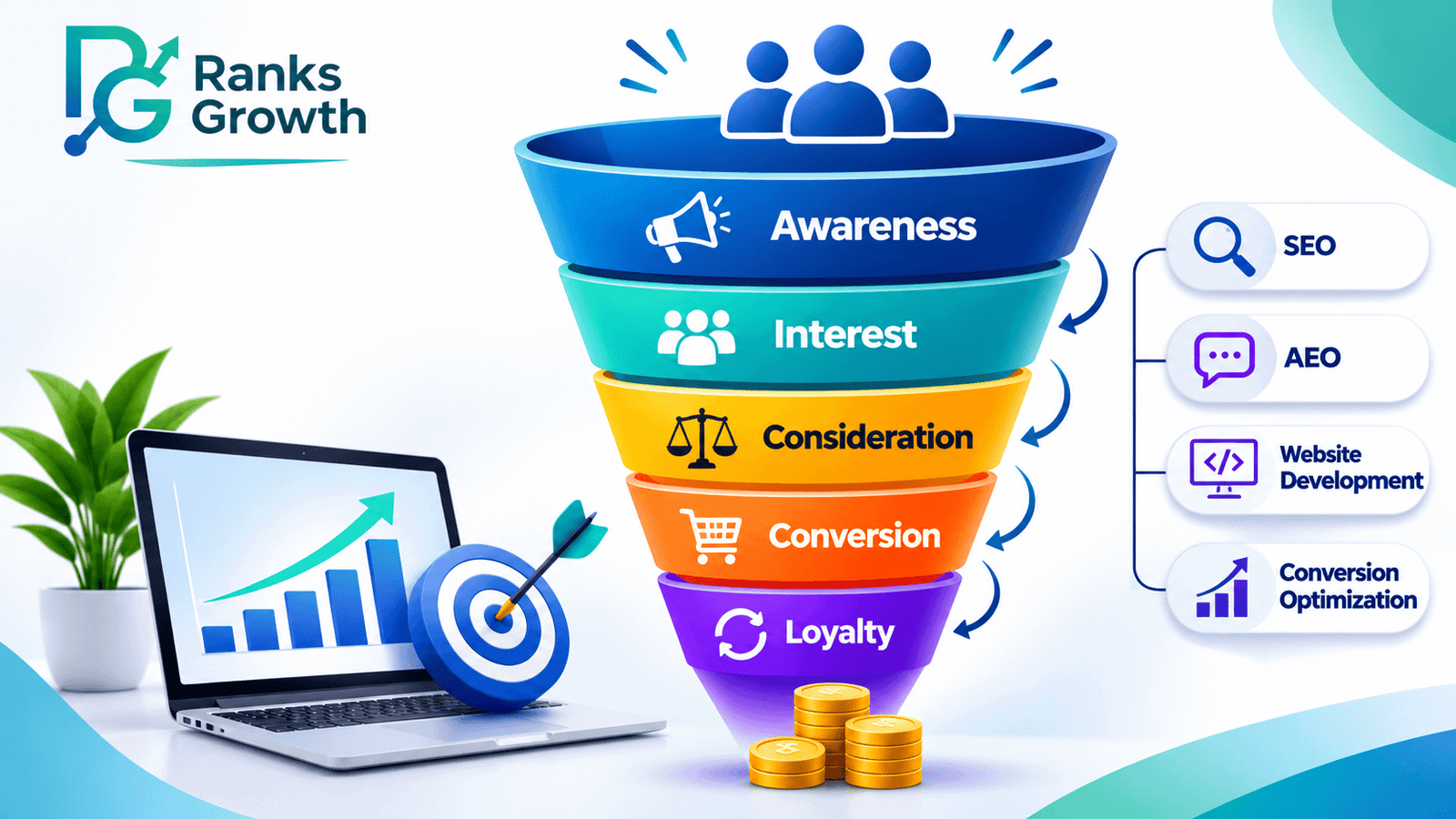
The 5 Stages of a Digital Marketing Funnel
There are 5 stages in a digital marketing funnel. To be successful, you have to know what to communicate in each stage and the best ways to communicate it.
-
Awareness
At this stage, you need to let your audience know that your company exists.
- Create informative content such as blog posts.
- Advertise using pay-per-click (PPC) advertisements.
-
Interest
At this stage, your audience is interested in your offering, but wants to learn more.
- Post videos and write content that explain the problems your audience is having and the solutions.
- Create downloadable content like ebooks and whitepapers.
-
Consideration
At this point, your audience has defined their problem and is researching companies that can help solve it.
- Display testimonials, reviews, case studies, and detailed service information.
- Offer consultations, product demonstrations, or comparison guides.
-
Conversion
Post content that lets your audience know the next steps and what you expect of them.
- Include pricing information.
- Limit the steps in the checkout process.
-
Loyalty
Send communications that reinforce your company and thank your audience for their business.
- Offer your audience savings on your services and products.
- Personalize recommendations to your audience.
How to Build a Digital Marketing Funnel Step by Step
To design a digital marketing funnel, consider your target audience, marketing goals, and the sales process.
- Identify Your Target Audience
Understand your target audience’s needs, issues, and the factors that influence their purchasing decisions.
- Establish Marketing Goals
Determine the type of results you want to achieve (e.g. sales, leads, appointments, etc.)
- Visualize the Customer Journey
Recognize how a customer interacts with each stage of your marketing funnel.
- Produce Content Based On Each Stage of the Customer Journey
Write content that addresses the issues potential customers have at each stage of the buying process. Content may include webpages, video clips, and/or text.
- Identify the Best Means to Reach Your Audience at Each Stage of the Funnel
SEO may be helpful at the top of the funnel. Email marketing and social media ads may work better at the bottom of the funnel.
- Analyze and Optimize
Examine customer behaviors based on funnel performance and make changes as necessary.
Best Digital Marketing Channels for Each Funnel Stage
It’s essential to be in the right channels with the right message at the right time.
Awareness: Channels such as social media and content distribution, paid advertising, and organic search engine optimization.
Interest: Informative content such as blog posts, videos, and landing pages.
Consideration: Campaigns directed toward past customers and prospective customers through remarketing, pages comparing and contrasting products or services, and customer endorsements.
Conversion: Google Ads and other pay-per-click advertising, and email marketing.
Loyalty: Rewards, promotions and offers, and customer support.
The strategies you utilize for digital marketing should work together to maximize the effectiveness of your funnel.
How SEO and Website Design Improve Funnel Conversions
SEO helps boost organic traffic to a website, while AEO assists in ranking content within result sections that answer user queries. Incorporating both of these elements in a well-built website helps strengthen the connection between visibility and conversion.
Both SEO and Website development services help achieve goals such as improving web page loading speeds, Website accessibility, and security.
At Ranks Growth, we help clients build and improve their online audience and increase lead conversions through a combination of our SEO, AEO, and web development services.
Common Digital Marketing Funnel Mistakes
The major reasons for poor performance of a well-articulated digital marketing funnel are often due to overlooked minor details.
These details often include:
- Targeting broad audiences without understanding their needs.
- Using the same message for every customer journey stage.
- Sending advertising traffic to irrelevant landing pages.
- Making contact forms or checkout processes unnecessarily complicated.
- Ignoring follow-ups and customer retention.
- Failing to measure conversions across different channels.
How to Measure Funnel Performance
Know the right metrics to assess funnel performance.
Other than the metrics listed below, there are other important metrics to consider based on the objectives of your business.
The metrics are:
- Web traffic: Refers to the total number of visitors to a website.
- Lead conversion rate: Refers to the rate at which visitors to a website become leads.
- Cost per lead: Indicates the average amount spent to generate a lead.
- Customer acquisition cost: Represents the average amount spent to acquire a customer.
- Customer retention: Indicates the ability of a business to retain customers.
An analysis of the metrics above can help pinpoint business inefficiencies.
Contact Ranks Growth Today
Creating paying customers begins with drawing in visitors. This encompasses a variety of talent and strategies from design and development to copywriting and analytics.
Our SEO, AEO, and web development services will help you optimize your site and boost your search rankings. At Ranks Growth, our main objective is helping you meet and exceed your sales goals. Contact us for a free consultation and let us help you build a funnel that gets results!
FAQs
1. What is a digital marketing funnel?
A digital marketing funnel is a framework that guides potential customers through awareness, interest, consideration, conversion, and loyalty. It helps businesses understand customer behaviour and deliver relevant information at each stage, making it easier to turn interested visitors into paying customers.
2. How do I create a digital marketing funnel for my business?
Start by identifying your target audience and defining your conversion goals. Map the customer journey, create relevant content for each stage, select suitable marketing channels, and establish tracking. Review the results regularly and improve the stages where visitors stop engaging or fail to convert.
3. Which marketing channels work best for a conversion funnel?
SEO, content marketing, email marketing, social media, and paid advertising can all support a conversion funnel. The best combination depends on your audience, business model, and objectives. Use search and social channels for discovery, educational content for consideration, and targeted offers to encourage conversions.
4. How does SEO help improve funnel conversions?
SEO attracts visitors who are actively searching for relevant information, products, or services. When your website provides useful content, clear navigation, relevant landing pages, and strong calls to action, organic traffic has a better opportunity to become qualified leads and customers.
5. How long does it take to see results from a digital marketing funnel?
The time required depends on your industry, audience, marketing channels, budget, and sales cycle. Paid campaigns may generate enquiries sooner, while organic SEO generally requires ongoing effort. Consistent measurement and optimisation help identify improvements and strengthen results over time.